
Choosing the right TV unit can transform your living room into a stylish, functional haven. It’s not just about holding your television; it’s about complementing your décor, organizing your media essentials, and reflecting your personal style. For those who appreciate craftsmanship and sustainability, a handmade TV unit crafted from reclaimed solid wood offers a unique blend of beauty and eco-consciousness. This guide will walk you through everything you need to consider to pick a TV unit that fits your space perfectly.
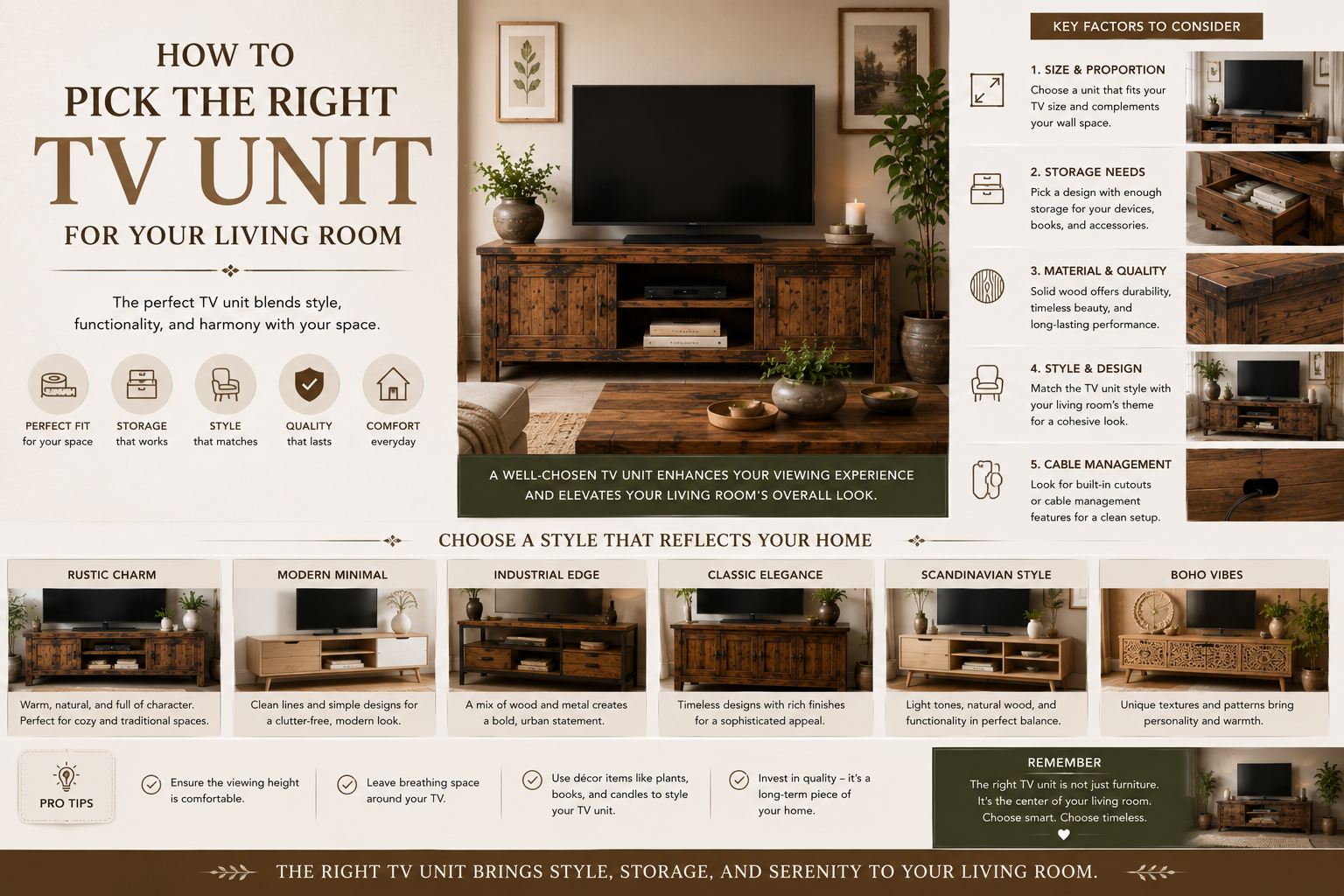
Table of Contents
- Start With the Room, Not the TV
- Getting the Size Right
- Storage: More Than Just a Shelf
- Material Matters More Than You Think
- How It Fits Your Existing Décor
- From the Workshop to Your Living Room
- Why Reclaimed Wood Deserves a Spot in This Conversation
- FAQ
- Final Thoughts
Start With the Room, Not the TV
Most people start TV unit shopping by measuring their TV. Wrong move.
The room comes first. A massive entertainment unit in a compact apartment will eat the space alive. A tiny stand under a 75-inch screen looks like it’s apologizing for itself. Before you search for anything, walk into your living room and take a proper look.
Ask yourself:
- Where does the natural line of sight fall when you’re seated?
- How far is the couch from where the TV will sit?
- Is there a wall dedicated to this, or are you fitting it into a corner?
- How much storage do you actually need, vs. how much you think you need?
Once you have a clear read on the room, the right TV unit becomes much easier to identify. It’s not about finding something you like in a catalog—it’s about finding something that makes sense in your space.
Getting the Size Right
There are two measurements that matter: the width of the unit relative to your TV and the height relative to your seating.
Width: Your TV unit should be at least as wide as your TV, ideally wider. A unit that’s 10–15 cm wider on each side looks intentional and balanced. It also gives you surface space for speakers, remotes, or a decorative piece.
Height: When you’re seated, the center of the TV screen should be roughly at eye level. That usually puts the ideal TV height between 100 and 120 cm from the floor to the screen’s midpoint. If your unit sits too low, you’re craning your neck up all evening. Too high, and it starts to feel like you’re watching from the back row.
For rooms where a floating look works well, a wall-mounted unit can solve the height problem cleanly. For traditional and transitional interiors, a floor-standing unit with visible legs tends to feel more grounded and warm.
Storage: More Than Just a Shelf
Here’s an honest truth about TV unit storage: people consistently underestimate how much they’ll need and then overestimate how tidy they’ll be.
Think through what actually needs to live in or around your TV setup:
- Gaming consoles, controllers, and accessories
- Streaming devices, cable boxes, routers
- DVDs or Blu-rays (if you still have them — no judgment)
- Remote controls
- Cables that need hiding
Open shelving looks great on Pinterest. In real life, it becomes a dust magnet unless you’re genuinely disciplined about it. Closed cabinets hide the chaos but restrict ventilation for electronics. The best units tend to combine both—open shelves for décor and frequently used items and closed doors for the rest.
If you plan to put a cable box or gaming console inside a cabinet, make sure there’s a back panel with cutouts or, at minimum, enough space for heat to escape. Electronics stored in airtight spaces overheat.
Material Matters More Than You Think
Most mass-market TV units are made from MDF (medium-density fiberboard) with a veneer or laminate finish. They look fine in the showroom. After three to five years of real use—humidity changes, weight of items on shelves, and the occasional bump—the edges start lifting, the surface chips, and the whole thing starts looking tired.
Solid wood behaves completely differently. It’s heavier, yes. It costs more upfront. But it doesn’t swell in the same unpredictable ways, it can be sanded and refinished if it gets scratched, and the structural integrity holds over decades rather than years.
If you’re choosing between wood types, teak and sheesham are particularly well-suited to furniture that needs to bear weight and handle daily contact. Both have tight, dense grain structures and natural oils that resist moisture better than softer woods.
How It Fits Your Existing Décor
The unit doesn’t exist in isolation; it’s part of a room. A brutalist concrete-look unit in a home full of warm textiles and wooden furniture will always look out of place, no matter how good it looks on its own.
Some general rules that actually work:
- If your room already has wooden furniture, a wood TV unit will naturally fit. The key is keeping the wood tones in the same family; don’t mix pale ash with very dark walnut unless you’re deliberately going for contrast.
- If your room is mostly upholstered in neutrals with metal accents, a unit with metal legs or hardware can tie it together.
- For open-plan spaces, a unit that can be seen from multiple angles benefits from looking good from the sides too, not just head-on.
One thing worth considering: the finish. A high-gloss finish can reflect light in ways that create glare on your TV. A matte or natural oil finish tends to work better in living rooms where the lighting setup isn’t perfectly controlled.
From the Workshop to Your Living Room
There’s a real difference between furniture that gets assembled in a warehouse and furniture that gets built by hand. It’s not just about material or aesthetics—it’s about intent.
When a craftsperson builds a TV unit, they’re making decisions at every stage. Which plank carries the grain that will show best on the top surface? Where do the joints need reinforcement to handle cable management hardware? How much clearance should the cabinet doors have so they sit flush but don’t stick in humid conditions?
Mass-produced furniture skips most of these questions because the process is standardized. That’s fine for items you plan to replace in a few years. For something central to your living room — a piece you’ll look at every day — it’s worth thinking about whether you want something made with that level of care.
Handmade furniture also tends to have more honest proportions. The dimensions aren’t dictated by what’s cheapest to cut from a standard MDF sheet. A craftsperson can build to the exact size your wall needs and the exact height your seating position calls for.
Why Reclaimed Wood Deserves a Spot in This Conversation
Reclaimed wood is timber that’s been salvaged from old structures—demolished buildings, old warehouses, dismantled boats, and aged agricultural frameworks. It gets cleaned up, dried out properly, and then used for new furniture.
There are a few reasons it’s worth talking about here.
First, the material itself is often better than what you’d buy new. Old-growth timber — the kind used in buildings from 50 to 100 years ago — was denser and more stable than much of what’s commercially grown today. The wood has already done its expanding and contracting through decades of climate changes. It’s more dimensionally stable as a result.
Second, each piece is genuinely unique. The grain patterns, the natural marks, the variation in tone — none of it can be replicated. If you want a TV unit that doesn’t look like the one in three of your neighbors’ homes, reclaimed wood is a straightforward answer to that.
Third, there’s the sustainability argument. Using salvaged timber reduces demand for newly felled wood. For homeowners who care about that, it’s a meaningful choice rather than a marketing talking point.
If you’re curious about what handmade reclaimed teak furniture actually looks like at this quality level, this reclaimed wood TV unit is a good place to start—solid teak construction, built by hand. There’s also a sheesham wood sideboard that works well as a media console in wider living rooms.
For rooms where you want storage with a more rustic feel, this reclaimed wood cabinet handles media storage cleanly while adding real character. And if you’re setting up a smaller space or a bedroom TV setup, this compact reclaimed wood unit hits the proportions well without taking over the room.
FAQ
What height should a TV unit be?
The ideal TV unit height puts the center of your screen at eye level when you’re seated—typically between 100 and 120 cm from the floor to the screen’s midpoint. The unit itself is usually between 40 and 60 cm tall depending on your screen size and viewing setup.
How wide should a TV unit be compared to the TV?
At minimum, the unit should match the TV’s width. Ideally it’s 15–25 cm wider on each side, which gives it a grounded, proportional look and provides surface space for speakers or decor.
Is solid wood better than MDF for a TV unit?
Yes, for long-term use. MDF is cheaper upfront but prone to edge chipping, swelling in humidity, and surface wear after a few years. Solid wood is heavier and costs more initially but lasts significantly longer and can be refinished.
Can I use a sideboard as a TV unit?
Absolutely. A sideboard at the right height makes an excellent TV stand—often with more storage capacity, better proportions for wide walls, and a more distinctive look than units sold specifically as TV furniture.
How do I manage cable clutter with a TV unit?
Look for units with back panel cutouts, cable management channels, or hollow legs that route cables cleanly. If your unit doesn’t have these, cable conduits or adhesive cable clips along the wall work well as a secondary fix.
Is reclaimed wood furniture durable enough for everyday use?
Yes. Reclaimed wood, particularly old-growth teak or sheesham, is often more dimensionally stable than newly sourced timber. It’s already been through years of climate variation, which reduces warping and movement over time.
Conclusion:
Picking the right TV unit is genuinely one of the more impactful furniture decisions you’ll make for a living room. It’s a daily-use piece in a central position, which means every compromise you make shows up regularly.
Get the size right first. Think honestly about your storage needs. Choose a material that matches how long you want the piece to last. And if you’re considering solid wood, especially reclaimed, know that you’re buying something that will hold up and look better with age, not worse.
If you want to see what handmade reclaimed teak TV furniture looks like in practice, take a look at the Modern Karigar Etsy shop. Each piece is built to order, which means proportions can be adjusted to suit your specific wall and viewing height.