
Shelving looks simple until you actually live with it. A shelf that photographs beautifully empty can sag under real books within a few months. A floating shelf mounted with the wrong hardware can pull straight out of drywall. And plenty of shelving ends up looking cluttered fast, not because the owner did anything wrong, but because the shelf itself wasn’t built with enough depth or spacing to hold what people actually want to put on it.
Wooden shelving, done right, solves most of these problems just by being solid wood instead of thin veneer or particleboard. But “wood” alone isn’t a guarantee; thickness, support, and placement matter just as much as material. Here’s what actually makes wooden shelving work in a real room, not just in a styled photo.
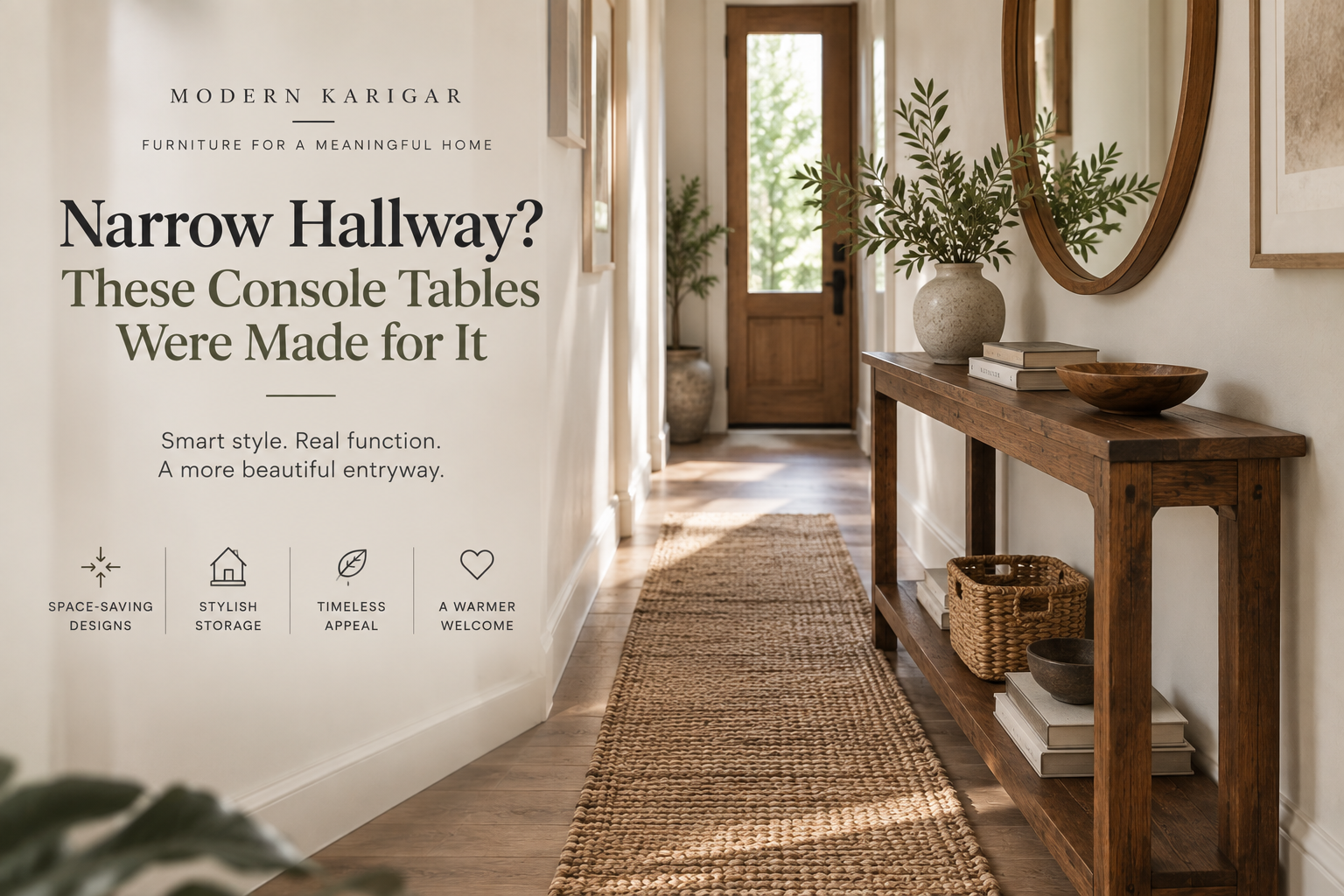
Table of Contents
- Why Standard Console Tables Don’t Work in Narrow Hallways
- The Depth Number That Actually Matters
- Length and Placement Considerations
- Choosing a Style for a Narrow Space
- Styling a Narrow Console Without Cluttering It
- Storage Options That Still Fit Tight Spaces
- From Workshop to Hallway: How These Tables Are Made
- A Note on Reclaimed Wood in Narrow Furniture
- FAQ
- Conclusion
Why Standard Console Tables Don’t Work in Narrow Hallways
Most console tables on the market are designed with entryways in mind, and a typical entryway has more clearance than a hallway does. A standard console often runs 14 to 18 inches deep, which is fine against an entry wall but becomes a problem the moment it’s placed in a hallway under 40 inches wide, since it eats into the walking path more than people expect until it’s actually in place.
Narrow hallways need furniture designed around a different constraint: how little depth can the piece take up while still being useful? That’s a different design problem than a standard console table solves, which is why purpose-built narrow consoles exist as their own category rather than just a smaller version of a regular one.
The Depth Number That Actually Matters
For a hallway under 40 inches wide, look for a console table no deeper than 10 to 12 inches. That leaves at least 28 to 30 inches of clear walking space, which is the minimum most people need to pass through comfortably without brushing against the table on one side.
For slightly wider hallways, 42 to 48 inches, a console up to 14 inches deep can work, but it’s worth measuring the actual walkway with the table in place, on paper or with painter’s tape on the floor, before committing. It’s easy to underestimate how much a piece narrows the usable path once it’s physically there.
Length and Placement Considerations
Length matters less than depth in a hallway, but it’s still worth planning around. A console that runs the full length of a hallway wall can look intentional, especially if it’s paired with wall décor above it, but leave at least a few inches of clearance from any doorway swing or corner turn. A console blocking part of a door’s arc is a common oversight that only shows up once the furniture is delivered and placed.
If the hallway leads to a frequently used door, position the console on the side of the hall with the least foot traffic interruption, rather than centering it purely for visual symmetry.
Choosing a Style for a Narrow Space
Simple, straight-legged designs tend to work better in narrow hallways than consoles with wide splayed legs or heavy ornamental bases, since the extra width at the base can eat into the already-tight clearance even when the tabletop itself is a reasonable depth. A narrow reclaimed teakwood console table built specifically for tight spaces avoids this problem by keeping the base as slim as the top.
Wood tone matters more in hallways than in most rooms, since hallways often have limited natural light. A lighter or medium wood tone can help keep a dim hallway from feeling closed in, while a deeper tone works well in hallways with good natural light or an already warm color palette.
Styling a Narrow Console Without Cluttering It
A narrow surface has less room for error than a wider one; anything placed on it needs to actually fit the depth without overhanging the edge. A single lamp, a small tray for keys, and one framed piece of art leaning against the wall behind it are usually enough. Resist adding multiple decorative objects side by side, since a narrow top fills up visually much faster than a standard-depth console would.
Mirrors work particularly well above a narrow hallway console, since they add visual width to a tight space without taking up any actual floor depth.
Storage Options That Still Fit Tight Spaces
A shallow drawer is usually the most practical storage option for a narrow console, since it adds function without requiring extra depth the way a lower shelf with baskets might. A teak wood console table with drawers gives you a place for keys, mail, and small items without sacrificing the slim profile a narrow hallway needs.
Open lower shelving can also work, provided it’s kept nearly empty or styled with only one or two low-profile items, since anything stacked or bulky on an open shelf will visually widen the piece even if the shelf itself is shallow.
From Workshop to Hallway: How These Tables Are Made
A narrow console table takes more precision to build well than a standard-depth piece, since there’s less structural material to work with while still needing the table to stay sturdy. Builders start with reclaimed timber, sorted by hand for grain and stability, then shape the frame and legs individually to keep the base as slim as the top without compromising how steady the piece feels in daily use.
That level of individual attention is part of why a handmade narrow console holds up better over time than a mass-produced version built from thinner, less considered materials. Every joint on a slim piece like this matters more, since there’s less bulk to hide an imprecise fit.
A Note on Reclaimed Wood in Narrow Furniture
Reclaimed wood works especially well for narrow furniture because it tends to be denser and more stable than new-cut lumber, which matters when a piece has less overall material to draw structural strength from. A piece like this reclaimed teak wood console table also brings visible grain and warmth to a hallway, a space that’s often left plain simply because it’s hard to furnish well. The character in the wood does a lot of the visual work in a room that otherwise has little else going on.
FAQ
What’s the maximum console table depth for a narrow hallway?
For hallways under 40 inches wide, aim for a console no deeper than 10 to 12 inches to preserve enough clear walking space.
Do narrow console tables come with storage?
Yes, many narrow consoles include a shallow drawer, which is usually more practical than open shelving in a tight space since it doesn’t visually widen the piece.
Should I choose a lighter or darker wood tone for a hallway console?
It depends on the hallway’s natural light. Lighter tones help open up dim hallways, while deeper tones work well in hallways with good natural light or a warm existing palette.
Can I put a mirror above a narrow console table?
Yes, and it’s one of the most effective ways to add visual width to a narrow hallway without taking up any floor space.
Is reclaimed wood strong enough for a narrow, slim-profile table?
Yes. Reclaimed wood tends to be more stable and dense than newer lumber, which helps a narrow piece stay sturdy despite having less material to work with structurally.
Conclusion
A narrow hallway doesn’t have to stay empty just because most console tables are too deep for the space. Measure the actual clearance, look for a table built specifically for narrow depth, and keep the styling simple enough to match the scale of the piece. If your hallway has been sitting bare for lack of the right fit, it’s worth looking at a console table designed for exactly this kind of space.