Every year, Pinterest releases a trend forecast built from billions of searches and saves, and it’s become one of the more reliable early signals for where home decor is actually headed, with the company reporting an 88% accuracy rate across six years of predictions. For 2026, the report leans into a clear theme: interiors are moving away from safe, minimal neutrals and toward spaces that feel personal, textured, and a little more expressive.
That shift matters most for furniture, since furniture is usually the part of a room that changes slowest. A wall color is easy to update; a dining table isn’t something most people replace on a whim. This post breaks down the parts of Pinterest’s 2026 forecast that actually translate into furniture decisions, so you know what to look for whether you’re furnishing a whole room or just adding one new piece.
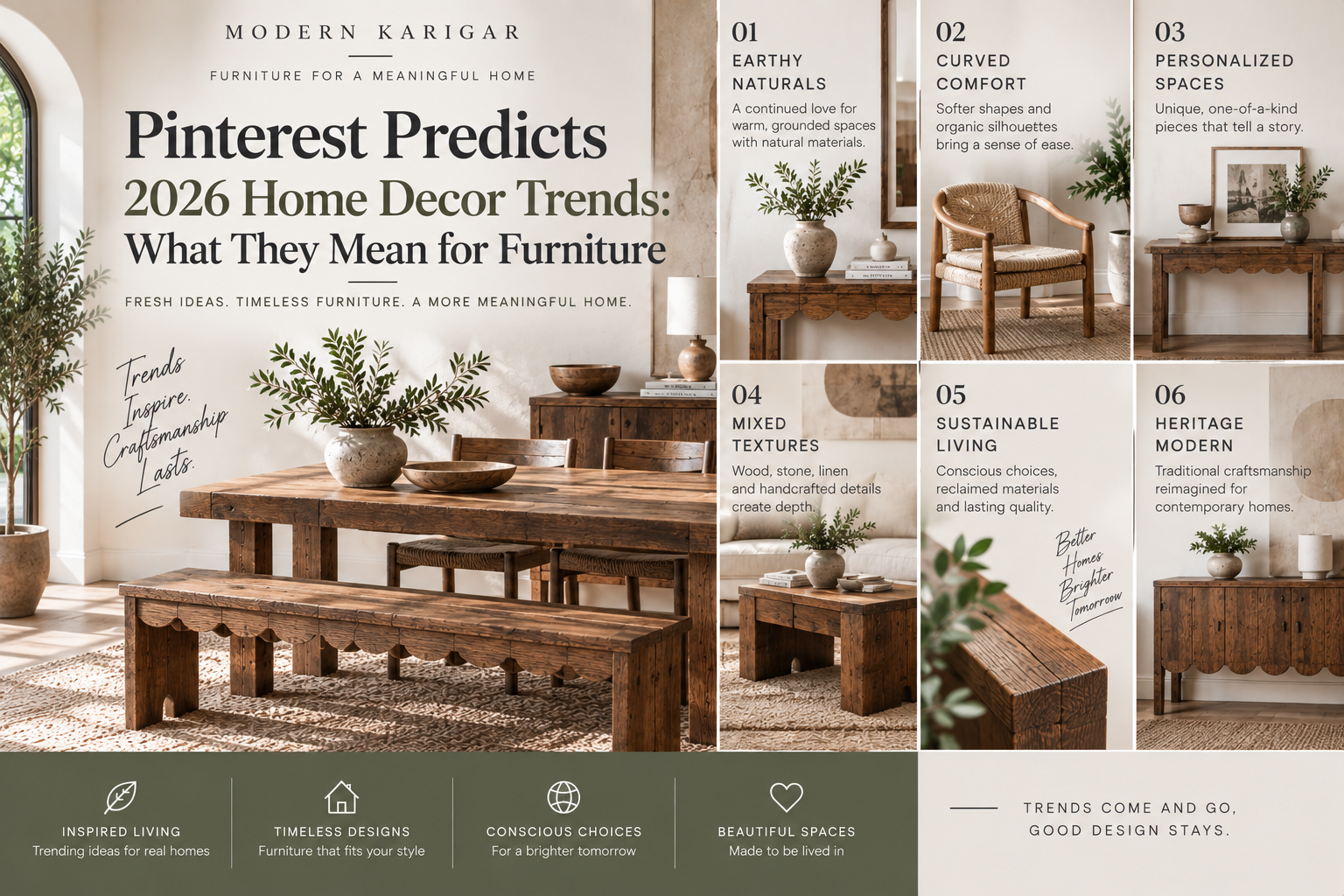
Table of Contents
- The Big Theme: Personal Over Polished
- Afrohemian Decor and What It Means for Furniture
- Neo Deco: Old Glamour, New Materials
- Earthy, Nature-Led Spaces
- The Wood Tone Shift Worth Watching
- How to Use These Trends Without Overcommitting
- From Workshop to Living Room: Where Craftsmanship Fits This Year’s Trends
- A Note on Reclaimed Wood and 2026’s Bigger Theme
- FAQ
- Conclusion
The Big Theme: Personal Over Polished
Across the various directions in this year’s report, one thread runs through almost all of them: a move toward interiors that feel expressive, dimensional, and personal rather than built around a single, safe aesthetic. For furniture specifically, that’s a meaningful shift. The last several years leaned heavily on matched sets and uniform neutral tones. 2026’s forecast points toward rooms built from pieces that look collected and considered rather than purchased as a set.
That’s good news for anyone furnishing with handmade or one-of-a-kind pieces, since a room built around personality doesn’t need everything to match perfectly. It needs a few pieces with real character doing the visual work.
Afrohemian Decor and What It Means for Furniture
One of the standout directions in this year’s report is what Pinterest is calling Afrohemian decor, described as a style rooted in texture, craftsmanship, and cultural expression, blending African and bohemian influences. Search interest in related terms has climbed sharply, with searches for “afrobohemian home decor” up 220% year over year.
For furniture, this trend translates into natural fiber materials, handwoven texture, and a visible appreciation for pieces that were clearly made by hand rather than mass-produced. It’s a trend that rewards furniture with real grain, real joinery, and a sense that a person actually built it, rather than furniture designed to look uniform on a factory line.
Neo Deco: Old Glamour, New Materials
Neo Deco is another major direction in the 2026 forecast, essentially art deco reinterpreted with more modern materials and a sleeker finish, showing up in rising searches for pendant lamps, antique bar carts, brass aesthetics, and leather banquette styling. Practical ways this shows up in furniture include brushed brass or satin metal accents, fluted wood detailing, and furniture with clean, structured lines rather than heavily ornamented silhouettes.
This is a trend worth approaching selectively. A single Neo Deco-leaning piece, a console with brass hardware, a chair with a fluted wood detail, tends to work better in most homes than trying to build a full room around it, since the look is bold enough to dominate a space quickly.
Earthy, Nature-Led Spaces
Alongside the louder, more maximalist trends, this year’s forecast also includes quieter, nature-driven directions, grounded in organic materials and earthy palettes rather than the glossier, more metallic looks getting a lot of the attention. This shows up as a continued preference for warm neutrals, natural wood tones, and furniture that leans textural rather than polished.
This is arguably the easiest trend direction to build a room around long-term, since earthy, wood-forward interiors tend to age well and don’t require frequent updating the way a more maximalist trend might.
The Wood Tone Shift Worth Watching
One detail worth paying attention to: this year’s forecast specifically calls out named wood tone directions, pairing deep finishes and rich wood tones with gothic-inspired spaces, alongside warmer neutral wood tones for more nature-driven rooms. That’s a meaningful signal for furniture shopping specifically, since it suggests wood tone itself, not just furniture shape or style, is becoming part of how people are choosing to express a particular mood in a room.
Practically, this means it’s worth thinking about wood tone as intentionally as you’d think about a paint color, rather than defaulting to whatever tone happens to match existing furniture. A deeper, richer tone signals a different feeling in a room than a lighter, warmer one, and both are getting attention in this year’s forecast.
How to Use These Trends Without Overcommitting
Trend forecasts are useful for direction, not for wholesale room overhauls. The most practical way to bring any of this year’s furniture-relevant trends into a home is through one or two anchor pieces rather than replacing everything at once. A single handmade console with real texture and grain does more for a room aligned with Afrohemian decor than a dozen smaller accessories would. A wood tone shift can start with one new piece rather than refinishing everything you already own.
Trends also tend to last longer when they’re rooted in something timeless. Craftsmanship, natural materials, and genuine wood grain aren’t new ideas; they’re just getting more attention this particular year, which is part of why furniture built around those qualities tends to outlast the trend cycle that initially drew attention to it.
From Workshop to Living Room: Where Craftsmanship Fits This Year’s Trends
It’s worth noting that several of this year’s biggest directions, from the emphasis on craftsmanship in Afrohemian decor to the textural, nature-led earthy trend, are really pointing back toward furniture that’s made with visible care rather than mass-produced. That’s the same process behind any handmade solid wood piece: timber sorted by hand, shaped and joined individually, and finished without rushing the process to hit a production quota.
That slower, more deliberate process is exactly what shows up in the kind of furniture these trends are gesturing toward, pieces with real presence, visible grain, and a sense of having been made by someone rather than assembled on a line.
A Note on Reclaimed Wood and 2026’s Bigger Theme
If there’s one furniture material that fits naturally into almost every direction in this year’s forecast, it’s reclaimed wood. It brings the natural texture and grain that the earthy trend calls for, the handmade character that Afrohemian decor rewards, and enough tonal range, lighter and warmer or deeper and richer, to work with either end of this year’s wood tone shift. If you’re thinking about building a room around any of these directions, it’s worth browsing a shop like Modern Karigar for reclaimed wood pieces that already carry that kind of natural character.
FAQ
How accurate are Pinterest’s yearly trend predictions?
Pinterest reports an 88% accuracy rate across six years of forecasts, based on analysis of billions of monthly searches and saves.
Do I need to redecorate my whole room to follow these trends?
No. Most of this year’s furniture-relevant trends work well introduced through one or two anchor pieces rather than a full room overhaul.
What’s the easiest 2026 trend to work on in an existing room?
The earthy, nature-led direction tends to be the easiest, since it’s built around natural wood tones and texture that pair well with most existing furniture rather than requiring a dramatic style shift.
Is handmade furniture actually part of this year’s trend forecast?
Indirectly, yes. Several of the biggest directions, particularly the Afrohemian decor trend, specifically call out craftsmanship and texture as key elements, which points toward handmade and artisan-made furniture over mass-produced pieces.
Should I choose a lighter or darker wood tone based on this year’s forecast?
It depends on which direction you’re leaning toward. Deeper, richer tones pair with the more dramatic, gothic-leaning trends this year, while warmer, lighter tones suit the earthier, nature-driven direction.
Conclusion
Pinterest’s 2026 forecast points toward homes that feel more personal and less uniform, and furniture is one of the clearest places that shift shows up. Whether you lean toward the craftsmanship-forward Afrohemian direction, the glamour of Neo Deco, or the quieter earthy trend, the common thread is furniture with real character rather than anything mass-produced to look identical. If you’re thinking about where to start, a single well-chosen wood piece is usually enough to bring any of this year’s directions into a room without overcommitting.