
A dining table takes more daily abuse than almost any other piece of furniture in the house. Hot dishes, dropped silverware, kids doing homework, someone leaning on the edge while reaching for something across the table. The material it’s built from determines how well it survives all of that, and the honest answer is that not every option performs the same way once real life starts happening on top of it.
This comparison looks at the five materials people most commonly weigh against each other for a dining table: solid wood, engineered wood or laminate, glass, metal, and stone, specifically for durability and how each one actually holds up over years of everyday use, not just how it looks on day one.
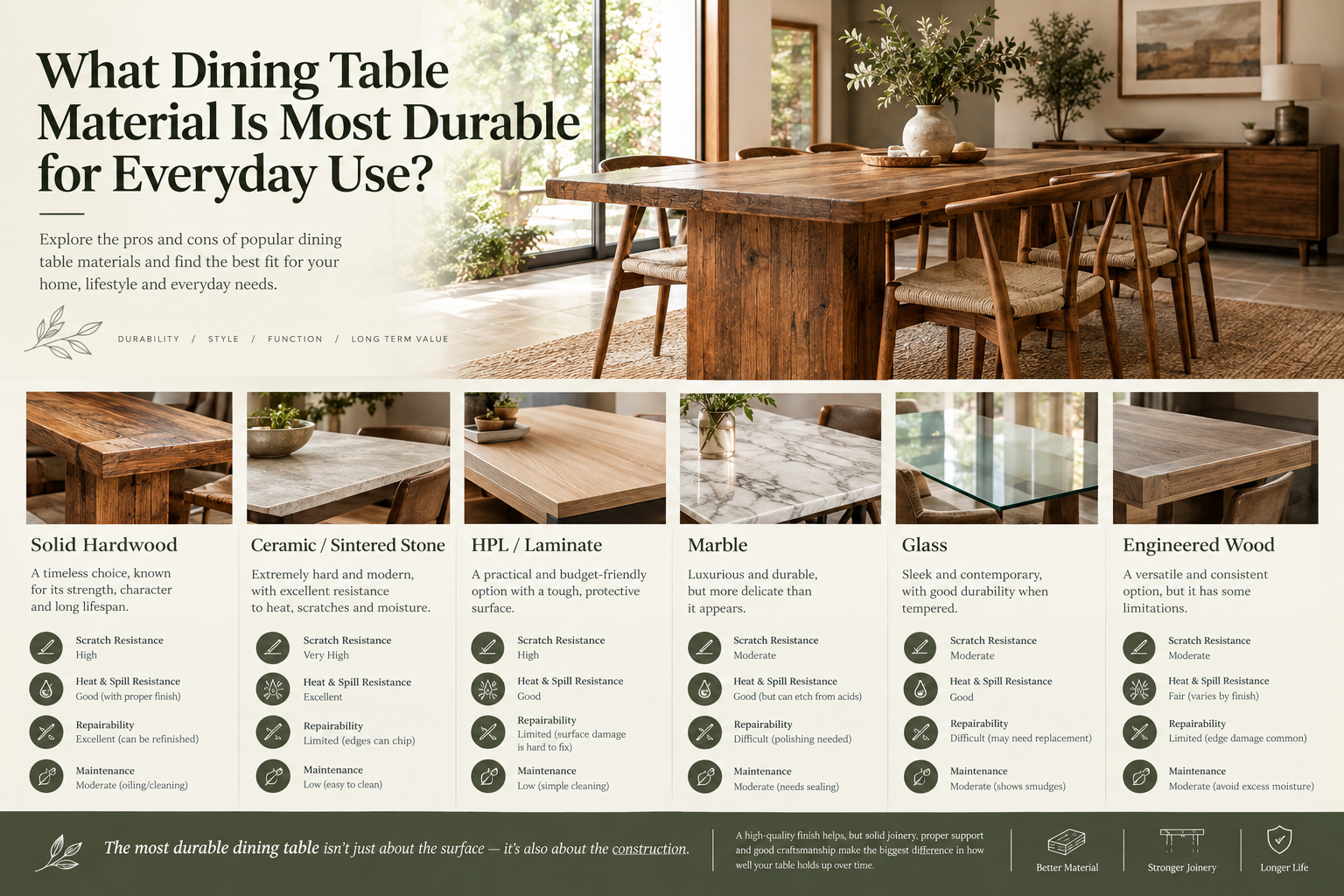
Table of Contents
- What “Durable” Actually Means for a Dining Table
- Solid Wood: Strengths and Trade-Offs
- Engineered Wood and Laminate
- Glass
- Metal
- Stone
- The Honest Comparison
- From Workshop to Dining Room: How Solid Wood Tables Are Built
- A Note on Reclaimed Wood Specifically
- FAQ
- Conclusion
What “Durable” Actually Means for a Dining Table
Durability for a dining table breaks down into a few separate qualities worth considering individually. Scratch resistance matters for everyday use with plates, utensils, and kids’ projects. Impact resistance matters for dropped objects and accidental bumps. Repairability matters most over the long run, since even the most durable material eventually shows some wear, and how easily that wear can be fixed affects how long the table actually stays in good condition.
A material can score well on one of these and poorly on another, which is why the “most durable” answer depends partly on which kind of daily wear your household actually produces most.
Solid Wood: Strengths and Trade-Offs
Solid wood holds up exceptionally well to general daily use. It resists everyday scratches reasonably well, especially with a quality finish, and more importantly, it’s repairable in a way most other materials aren’t. A scratch or minor dent in solid wood can often be sanded and refinished, restoring the surface almost completely, something that’s simply not possible with most engineered or composite materials.
The trade-off is weight and price. Solid wood tables are heavier and generally cost more upfront than engineered alternatives. They also require occasional maintenance and periodic oiling or refinishing to stay in top condition, though this maintenance is part of what extends their lifespan well beyond most other materials.
Engineered Wood and Laminate
Engineered wood, MDF, or particleboard with a wood veneer costs less upfront and resists minor surface scratches reasonably well when new. The durability problem shows up over time rather than immediately. Veneer can chip or peel at edges and corners with repeated use, and once that happens, repair options are limited since there’s no solid material underneath to sand or refinish.
Moisture is a bigger concern here than with solid wood. Water that sits on an engineered wood surface for any length of time can cause swelling or delamination, which is a much more serious and often unfixable problem compared to the same moisture exposure on solid wood
Glass
Glass dining tables resist scratching from normal use reasonably well and wipe clean easily, which makes them appealing for households focused on easy maintenance. The real durability concern is impact resistance. A hard enough knock, a dropped heavy dish, or a chair pushed back too quickly into the table’s edge can chip or crack glass in a way that’s not repairable. Tempered glass reduces this risk somewhat but doesn’t eliminate it.
Glass also shows fingerprints, smudges, and water spots more visibly than other materials, which isn’t a structural durability issue but does affect how much upkeep the table needs to look consistently clean.
Metal
Metal dining tables, whether a full metal top or a metal base with another material on top, hold up extremely well to impact and generally don’t scratch the way wood or laminate can. The main durability concern is finish degradation over time; powder-coated or painted metal can chip, and once the underlying metal is exposed, it’s vulnerable to rust, particularly in humid climates or near kitchens with a lot of moisture in the air.
Metal is also less forgiving acoustically and thermally; it feels cold to the touch and can be noisier when dishes or utensils make contact with the surface, which affects daily comfort more than structural durability.
Stone
Natural stone, granite, marble, or quartz, offers excellent resistance to scratching and heat, making it one of the most physically durable surfaces for a dining table. The trade-offs are weight, cost, and, in some cases, porosity. Marble specifically can stain from acidic foods like wine or citrus if not sealed properly, and even sealed stone generally needs periodic resealing to maintain that resistance.
Stone is also the least forgiving material if dropped objects cause chipping at an edge or corner, since repair typically requires a professional and isn’t always possible to make fully invisible.
The Honest Comparison
If the priority is long-term durability combined with the ability to repair rather than replace, solid wood generally comes out ahead, specifically because of its repairability. Materials like glass, stone, and metal can resist daily wear well in certain categories, but once damaged at their weak points, impact for glass, chipping for stone, and finish failure for metal, repair options are limited or impossible.
If the priority is pure scratch and heat resistance with less concern for repairability, stone performs very well. If budget and weight are the primary concerns and the table won’t see heavy daily use, engineered wood can be a reasonable, if shorter-lived, choice.
From Workshop to Dining Room: How Solid Wood Tables Are Built
A solid wood dining table’s durability starts well before it reaches a home. Builders select timber specifically for density and grain stability, then construct the piece using joinery, mortise-and-tenon joints, dovetails, or similar solid connections, rather than relying primarily on glue or hardware, which affects how well the table holds up to years of daily stress at its joints.
That construction approach takes longer than assembling an engineered wood table from pre-cut, uniform panels, but it’s a large part of why a well-built solid wood table can last for decades with proper care, while lower-quality furniture, regardless of material, often needs replacement within a much shorter window.
A Note on Reclaimed Wood Specifically
Reclaimed wood adds a practical advantage on top of solid wood’s general durability. Because it’s already been through years of natural aging and settling in its previous life, reclaimed timber tends to be more dimensionally stable than freshly milled wood, which can reduce the kind of warping or movement that affects newer lumber during its first few years in a new environment. It also brings grain character and visual depth that engineered or synthetic materials simply can’t replicate. Pieces like this reclaimed teak wood round dining table or this reclaimed teak wood dining table reflect that combination of durability and material character directly.
FAQ
Is solid wood really more durable than glass or metal?
It depends on the type of wear. Glass and metal resist certain kinds of damage well, but solid wood’s main advantage is repairability; scratches and dents can often be sanded and refinished, while damage to glass or metal is frequently permanent.
What’s the most low-maintenance dining table material?
Glass and sealed stone require the least hands-on maintenance day-to-day, though both have specific vulnerabilities: impact for glass and potential staining for porous stone, which solid wood doesn’t share in the same way.
Does engineered wood work for everyday family use?
It can be for lighter use, but it tends to show wear at edges and corners faster than solid wood, and moisture damage to engineered wood generally isn’t repairable the way it is with solid wood.
Is reclaimed wood more durable than new, freshly milled wood?
Reclaimed wood tends to be more dimensionally stable due to its prior natural aging, which can reduce early warping, though both reclaimed and new solid wood share the same core durability advantages over engineered alternatives.
What dining table material is best for a household with young kids?
Solid wood is generally the most forgiving choice, since minor dents and scratches from daily use can be sanded and refinished rather than becoming permanent damage.
Conclusion
No single material wins in every durability category, but for everyday use combined with long-term repairability, solid wood holds up better over the full life of a dining table than most alternatives. Glass, metal, and stone each have real strengths, but their weak points tend to be permanent once damaged, while solid wood can usually be restored rather than replaced. If durability over the long haul is the priority, it’s worth looking closely at solid wood, particularly reclaimed options built with the joinery and material quality to actually last.