
Console tables are one of the easiest pieces of furniture to get wrong. They’re long and narrow, they sit in tight spots, and a few inches in the wrong direction can mean a door that won’t open or a hallway that feels like an obstacle course. Because they look simple, people often order one based on a rough guess and discover the problem only when the box arrives.
The fix is not complicated. It just takes about fifteen minutes with a tape measure and some painter’s tape. This guide walks through the process in the order you should do it, from measuring the wall to checking whether the table can even get through your front door.
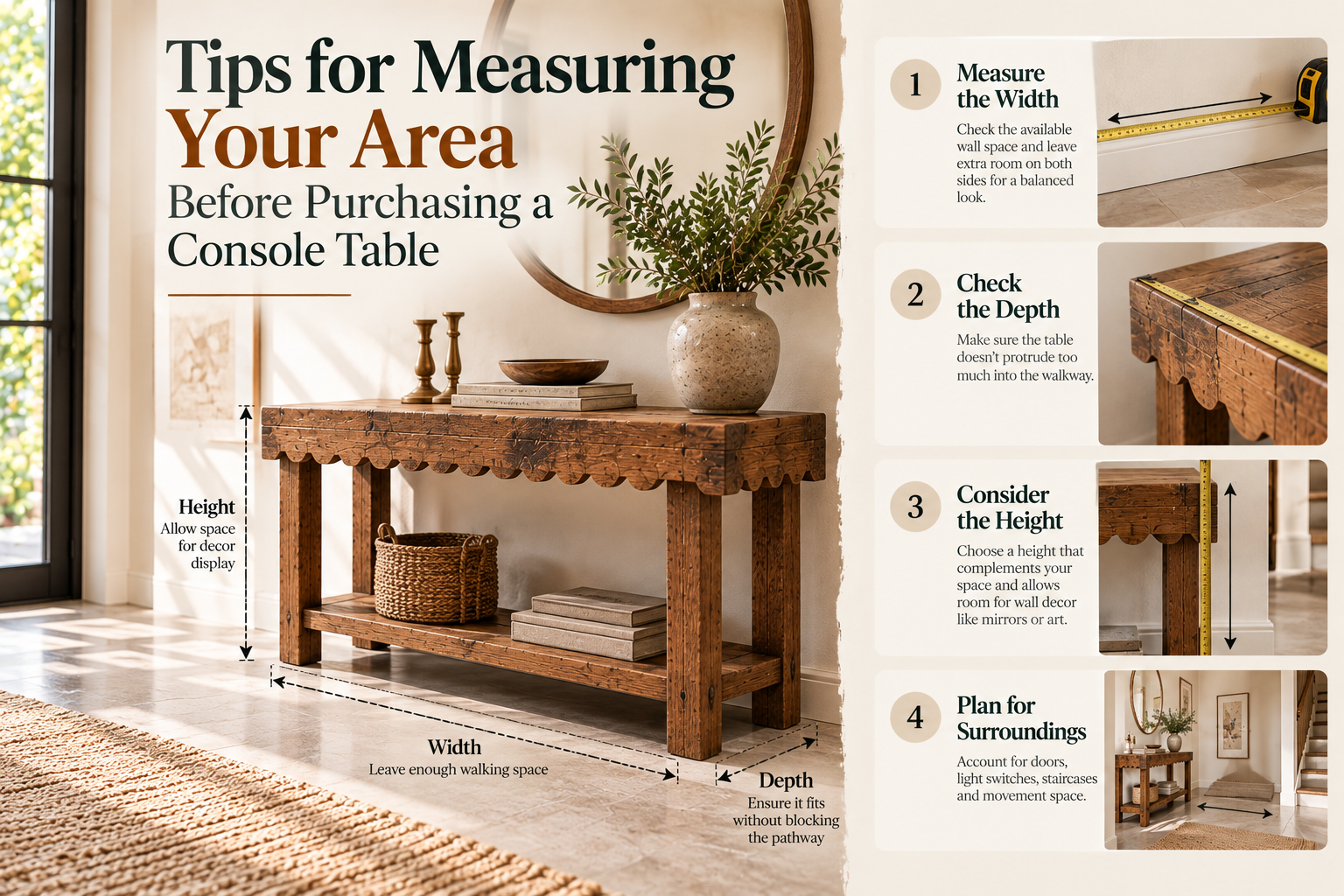
Table of Contents
- What You Need Before You Start
- Step One: Measure the Wall
- Step Two: Check Depth and Walking Space
- Step Three: Look Up and Check Height
- Step Four: Account for Doors, Outlets, and Baseboards
- Step Five: Mock It Up With Tape
- Step Six: Plan the Delivery Path
- Reading the Listing Dimensions
- From Workshop to Your Door: Why Measurements Matter for Handmade Pieces
- A Note on Reclaimed Wood and Size
- FAQ
- Conclusion
What You Need Before You Start
You don’t need much: a tape measure, painter’s tape (which won’t damage paint or flooring), a pencil, and a notebook or your phone. If you plan to hang a mirror or art above the table, grab a piece of cardboard too.
Write every measurement down as you take it, and note whether it’s in inches or centimeters. Mixing units is a surprisingly common reason for a table that doesn’t fit.
Step One: Measure the Wall
Measure the full length of the wall where the console will sit, from corner to corner or from one obstruction to the next. Then decide how much of that length the table should fill. A console that runs the entire wall can look heavy, while one that’s far too short looks lost.
As a rough guide, aim for a table about two-thirds to three-quarters of the wall or furniture it sits beside. If it’s going behind a sofa, a table that’s slightly shorter than the sofa usually looks balanced. Leave a little breathing room on each end rather than pushing the table into a corner.
Step Two: Check Depth and Walking Space
Depth matters more than most people expect. Standing at the wall, measure out to the opposite wall or the nearest piece of furniture. Subtract the depth of the console you’re considering, and see how much floor is left.
You want at least 30 inches of clear walking space, and 36 inches feels comfortable. In a narrow hallway, that may mean a table only 10 to 12 inches deep. If the leftover space is under 30 inches, either choose a shallower table or look at a different spot in the room.
Step Three: Look Up and Check Height
Most console tables are between roughly 28 and 34 inches tall, but it varies. Measure the height available, especially if there’s a window sill, a switch plate, or an art piece in the way.
If the table is going behind a sofa, check the height of the sofa back. A console that sits at or just below the sofa back usually looks right, while one that’s taller can feel like it’s competing. If you plan a mirror or artwork above, leave about 6 to 8 inches between the tabletop and the bottom of the frame, and measure to make sure the combination fits your wall height.
Step Four: Account for Doors, Outlets, and Baseboards
This is the step people skip, and it causes most of the problems. Open every door near the spot fully and see whether the table would block it. Check whether it would cover an outlet, light switch, thermostat, or vent you need to reach.
Measure the baseboard, too. Baseboards typically stick out about half an inch to an inch, which pushes the table slightly away from the wall. That small gap affects how much depth you really have. Also look for radiators or heating vents, since solid wood furniture should sit a few feet away from direct heat sources to avoid drying out.
Step Five: Mock It Up With Tape
Before you buy, mark the table’s footprint on the floor with painter’s tape. Use the exact length and depth from the listing. Then stand back, walk around it, and try opening nearby doors.
For height, tape a rectangle on the wall the size of the table, or hold up a piece of cardboard cut to the table’s height. Live with the marks for a day. If you keep bumping into the tape or find the setup awkward, you’ve saved yourself a return. If it feels natural, you’ve got your answer.
Step Six: Plan the Delivery Path
Fitting the room is only half the job. The table also has to get there. Measure the width of your front door, hallways, and any stairwells or tight turns along the route. Compare these to the table’s longest dimension and any packaging.
If the piece arrives assembled, a long console may need to be tilted or turned to get through a doorway, and you’ll want to check the clearance. If it ships partly disassembled, ask what the assembly involves so you’re prepared.
Reading the Listing Dimensions
When you’re looking at a listing, find the length, depth, and height, and check whether the measurements describe the table itself or the packaged item. Note details like the thickness of the top and the size of the legs, since those affect how it looks in your space.
Be cautious with ranges or approximate sizes. For handmade pieces especially, ask the maker to confirm exact dimensions if your space is tight, because a difference of an inch or two can matter in a narrow spot.
From Workshop to Your Door: Why Measurements Matter for Handmade Pieces
Handmade furniture is built board by board, which means dimensions can differ slightly from piece to piece, and small natural variations in the wood are part of its character. A good maker will tell you the actual measurements and, in many cases, can build to a custom size if the standard one doesn’t fit.
That flexibility is one of the advantages of buying from a maker rather than off a shelf. If your hallway is an unusual width or your wall has an awkward obstruction, it’s worth asking whether a custom length or depth is possible, rather than settling for an almost right table.
A Note on Reclaimed Wood and Size
Reclaimed wood can influence a table’s proportions, since the length and width of available boards shape what can be built. Sizes can vary slightly, so it’s wise to treat the listed dimensions as the starting point and confirm them if your space is tight. If you’re looking for a console and want to compare sizes, you can browse the options at Modern Karigar and ask about exact measurements or custom sizing before you order.
FAQ
How deep should a console table be?
Most are 10 to 16 inches deep. In a narrow hallway, aim for 10 to 12 inches so you keep at least 30 inches of walking space.
How long should a console table be?
Roughly two-thirds to three-quarters of the wall or furniture it sits beside, with a little space at each end so it doesn’t look crammed.
How high should a console table be behind a sofa?
Usually at or slightly below the height of the sofa back. Measure the sofa before you buy.
How much space do I need between a console table and a wall?
Baseboards often push the table about half an inch to an inch from the wall, so account for that, and leave a few inches from heat sources.
Can I get a custom-size console table?
With handmade furniture, often yes. Send exact measurements and a photo of the space, and ask the maker what’s possible.
Conclusion
Measuring for a console table takes fifteen minutes and saves you from a lot of hassle. Measure the wall, check depth and walking space, look at height, account for doors and outlets, mock it up with tape, and confirm the delivery path. Do that, and the table you choose will fit the room and feel right in it. If you’re ready to shop, it’s worth keeping your measurements handy and asking the maker to confirm the exact size.