
The entryway is the one room in the house where the furniture question isn’t just aesthetic. It’s also spatial, functional, and more than people realise architectural. Whatever you put there shapes how the space reads and how it works every single day.
Console table or sideboard: it sounds like a preference question, but it’s actually a practical one, with real answers that depend on your hallway dimensions, your storage needs, and how the room connects to the rest of the house. Get it right and the entry feels intentional, calm, considered. Get it wrong and you’ve blocked a corridor or created a landing zone for everything that doesn’t have a proper home.
This guide walks through both options honestly. Not to declare a winner because neither piece is universally better but to give you the specific criteria that make the decision clear for your particular space.
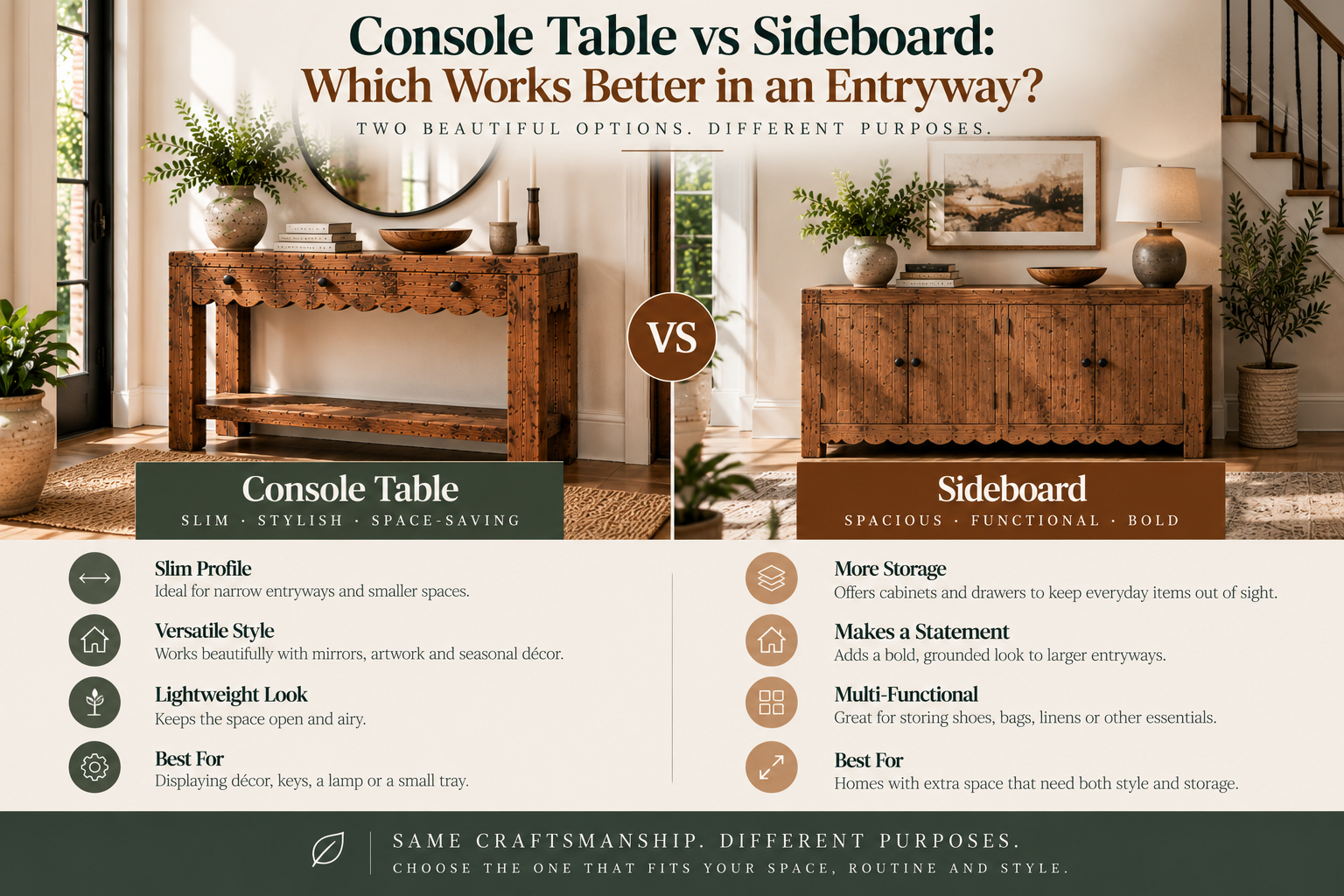
Table of Contents
- Understanding the Two Pieces
- The Case for a Console Table in Your Entryway
- The Case for a Sideboard in Your Entryway
- How to Decide: A Practical Framework
- From the Workshop to Your Entryway
- FAQ
- Final Thoughts
Understanding the Two Pieces
Before making a case for either, it’s worth being precise about what each piece actually is because both terms get used loosely in furniture retail, and the distinctions matter for an entryway.
A console table is a narrow, typically shallow table designed to be placed against a wall. Standard dimensions: 75–85cm tall, 25–40cm deep, anywhere from 90cm to 160cm wide. It has no storage in most versions: no doors, no drawers, and occasionally an open shelf below. Its defining characteristic is that it takes up very little floor depth, making it suitable for spaces where there isn’t much to spare.
A sideboard (also called a buffet or credenza depending on context and height) is a storage cabinet with a flat working surface. Standard dimensions: 75–85cm tall, 40–55cm deep, 120–180cm wide. The depth is the critical difference: a sideboard projects significantly further into the room than a console table, which means it needs more floor space and carries more visual weight. In return, it offers closed storage: drawers, doors, shelves behind panels.
Both pieces end up in entryways for the same reason: they provide a surface and occupy the wall beside the door. But how they occupy that wall, and what they give back, is quite different.
The short version: a console table borrows space from a room without taking much of it. A sideboard commits to the space more fully and asks for more in return.
The Case for a Console Table in Your Entryway
For most hallways and entry spaces, the console table is the better default, and the reasons are largely spatial.
It Works in Narrow Halls
The average British hallway is 90–120cm wide. Once you factor in movement clearance (the comfortable minimum is about 90cm of unobstructed width), a console table at 25–35cm depth can sit flush against the wall while leaving the corridor fully functional. A sideboard at 45–55cm depth in the same space leaves you 35–75cm of clearance, which is fine for passing single-file, not fine for two people maneuvering with bags and coats.
In a tight entryway, the console table is not only the preferable option; it frequently stands as the only practical solution. Attempting to fit a sideboard in a space with inadequate depth results in a passage that feels obstructed instead of well-decorated.
It Reads as Lighter in the Space
A console table is visually open. The legs create negative space beneath it; the shallow profile means it reads against the wall rather than projecting from it. In an entryway, which you want to feel welcoming and easy to move through rather than dense and cluttered, that visual lightness matters.
Solid wood console tables, particularly those with turned or tapered legs, achieve this naturally. The material brings warmth without the bulk, which is precisely what a narrow entry needs.
It’s a Better Styling Surface
The console table’s stripped-back function as a surface, nothing more is also its aesthetic strength. Because it doesn’t have the visual bulk of storage doors and drawer fronts, the top becomes a genuine canvas. A mirror above it, a small plant, a tray for keys and cards, and one piece of considered decoration this is where entryway styling works best, and a console table is the right foundation for it.
The absence of storage isn’t necessarily a drawback. If you’re managing entry clutter with hooks, a bench, and wall storage (as most functional drop zones do), the console table’s surface is all you actually need.
The Case for a Sideboard in Your Entryway
For the right space, a sideboard in an entryway is a genuinely strong choice and sometimes the only piece that solves the problem properly.
You Actually Need the Storage
If the entryway has to manage a significant volume of incoming items in a large household, sports equipment coming in and out, or an entry that doubles as a utility space, a console table’s surface isn’t enough. The sideboard’s closed storage is what makes it worth the extra depth.
Drawers at the top handle the small-item chaos: keys, cards, chargers, sunglasses, mail that needs to be actioned. Cupboard space below handles the medium-size items that don’t belong anywhere visible: dog leads, reusable bags, shoe-cleaning equipment. None of this is possible with a console table. The sideboard takes a lot of entryway friction and makes it disappear behind closed doors.
The Space Can Support the Footprint
For an entry hall wider than 150cm, or an open-plan entry that flows directly into a living area, the depth of a sideboard isn’t a constraint; it’s appropriate. A console table in a generous entry can look too slight; it doesn’t fill the wall the way the proportions of the space call for. A sideboard anchors a larger entry properly, gives the wall the visual weight it needs, and still leaves comfortable movement clearance.
The Entry Is a Double-Duty Room
Some entries serve more than one function. A house where the entryway is also the home office pass-through, where parcels are sorted and work bags are organized, benefits from the sideboard’s working surface combined with its storage. A wider, deeper top at the right height (78–82 cm) functions as a genuine working surface that a narrow console table can’t replicate.
For open-plan homes where the entry bleeds into the living room, a sideboard placed perpendicular to the wall can also serve as a gentle spatial divider defining zones without walls.
How to Decide: A Practical Framework
If you’re still weighing the two, these four questions tend to resolve it.
What is the usable depth of the wall?
Measure from the wall to where you need movement clearance to remain. If you have 35cm or less before that clearance line, you need a console table; a sideboard won’t fit without compromising flow. If you have 55cm or more, either works. Between 35cm and 55cm, a slim sideboard (40–45cm depth) might just be viable, but measure carefully and don’t round up.
Do you need closed storage, or is surface enough?
Be honest about this one. If you have hooks, a bench, and a basket system already handling your entry items, a console table surface for keys and a plant is genuinely sufficient. If you don’t have those systems or if the volume of daily incoming items exceeds what hooks and baskets can handle, the sideboard’s storage is the more functional solution.
Will this piece be seen from the rest of the house?
In a hallway, which serves as a passage between the entrance and other rooms, the furniture is viewed from a single perspective: directly as you approach the door or from the side as you walk by. In an open-plan layout, the furniture can be seen from various viewpoints and distances, such as from the sofa, the kitchen, and along the sightlines. A sideboard presents itself well from afar, while a console table may appear too delicate in a spacious area.
What does the room need aesthetically, not just functionally?
Some entries feel underfurnished and need visual anchoring. Others feel cramped and need breathing room. A sideboard anchors and grounds; a console table opens and lightens. Trust your read of the space; that instinct is usually correct, and the dimensions will confirm or redirect it.
From the Workshop to Your Entryway
Handmade reclaimed wood furniture occupies an interesting position in the console-versus-sideboard conversation because solid wood changes some of the assumptions.
Factory-produced console tables are often built very lightly: thin veneered tops, tubular metal legs, a shelf that’s decorative rather than structural. They look right in photographs and work reasonably well as styling surfaces, but they’re not built to take daily contact; the surface scratches easily, the joints loosen over time, and the piece gradually starts to look exactly like what it is: something that was made quickly and cheaply.
A console table made by hand from reclaimed timber reclaimed teak or acacia, perhaps with solid wood legs jointed properly to a full-thickness top, is a fundamentally different object. The surface handles daily key drops, bag drops, and the accumulated contact of a busy entry without deteriorating. The solid wood legs don’t flex. The material is real enough to be repaired rather than replaced.
The distinction of handmade reclaimed wood sideboards is particularly significant. In contrast, factory-made sideboards often feature an MDF core with veneer finishes and are constructed using mechanical fasteners, which are suitable for dining rooms where the furniture is infrequently handled. However, they are not ideal for entryways that experience regular use. A handcrafted solid wood sideboard, designed with proper cabinet joinery and authentic hardwood drawer fronts, is constructed to withstand the wear and tear typical of an entryway.
There’s an aesthetic dimension too. Reclaimed wood brings warmth and grain variation that makes an entryway feel immediately less clinical. The first impression a home makes is shaped by what you see in the first five seconds after the door opens, and a piece of handmade reclaimed timber, placed well, makes that impression in a way that flat-pack furniture simply doesn’t.
Explore handmade reclaimed wood console tables and sideboards at Modern Karigar →
FAQ
What is the difference between a console table and a sideboard?
The primary difference is depth and storage. A console table is shallow, typically 25–40cm deep with a surface and often an open shelf below, but no closed storage. A sideboard is deeper (40–55cm typically) and includes drawers, cupboards, or both behind closed fronts. Both tend to be similar in height (75–85cm) and are designed to sit against a wall. The console table prioritizes visual lightness and minimal footprint; the sideboard prioritizes storage capacity and visual presence.
Can you put a sideboard in an entryway?
Yes, provided the hallway is wide enough to accommodate it without compromising movement. For comfortable use, a sideboard needs the depth of the piece (typically 40–55cm) plus at least 90cm of clear walkway beside it. In a hallway narrower than 130–140cm total, a sideboard is likely to feel obstructive. In a wider entry or open-plan space, it works very well and offers the benefit of closed storage that a console table can’t provide.
What height should a console table be in an entryway?
Standard console table height is 75–85cm, which puts the surface comfortably at hand height for an adult standing beside it. This height also works well visually with a mirror hung above it; the conventional arrangement is to leave 15–25 cm between the top of the console table and the bottom of the mirror. Slightly taller versions (85–90cm) exist and suit taller households or spaces with higher ceilings.
How deep should an entryway console table be?
For a functional entryway surface, 30–40cm of depth is the practical sweet spot. It is shallower than 30cm and the surface becomes too narrow for useful items to fall off easily, and the proportions look wrong. Deeper than 40cm starts to eat into corridor space in a way that most entryways can’t afford. For a very tight hallway, 25cm is the minimum that still functions as a surface.
What wood is best for an entryway console table or sideboard?
The entryway is one of the more demanding furniture locations in a home, with frequent contact, occasional impact, and humidity changes as the door opens and closes. Dense hardwoods handle this better than softwoods or engineered alternatives. Reclaimed teak is particularly well suited: its natural oil content makes it moisture-resistant, its density means it resists denting and scratching, and its aged grain gives it a warmth that new timber takes years to develop. Reclaimed acacia is another strong choice, slightly more varied in grain, warm in color, and equally durable for everyday entry use.
Final Thoughts
The console table versus sideboard question doesn’t have a universal answer, but it does have a correct answer for your specific entry once you know the dimensions and the functional requirements.
For most narrow to medium hallways where the entry needs to feel open and welcoming, the console table. For wider entries or open-plan spaces where closed storage would genuinely improve daily life: the sideboard. In either case, the material matters enormously in an entry setting: solid wood handles the daily contact, moisture exposure, and general rough handling that an entryway involves in a way that veneered or lacquered alternatives don’t sustain over time.
If you’re looking for handmade reclaimed wood console tables or sideboards built for daily use with real timber, real joinery, and built to last the Modern Karigar collection on Etsy is worth exploring.