
A dining table for daily family use is not the same proposition as a dining table for occasional entertaining. It needs to handle sticky fingers, homework sessions, accidental scrapes from plates and cutlery, the damp ring from a glass that didn’t make it to a coaster, and years of chairs being pulled in and out without much ceremony. The question isn’t just which wood looks better; it’s which wood holds up better under the actual conditions of family life.
Reclaimed teak and oak both provide valid options, yet they are distinct materials with unique characteristics, properties, and maintenance needs. There is no clear winner between the two; each is better suited for different households and varying priorities.
This analysis focuses on the key factors for a family dining table: durability, resistance to scratches and moisture, the aging process of each material over time, practical maintenance requirements, and the aesthetic appeal of each option. By the conclusion, you’ll have a solid understanding of which material best suits your family, your space, and your willingness to maintain it.
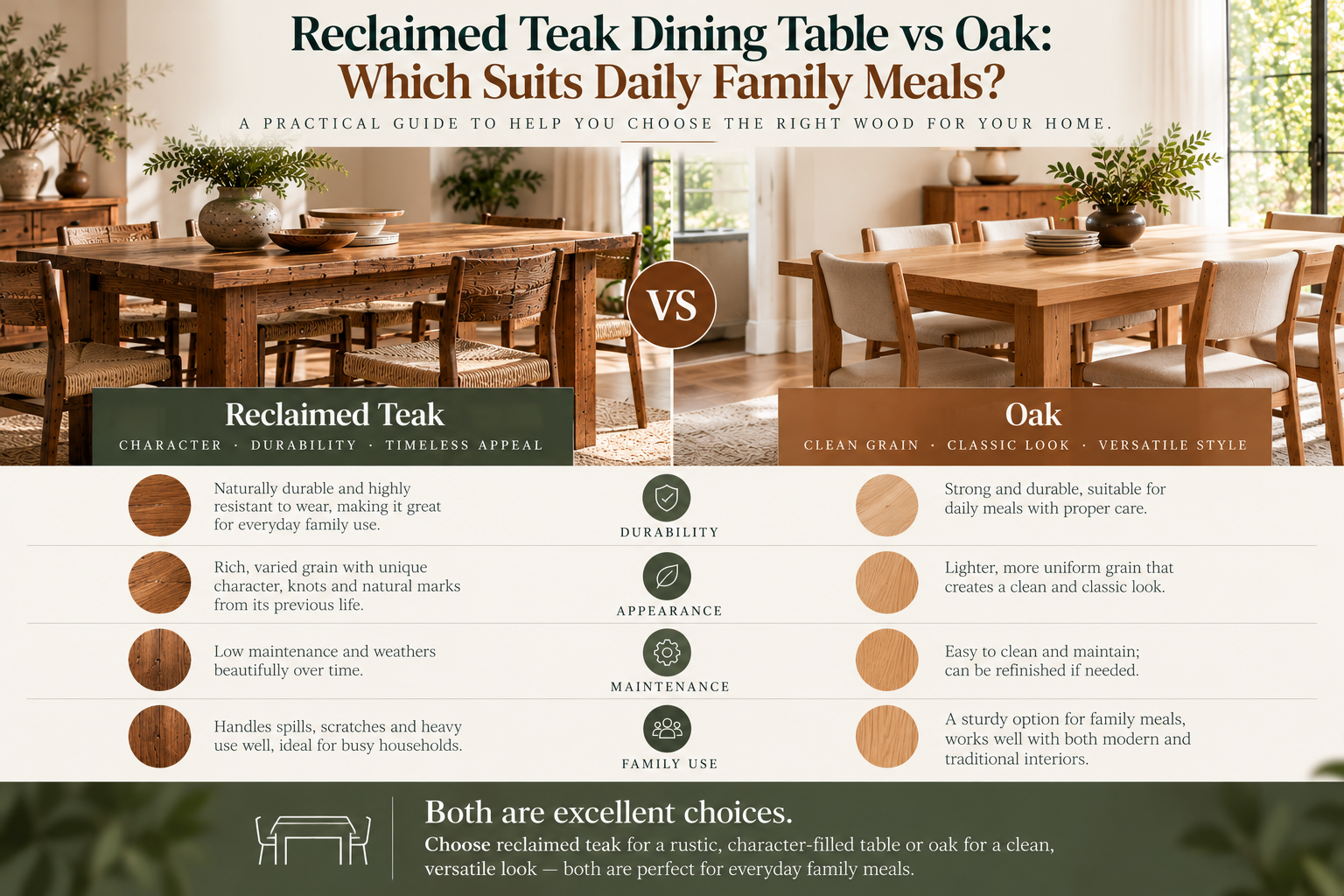
Table of Contents
- Understanding the Two Materials
- Head-to-Head: Durability and Daily Use
- Maintenance and Ageing
- Aesthetics and Room Fit
- From the Workshop to Your Family Dining Room
- The Verdict: Which Suits Daily Family Meals?
- FAQ
- Final Thoughts
Understanding the Two Materials
Before comparing how they perform, it helps to understand what each material actually is because ‘teak’ and ‘oak’ each cover more variation than the names suggest.
Reclaimed Teak
Teak is a tropical hardwood native to South and Southeast Asia. It’s one of the densest, most naturally oil-rich hardwoods in the world; the oil content is what makes it naturally resistant to water, warping, and insect damage without any chemical treatment. For centuries, it was the timber of choice for shipbuilding and exterior architecture, precisely because of how well it holds up under sustained exposure.
Reclaimed teak refers to teak that has previously been utilized for structural purposes, such as old-growth timber sourced from demolished buildings, colonial warehouses, or decommissioned bridges. This provenance is significant. Old-growth teak, obtained from trees that matured slowly over many decades or even centuries, features tighter growth rings and greater density compared to the plantation-grown teak available today. By the time reclaimed teak is transformed into your dining table, it has already endured more than most timber will ever encounter.
Oak
Oak is a temperate hardwood grown across Europe, North America, and Asia, and it’s been a furniture staple for centuries. European oak and American white oak are the most common species used in dining furniture. Both are hard, stable, and workable well, suited to furniture construction and widely available from managed, sustainable sources.
Oak is typically sold as new-growth timber rather than reclaimed, though reclaimed oak exists. For this comparison, we’re contrasting reclaimed teak with new-cut oak, since that’s the most common real-world choice buyers face.
Head-to-Head: Durability and Daily Use
Hardness and Scratch Resistance
Both materials are hardwoods and both are hard enough for daily dining table use. On the Janka hardness scale, the standard measure of wood’s resistance to denting, European oak scores around 1,120 lbf and American white oak around 1,360 lbf. Teak scores approximately 1,155 lbf, placing it in a similar range to European oak.
In practical terms, this means both will resist everyday scratches from cutlery and plates reasonably well; neither will mark as easily as softwoods like pine. Reclaimed teak, with its denser grain from slow old-growth development, tends to resist surface denting slightly better than new-cut oak of equivalent species, though the difference is modest rather than dramatic.
Moisture and Spill Tolerance
Teak’s natural oil content offers a notable practical benefit for family dining. Its oils provide inherent water resistance, so liquid spills that sit on the surface briefly before you clean them up are much less likely to raise the grain or leave water marks than on untreated or lightly finished oak.
Oak is more porous and more reactive to moisture. An unfinished or lightly oiled oak table is vulnerable to water rings, grain raising from repeated spills, and staining from acidic foods like wine or citrus juice. A well-lacquered oak table provides better moisture protection but lacquer creates a film finish that eventually chips and yellows, requiring more involved refinishing when it fails.
For families with young children who spill regularly, reclaimed teak’s natural moisture resistance is a genuine functional advantage.
Thermal Movement
All wood expands and contracts with fluctuations in humidity and temperature. A dining table positioned near a radiator or in an environment that alternates between dry winters and humid summers will undergo this movement, no matter the wood species.
Oak is relatively stable but more reactive than teak to humidity changes, particularly when used as wide boards. Teak’s density and oil content make it more dimensionally stable; it moves less, and when it does move, it tends to do so more slowly and uniformly. For a large family dining table, that stability matters for the longevity of the top and the joints.
Maintenance and Ageing
Caring for a Reclaimed Teak Dining Table
Teak’s maintenance requirements are genuinely low compared to most other hardwoods. Because the wood contains its own oils, it doesn’t need frequent treatment to remain stable. For an indoor dining table:
- Wipe spills promptly with a damp cloth
- Apply teak oil or natural beeswax once or twice a year to maintain the surface and deepen the colour
- Avoid silicone-based sprays, which build up and dull the natural finish without feeding the wood
- For scratches or dull patches, a light sanding with fine-grit paper and a fresh oil coat restores the surface completely
Left without oiling, reclaimed teak will gradually lighten and develop a silvery patina, a natural and deliberate choice for outdoor teak, less conventional for indoor dining furniture. Annual oiling keeps the warm amber and honey tones intact.
Caring for an Oak Dining Table
Oak maintenance varies considerably depending on the finish:
Oiled oak requires similar care to teak: regular oil application (typically twice yearly), prompt spill management, and occasional light sanding for surface restoration. It’s more vulnerable to water marks than teak if spills are left to sit.
Lacquered oak requires less frequent oiling but is more susceptible to surface damage over time. Chips and scratches in lacquer are harder to repair invisibly than scratches in an oiled surface. When the lacquer eventually reaches the end of its life, full refinishing is a more involved process than refreshing an oiled surface.
How Each Ages Over Years of Family Use
This is where the two materials diverge most clearly in character. Oak ages beautifully when it’s well-maintained; it deepens in color, develops a patina, and the grain becomes more pronounced over time. Scratches and marks on an oiled oak surface can be minimized with regular care and become part of the table’s character over years.
Reclaimed teak ages differently and the key word is reclaimed. Because the timber has already been through decades of use in a previous form, it arrives at your dining table with a settled, mature quality that new-cut oak spends years developing. Family use continues that story. The surface accumulates use without deteriorating; marks integrate into the grain rather than sitting on top of it. A reclaimed teak dining table in a busy family home in ten years tends to look like a piece that was always meant to be there.
Aesthetics and Room Fit
Both materials are beautiful but they’re beautiful in different ways, and they suit different rooms.
Reclaimed Teak: Warm, Varied, Characterful
Reclaimed teak is typically warm in the tone of amber, honey, and deep brown, with the color shifting depending on the specific piece and its history. The grain is tight and varied: mineral streaks, subtle tonal shifts from heartwood to sapwood, and the occasional character mark from its previous life. No two reclaimed teak tables are alike, which means the table you buy is specifically yours.
Aesthetically, reclaimed teak works best in rooms that lean toward warmth and texture: Japandi interiors, organic modern spaces, earthy bohemian dining rooms, and farmhouse or rustic settings. It also holds its own in contemporary rooms when the surrounding palette is neutral; the warmth of the teak becomes the single natural element in an otherwise minimal space.
Oak: Pale, Clean, Versatile
Oak in its natural colour is lighter than teak, pale gold to light tan, with a pronounced open grain that’s distinctly its own. American white oak can have a more even tone; European oak often shows more figure and grain variation. Both have a fresh, clean quality that works particularly well in Scandinavian and Nordic interiors, contemporary farmhouse rooms, and spaces that are being designed to feel light and airy rather than warm and enveloping.
Oak is also more easily stained or finished to alter its appearance; a darker stain can bring it closer to walnut or deep brown territory, while a light oil keeps it pale and contemporary. That flexibility makes it a safer choice for buyers who aren’t certain about the final direction of a room.
Which Suits Your Dining Room?
If the room is warm in tone and you want the table to be a character piece something with history and visual depth choose reclaimed teak. If the room is light, Scandinavian, or you want a versatile neutral that can adapt as the room evolves, choose oak.
From the Workshop to Your Family Dining Room
A handmade dining table built from reclaimed teak carries something that a new-cut oak table however well made cannot: a material that has already proven itself.
When reclaimed teak arrives at a workshop, it has already spent decades as something else. The timber is already settled, dimensionally stable, and dense in a way that new-growth timber takes years to become. The craftsman’s job is to understand that specific material, its grain direction, its moisture content, and its individual character marks and to build something that honors and continues it rather than imposing uniformity on it.
Handmade reclaimed wood furniture made this way produces dining tables that no factory process can replicate. The top is a specific piece of timber, not a grade specification met by any piece in the batch. The joinery is fitted to that timber, the mortise and tenon connections cut to the actual material, not to a standardized component. The finish is applied to a surface prepared by hand, where the craftsman knows exactly what the grain is doing and where it needs more attention.
For a family dining table, something that will be the center of daily life for years, the quality of making matters practically, not just aesthetically. A table built this way doesn’t develop the wobble that loose-jointed factory tables acquire over time. The top doesn’t cup or warp at the same rate that less stable timber does. And as the surface accumulates the honest marks of family use, it looks more like itself rather than more damaged.
Oak tables from quality makers can also be built to a high standard, and a well-made oak table is a genuinely excellent piece of furniture. The reclaimed teak difference is in the starting material: it arrives already seasoned, already proven, and already carrying thirty or fifty years of the stability that a new-cut oak table is still in the process of achieving.
See handmade reclaimed teak dining tables at Modern Karigar →
The Verdict: Which Suits Daily Family Meals?
Neither material wins outright. The right choice depends on your household’s specific combination of priorities.
Choose reclaimed teak if:
- Your family includes young children who spill regularly; teak’s natural oil content handles moisture better than most oiled oak
- You want a table that requires minimal intervention and improves with use rather than requiring ongoing vigilance
- The dining room has a cozy ambiance, and you desire a table that feels integrated into the space rather than one that appears newly purchased.
- You value a piece with genuine material character: individual grain and real history over finish flexibility
- Long-term stability and density are important (teak’s slow-growth density means a more stable surface over decades)
Choose oak if:
- The space has a bright, Scandinavian aesthetic, or you prefer a soft neutral that remains versatile as the room evolves.
- You prefer the option to stain or finish the table differently down the line
- Budget is a factor; quality oak dining tables are typically less expensive than reclaimed teak of comparable size
- You want a more widely available material with more makers and options to compare
For most families who cook and eat together daily, reclaimed teak’s natural moisture resistance, low maintenance requirements, and the way it ages under real use give it a practical edge for the dining room specifically. Oak is not the wrong answer but it requires slightly more attentiveness in a family setting to stay in good condition.
FAQ
Is teak or oak better for a dining table?
Both are excellent hardwoods for dining tables, but they suit different priorities. Teak particularly reclaimed old-growth teak is denser, more naturally moisture-resistant, and more dimensionally stable than oak. It requires less intervention to maintain and handles spills and daily family use with less vulnerability. Oak is lighter in colour, more versatile in finish options, and typically more affordable. For a high-use family table, teak has practical advantages. For a lighter, Scandinavian-style dining room or a more budget-conscious choice, oak is a strong option.
Does teak scratch more or less easily than oak?
Both fall in a similar hardness range on the Janka scale. Reclaimed teak, with its denser old-growth grain, tends to resist surface scratching and denting marginally better than new-growth plantation oak, though the difference is modest. For either material, the finish is as important as the hardness; an oiled surface on both species will show scratches more visibly than a lacquered one but is significantly easier to repair.
How do I remove water marks from a teak dining table?
To maintain an oiled teak surface, you can typically eliminate minor water marks by using a cloth and a little fresh teak oil. For more stubborn marks, a gentle sanding with 240-grit paper in the direction of the grain, followed by applying oil, will completely remove them. This straightforward process, which is manageable for any homeowner with basic tools, highlights one of the practical benefits of teak compared to lacquered finishes.
Does reclaimed teak need oiling as often as oak?
Generally, reclaimed teak requires less frequent oiling than oak because its natural oil content means it doesn’t dry out as quickly. Once or twice a year is typically sufficient for an indoor dining table. Oak particularly if the finish is a light penetrating oil rather than lacquer, benefits from two to three applications per year and more frequent treatment if the dining room environment is dry.
Is reclaimed teak more expensive than oak for a dining table?
Typically yes. Reclaimed old-growth teak is a premium material; its density, stability, and natural properties are the result of slow growth that can’t be rushed or manufactured. Quality handmade reclaimed teak dining tables reflect the material cost, the sourcing complexity, and the craftsmanship involved. Oak dining tables span a wide price range, from affordable mass-produced pieces to high-end handmade versions that approach teak pricing. For a comparable quality level of handmade solid wood construction, reclaimed teak tends to cost more.
Final Thoughts
Reclaimed teak and oak are both worthy answers to the family dining table question. The choice comes down to what your household actually needs from the surface: maximum moisture tolerance and minimal maintenance effort (teak), or palette flexibility and a lighter aesthetic (oak).
If you’re cooking every night, eating together as a family, and not keen on a maintenance regime that requires real attentiveness, reclaimed teak earns its premium. It handles the daily evidence of family life better, and it gets more characterful with use rather than more worn.
If you’re looking for a handmade reclaimed teak dining table built to last generations of real material and real craftsmanship, built for the table that’s in the middle of daily life, the Modern Karigar collection on Etsy is worth your time.