
Most custom furniture mistakes happen before a single piece of wood is cut. Not in the workshop, but in the brief. A dimension misunderstood, a clearance not mentioned, and a finish described loosely enough to mean different things to the buyer and the maker. By the time the piece arrives and something is wrong, it’s expensive and time-consuming to fix and sometimes impossible.
The good news is that a thorough brief isn’t complicated. It’s a detailed compilation of information that, when put together, provides a maker with all they require to create precisely what you envisioned. Interior designers typically rely on this level of detail. Most individual buyers don’t, which is why misaligned expectations are so common in custom furniture commissions.
This post covers the twelve details that matter, the ones that, if all present in the initial communication, eliminate most of the back-and-forth and the downstream problems. Whether you’re commissioning a dining table, a console, a storage piece, or a desk, these are the measurements and specifications to have ready before the conversation starts.
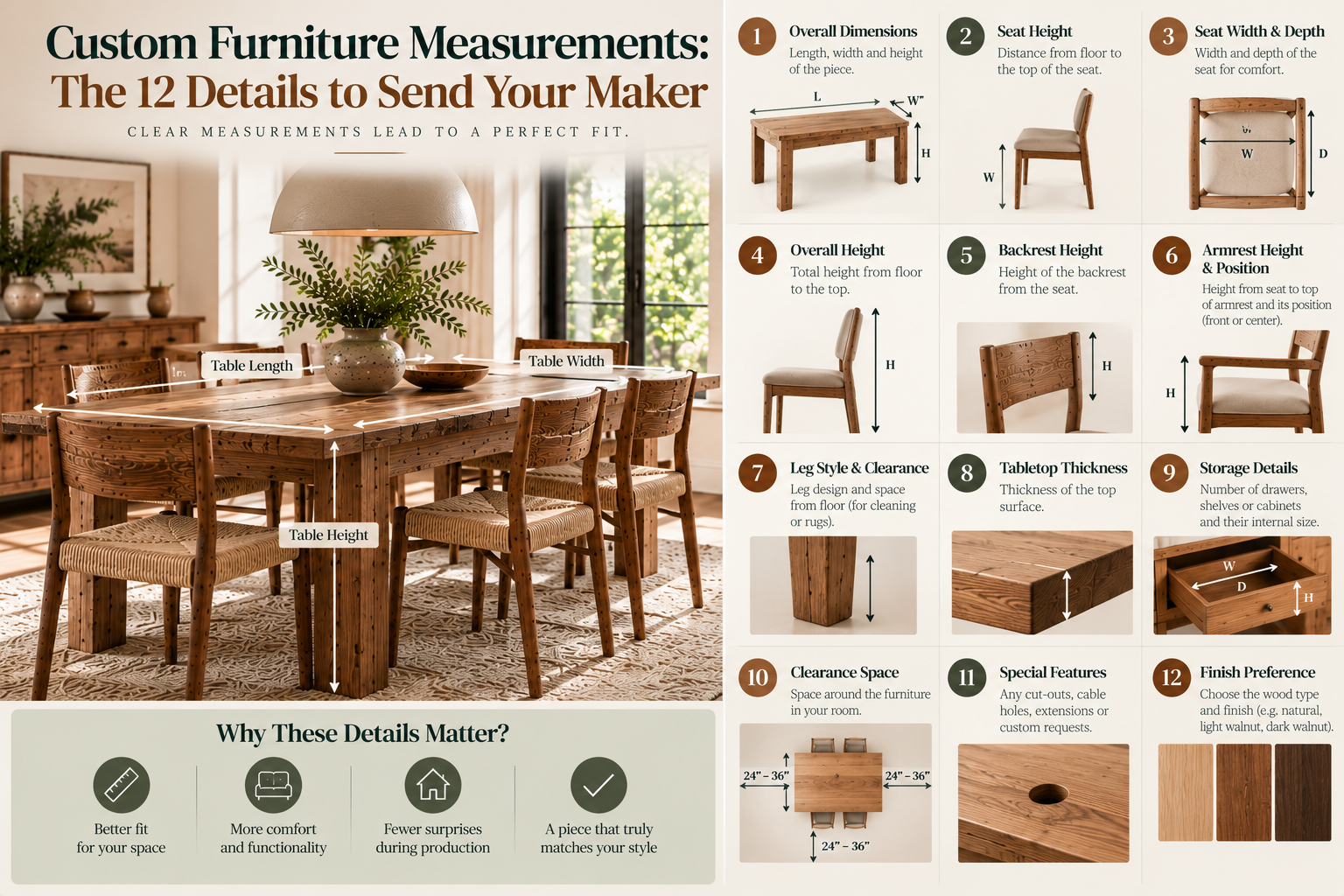
Table of Contents
- Why Getting the Brief Right Saves Everyone Time
- The 12 Details to Send Your Maker
- From the Workshop to Your Home
- How to Communicate Measurements Clearly
- FAQ
- Final Thoughts
Why Getting the Brief Right Saves Everyone Time
A custom furniture commission is a collaboration, and like any collaboration, it’s only as good as the communication at its foundation. The maker’s job is to interpret your requirements and build to them. Your job is to make those requirements clear enough that the interpretation has very little room for error.
Vague briefs create vague results. ‘About 180cm wide’ becomes a table that’s 175cm when you need 180 to seat six. ‘Natural finish’ means three different things to three different craftsmen. ‘ Similar to the one in the photo’ it leaves the maker guessing at dimensions, proportions, and material that aren’t visible in the image.
Conversely, a well-prepared brief speeds everything up. The maker can quote accurately without back-and-forth on dimensions. They can source the right material from the outset. They can identify constraints, like a ceiling that limits height or a doorway that limits delivery width before building, not after. And when something needs discussion, the conversation focuses on genuine creative decisions rather than chasing down missing information.
For handmade solid wood furniture in particular, the brief matters more than it does for off-the-shelf purchases. Each piece is built once, from real material, by a specific person. Getting it right the first time isn’t just preferable; it’s the whole point of commissioning custom work.
The 12 Details to Send Your Maker
-
Complete Dimensions (Width × Depth × Height)
State all three dimensions explicitly, in centimetres. Width × depth × height is always in that order, so there’s no ambiguity. Don’t round to approximate figures unless you genuinely have flexibility; a table that needs to fit a specific alcove should be specified to the centimeter.
If there’s a range (the piece can be anywhere from 160–180cm wide), say so; that gives the maker useful flexibility and may allow them to use a more characterful piece of timber. If there’s a hard limit on one dimension and flexibility on another, state which is which.
2. Surface Height for Its Intended Use
Height requirements vary significantly depending on what the piece is for. A dining table needs to accommodate chairs with appropriate seat clearance (typically 25–30cm between seat and tabletop underside). A desk needs to fit the chair you’ll actually use with it. A console table needs to sit at hand height for the wall it will occupy. A sideboard surface height affects what can be displayed on it and how it reads against adjacent windows or artwork.
Don’t just give a height; explain the intended use. The maker will know from context whether the height you’ve specified makes sense and can flag a mismatch before building.
3. Clearance Requirements
Clearance is the space the piece needs to leave clear: the leg clearance under a dining table apron for comfortable seating, the space a sideboard drawer needs to open fully, and the gap required above a console table for the mirror that will hang above it. These constraints don’t always show up in a dimension measurement, but they affect how the piece has to be built.
For a bookcase or shelving unit: minimum shelf height for the tallest items you need to store. For a desk: knee clearance under the drawer unit. For a bed frame: under-bed clearance if you use storage boxes. State these explicitly; the maker can only account for constraints they’ve been told about.
4. Wood Species Preference
If you have a preference for reclaimed teak, acacia, mango, or oak state it. If you’re open to recommendations, say that too and describe the properties you’re prioritising: hardness, grain character, colour tone, and sustainability. A good maker will guide you toward the species that best suits both your aesthetic requirements and the piece’s functional demands.
For reclaimed timber in particular, note that the maker may have specific stock available. Sharing your requirements early means they can alert you to a particularly good piece that suits your brief.
5. Finish and Colour Tone
‘Natural,’ ‘oiled,’ ‘dark,’ and ‘light walnut’ these terms mean different things to different people. The clearer you can be, the more effective it will be. Reference a specific finish name if you know it. Share a photograph of a colour tone you’re aiming for. Note whether you want a matte, satin, or more sheen finish. Specify if you have preferences about the finish type: oil versus wax versus lacquer, and any maintenance commitment you’re willing to accept.
For reclaimed wood, also note whether you want the character marks of the timber (nail holes, surface variation, grain shifts) to be visible and integrated or minimised and smoothed.
6. Joinery or Structural Preferences
Most buyers won’t have a specific preference for mortise and tenon versus dowels, but some do, particularly interior designers specifying for high-use commercial contexts or knowledgeable buyers who understand the durability implications. Indicate your preferences if you have any. A competent maker will choose the right structural option if you don’t.
What’s worth stating is whether the piece needs to be disassembled for delivery (which affects the joinery type) and whether any part of the structure needs to take unusually heavy loads.
7. Leg Style and Height
Leg style affects the visual weight of a piece, the clearance beneath it, and how it reads in a room. Straight tapered legs read as lighter and more contemporary. Turned legs are more artisan and traditional. Hairpin or metal legs have a completely different character. Block or trestle bases are the most substantial.
Height affects clearance, the overall proportions, and whether chairs or stools will work under the piece. If you have a strong preference, share a reference image. If you’re open to input, describe the room and let the maker suggest what would work.
8. Storage Requirements
For pieces with storage sideboards, desks, bedside tables, and shelving, be specific about what you need to store. Not ‘some storage,’ but how many drawers, what minimum drawer depth, whether you need open shelves or closed cupboards, and for what category of items? A sideboard for tableware has different requirements from one for office files. A desk with storage for a printer has different dimensions from one for notebooks and cables.
9. The Room It Will Live In and Floor Type
Context matters for several practical reasons. A humid room (a kitchen or a bathroom-adjacent dining area) affects the finish recommendation. A room with underfloor heating affects how the wood needs to be prepared. The floor type stone, hardwood, or carpet affects whether protective feet are needed and what kind.
Sharing the room also helps the maker understand aesthetic context: the other materials, the light quality, and the colour palette. This is not about the maker creating the room; it’s about ensuring the piece complements it.
10. Existing Furniture It Needs to Work With
If the piece will sit alongside specific other furniture, matching a table to existing chairs, or building a desk to complement a shelving unit already in the room, that context is essential. Share the species or finish of the existing pieces. Share a photograph if possible. The maker can’t achieve a harmonious match without knowing what they’re matching to.
11. Delivery Access Constraints
This is the one detail most buyers forget until it’s too late. A dining table at 220cm wide might not navigate a standard doorway (typically 80–90cm) in one piece; it would need to be built in sections or a specific leg configuration that allows flat-pack delivery. A wardrobe or large bookcase needs to fit through the front door, around any landings, and through the room’s own door.
Measure the access route: front door width, any narrow corridors, staircase width and ceiling height if the piece is going upstairs. Share these measurements with the maker before they start. For a large or heavy solid wood piece, this can change the build approach significantly.
12. Timeline and Budget
Budget determines what’s possible in terms of material quality, time investment, and complexity of build. Stating a realistic budget early, even as a range, lets the maker propose an approach that fits it rather than designing a piece and then discovering the budget doesn’t stretch. It also avoids the awkward moment after a lengthy specification conversation when the quote arrives significantly higher than the buyer expected.
Timeline matters because good handmade work takes time. A realistic lead time for a custom solid wood piece is typically six to twelve weeks from final specification to delivery. If you have a hard deadline, a house move, or a renovation completion, state it from the beginning so the maker can factor it into whether they can take the commission.
From the Workshop to Your Home
A clear brief does something specific when the piece being made is handmade from reclaimed wood: it frees the maker to engage more fully with the material rather than spending the build second-guessing the requirements.
Reclaimed timber isn’t a uniform raw material. Each plank has its own grain direction, its own tonal variation, and its own character marks from previous use. When a maker understands the brief thoroughly, the dimensions, the finish preference, the room context, and the visual references, they can select timber that serves the brief rather than just timber that’s available. A buyer who has mentioned they want visible grain character and a warm honey tone permits the maker to reach for the most characterful piece in the yard rather than the most uniform one.
Clearance requirements affect build decisions that aren’t obvious to buyers but are fundamental to the craftsman. Knowing that a dining table apron needs to sit at a minimum of 65cm above the floor, because the chairs have a seat at 45cm and you need generous leg room, means the apron is positioned correctly from the first cut, not adjusted after assembly. Knowing that a desk needs to be disassembled for delivery through a narrow stairwell means the joinery approach is designed for that from the outset.
Timeline and budget, handled honestly at the start, allow the maker to commit fully to the commission rather than fitting it in around uncertainty. For handmade reclaimed wood furniture, which is made once, built carefully, and finished by hand, the quality of the outcome is directly related to the quality of the time invested. A well-briefed commission is a commission the maker can give their full attention to.
When the piece arrives in your home, built to the exact dimensions, finished to the specified tone, designed for the access route, and proportioned for the chairs it will sit with, that coherence is the product of the brief as much as the building.
Commission handmade reclaimed wood furniture at Modern Karigar →
How to Communicate Measurements Clearly
Obtaining the measurements is only part of the job. Effectively conveying them so the maker can proceed without requiring multiple follow-up questions is the other part.
Use a simple written specification, not just a conversation. Even if you’ve discussed the piece verbally, follow up in writing with all twelve details in a single message or document. This gives the maker a reference they can return to during the build, and it creates a record that both parties can refer back to if something is unclear.
Photograph the space. A photograph of the wall or area where the piece will go, taken straight on and from an angle, conveys spatial context that measurements alone don’t. Take the photographs in natural light and include something in frame for scale (a chair, a person, a standard door).
Include reference images for style and finish. Screenshots from your own saved photos, images from other furniture makers, and room photographs where the aesthetic feels right are enormously helpful for communicating tone, grain preference, and leg style. Just be clear about what specifically you’re referencing: ‘the leg style in this image, not the top’ prevents the maker from guessing which element you mean.
Sketch the footprint if it’s complex. For L-shaped desks, corner shelving, or pieces that need to work around architectural features, a rough hand-drawn sketch of the floor plan is clearer than a written description. Label it with dimensions. It doesn’t need to be precise, just legible.
Flag the constraints explicitly. Don’t embed delivery access dimensions in a paragraph of text where they might be missed. List them separately: ‘Delivery constraint: front door 85cm wide; staircase width 90cm; room door 78cm.’Constraints are the details that, if missed, cause the most expensive problems.
FAQ
How far in advance should I brief a custom furniture maker?
A typical lead time for a single handmade solid wood piece, once specifications are confirmed, is six to twelve weeks for most skilled craftsmen. If you’re working to a specific deadline for a house move, a renovation handover date, or a housewarming, add a buffer and brief the maker at least twelve to sixteen weeks before you need the piece. Custom work can’t always be rushed without compromising quality, and good makers book ahead.
What should I do if I’m unsure about the precise dimensions I require?
Start with the functional requirements and work backwards. What purpose will the piece serve? What items need to fit beneath, on, or alongside it? Measure the specific space it will occupy. If you genuinely have flexibility on dimensions, say so; makers can often work with a range and choose dimensions that best suit the specific timber available, which can result in a more characterful piece.
How specific do I need to be about wood species?
As specific as your preference is. If you have a genuine preference for reclaimed teak because you understand its properties and want them, say so. If you know you want a hardwood with warm grain but aren’t attached to a specific species, describe what you’re after; the maker can suggest what suits both your aesthetic and the piece’s functional demands. Saying ‘whatever you think is best’ without context gives the maker no useful guidance; saying ‘a warm-toned hardwood with visible grain character, something moisture-resistant for a dining table’ gives them a great deal.
Can I send reference images instead of written specifications?
Reference images are useful for communicating style, finish tone, and leg style, but they cannot replace written dimensions and clearance requirements. A photograph doesn’t tell a maker how tall your chairs are or how wide your doorway is. Use reference images alongside a written specification, not instead of one.
What happens if I forget a detail and the maker has already started?
If the missed detail doesn’t affect the build in progress, the maker can accommodate it. If it does, a clearance requirement that changes the apron height or a delivery constraint that requires a different leg attachment changes mid-build are expensive and sometimes structurally difficult. This is why the complete brief matters upfront. If you realise you’ve missed something, communicate it immediately rather than hoping it won’t matter.
Final Thoughts
Commissioning custom furniture is one of the more satisfying things you can do for a home; the result fits the space, suits the specific use, and tends to last far longer than anything bought off a shelf. The brief is the investment that makes the rest of the process run well.
The twelve details in this guide aren’t bureaucratic; they’re the natural language of making something specific. A dimension, a clearance, a finish preference, and a delivery constraint. Each one is a decision that needs to be made; the only question is whether it’s made before the build or discovered awkwardly after it.
If you’re ready to commission a handmade solid wood piece from reclaimed timber or just want to explore what’s possible, the Modern Karigar workshop on Etsy welcomes detailed briefs and genuine conversations about what you need.