
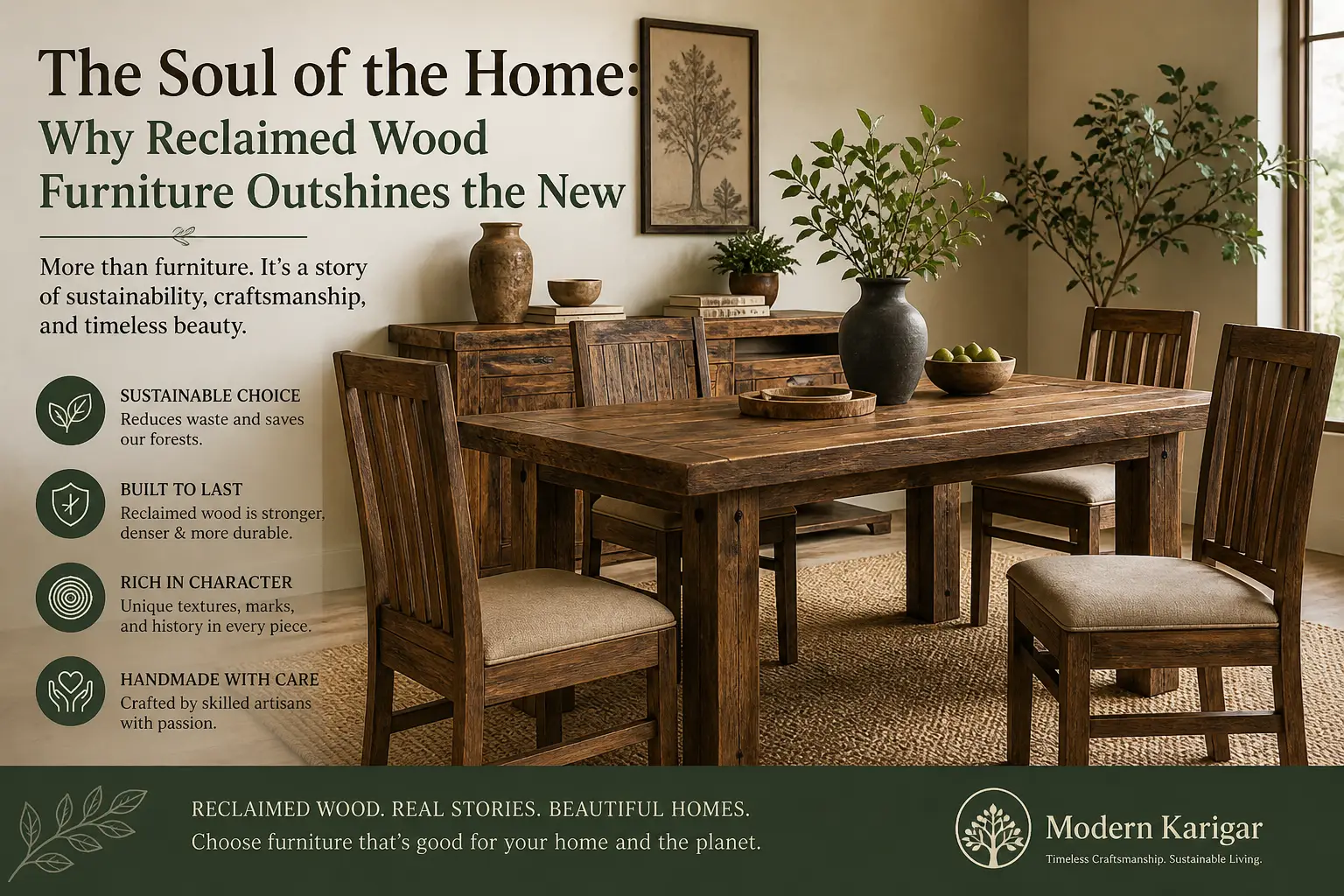
In the ever-evolving world of interior design, 2026 has ushered in a profound shift toward regenerative luxury. Homeowners are no longer satisfied with furniture that is merely “new”; they are seeking pieces with a pulse, a history, and a footprint that heals rather than harms. At the heart of this movement is reclaimed teak wood furniture.
But what exactly makes salvaged timber superior to freshly harvested wood? Is it just a matter of “rustic charm,” or is there a deeper, structural, and environmental science behind it? Let’s explore why choosing solid wood furniture from reclaimed sources is the ultimate investment for the modern karigar (artisan) and the conscious collector alike.
1. Unrivaled Structural Stability
One of the most significant advantages of reclaimed wood is its dimensional stability. When you buy “new” teak wood furniture, even if it is kiln-dried, the wood is often from younger trees (20–30 years old) harvested from plantations. This wood still possesses a certain level of internal tension and moisture.
In contrast, reclaimed teak wood furniture is sourced from old-growth timber that served as structural beams, flooring, or doors in colonial-era buildings or traditional Javanese joglos for 50 to 100 years.
- Natural Seasoning: Decades of exposure to the elements have naturally “shrunk” the wood to its limit. It has already done all the expanding and contracting it will ever do.
- Warp Resistance: Because the moisture content is virtually zero, reclaimed teak is incredibly resistant to warping, splitting, or cracking—even in humid or fluctuating climates.
2. The Density of History
New wood is often “fast-grown.” To keep up with global demand, plantation trees are fertilized to grow quickly, resulting in wider growth rings and softer wood. Reclaimed timber typically comes from “old-growth” forests where trees grew slowly over centuries.
- Tighter Grain: Slow growth creates a much tighter grain pattern. This density makes reclaimed teak wood furniture significantly harder and more durable than its modern counterparts.
- Natural Oils: Teak is famous for its high silica and oil content, which repels termites and water. In reclaimed pieces, these oils have permeated the fibers for decades. creating a natural armor that is far superior to any chemical treatment applied to new solid wood furniture.
3. A Guilt-Free Environmental Legacy
The term “eco-friendly furniture” is often used loosely, but reclaimed wood is the gold standard of the circular economy.
Reducing Deforestation
Every time you choose a reclaimed dining table, you are directly preventing the felling of a living tree. While sustainable furniture certifications like FSC (Forest Stewardship Council) help manage new harvests, “zero-cut” is always better than “managed-cut.”
Lower Carbon Footprint
The energy required to harvest, transport, and process new timber is immense. Research shows that using reclaimed wood can reduce carbon emissions by up to 78% compared to new wood production. By repurposing existing materials, we keep the carbon sequestered within the wood rather than releasing it into the atmosphere through decomposition or burning.
4. The Aesthetic of the “Modern Karigar”
In 2026, the trend of handmade wooden furniture has moved away from factory-perfect finishes toward “wabi-sabi”—the beauty of imperfection. This is where the modern karigar (craftsman) truly shines.
Feature | New Wood Furniture | Reclaimed Wood Furniture |
Texture | Uniform, smooth, often “flat.” | Deeply textured with a natural patina. |
History | Manufactured in a factory. | Carries stories of its previous life. |
Details | Mass-produced, identical. | Features nail holes, bolt marks, and unique scars. |
Character | Develops character over time. | Arrives with a century of character pre-installed. |
When a modern karigar works with reclaimed teak, they aren’t just building a chair; they are curating an artifact. The original nail holes, notches, and weather-worn grooves are preserved as “design features,” ensuring that no two pieces are ever identical.
5. The “Patina” Factor
There is a specific glow that only age can provide. New teak starts as a consistent golden-brown, which is beautiful but lacks depth. Reclaimed teak wood furniture possesses a “patina.” a rich, multi-tonal surface developed through decades of oxidation.
This patina is impossible to replicate in a laboratory or with wood stains. It gives the furniture a soulful, warm presence that anchors a room, making it feel lived-in and sophisticated rather than just “furnished.”
6. Low Maintenance, High Longevity
Because reclaimed wood is already “hardened” by time, it requires significantly less coddling.
- Resilience: It stands up better to the wear and tear of daily life, scratches from keys or dings from children’s toys often blend right into the existing rustic texture.
- Simple Care: While new solid wood furniture might need frequent oiling to prevent drying, reclaimed teak’s high oil density means a simple wipe-down or an occasional wax is all it needs to last for another century.
Pro Tip: If you prefer a more “modern” look, reclaimed wood can be sanded down to reveal the fresh grain underneath, providing the stability of old wood with the clean look of the new.
Summary: Why It’s Better
Choosing reclaimed teak wood furniture isn’t just a design choice; it’s a statement of values. It represents a preference for quality over quantity, history over novelty, and conservation over consumption.
Key Benefits at a Glance:
- Sustainability: Saves forests and reduces landfill waste.
- Durability: Denser grain and higher oil content than plantation wood.
- Stability: Minimal moisture means no warping or cracking.
- Uniqueness: Every piece is a one-of-a-kind work of art.
- Investment: Reclaimed pieces often appreciate in value as “antique-future” heirlooms.
Embracing the Future of Furniture
As we navigate 2026, the home has become our sanctuary. Filling that sanctuary with sustainable furniture that has already stood the test of time brings a sense of peace and permanence. Whether it’s a heavy dining table that once supported the roof of a heritage home or a sideboard crafted from old ship planks, reclaimed wood connects us to the past while protecting our future.
For those who value the touch of the modern karigar and the enduring strength of the Earth’s finest materials, the choice is clear. Reclaimed isn’t just “as good as” new, it is inherently, scientifically, and soulfully better.