
India has been carving, joining, and finishing wood long before “global supply chain” became a phrase anyone used at dinner parties. Walk through a workshop in Jodhpur or Saharanpur and you’ll hear chisels before you see anyone, the smell of mango wood and beeswax sitting heavy in the air. For homeowners, designers, and buyers abroad, this part of the world has quietly become one of the most interesting places to commission furniture that doesn’t look like everyone else’s.
But sourcing custom furniture from another continent can feel like a leap of faith. Who’s actually making it? How do you know the joinery will survive a dry winter in Berlin or a humid summer in Houston? This guide walks through how export furniture gets built in India, what separates a good maker from a risky one, and how to buy with your eyes open.
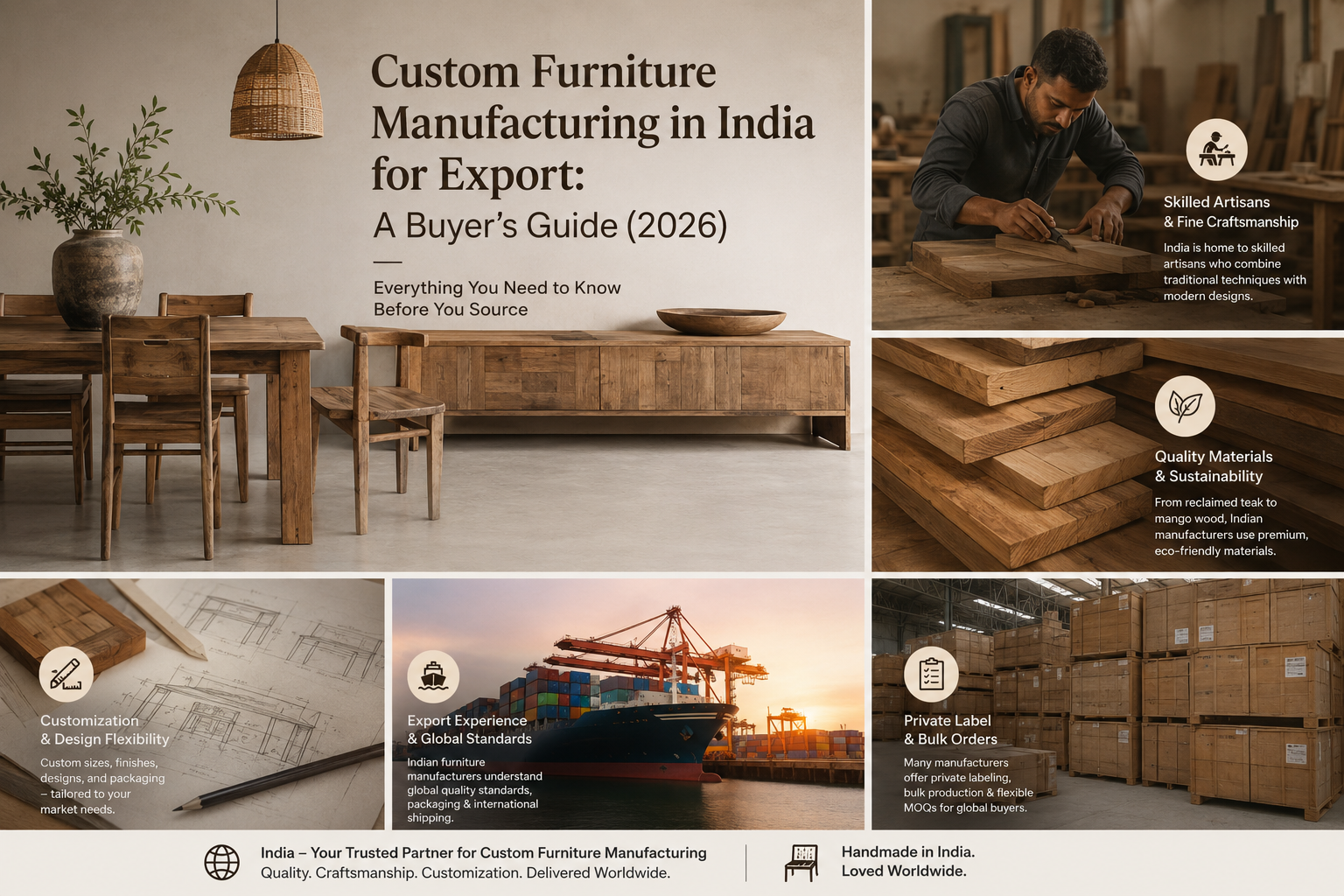
Table of Contents
- Why India became a furniture export hub
- What “custom” really means in manufacturing
- Choosing the right wood (and why it matters more than the finish)
- From workshop to your home: the real journey
- Handmade reclaimed wood furniture, explained
- Practical tips for buyers and designers
- FAQ
- Final thoughts
Why India Became a Furniture Export Hub
A few things lined up. There’s a deep, generational craft tradition, so the skills were already there. Raw and reclaimed timber is reasonably available. And labor-intensive work like hand-carving or dovetailing, which would price a piece out of reach in many Western countries, remains viable here.
That said, “made in India” covers a huge range. You’ll find slick factory output churning thousands of identical units, and you’ll find tiny family workshops where one artisan sees a piece from rough plank to final wax. Both export. Knowing which end of that spectrum you’re buying from tells you almost everything about what will arrive at your door.
The small-workshop advantage
Smaller makers tend to win on character and flexibility. Want a sideboard six inches longer to fit an awkward alcove? A workshop can usually say yes without blinking. A large factory often can’t, because their whole model depends on repetition.
What “Custom” Really Means
Here’s where buyers get burned. “Custom” gets used loosely. Sometimes it means genuine made-to-order: your dimensions, your wood, and your finish. Other times it just means you picked a color from three options.
Before you commit, get specific. Ask whether you can change dimensions, hardware, finish, and wood type. Ask for a CAD drawing or even a rough hand sketch with measurements. A maker who’s done real custom work won’t hesitate to send one.
Choosing the Right Wood
Finish gets all the attention in photos. Wood is what decides whether you still love the piece in fifteen years.
Solid hardwoods like sheesham (Indian rosewood), mango, and acacia are workhorses for export furniture because they’re dense, take a finish beautifully, and age with grace. Engineered boards and veneers have their place, but they don’t develop that lived-in patina, and they handle climate swings poorly.
Watch the moisture content
This is the unglamorous detail that prevents heartbreak. Wood that hasn’t been properly seasoned or kiln-dried will move, crack, or warp once it lands in a drier climate than where it was made. Reputable exporters dry timber to roughly 8–12% moisture content. It’s a fair question to ask outright, and the answer tells you a lot.
From Workshop to Your Home: The Real Journey
It’s easy to picture a piece appearing on your doorstep. The actual path is longer and more interesting.
It usually starts with planks resting in a yard, sometimes for months, drying naturally. An artisan then cuts, planes, and joins by hand or with simple machines, fitting drawers and testing how a door swings before anything gets finished. Sanding happens in stages, each grit finer than the last, until the surface feels like skin. Then comes oil, wax, or lacquer, often several coats with drying time between each.
Once it passes a final check, the piece is wrapped, crated, and loaded into a container. Sea freight takes weeks. Customs clearance adds days. By the time a hand-finished cabinet sits in your living room, dozens of people have touched it across thousands of miles. That’s worth remembering when a quote feels higher than a flat-pack alternative. You’re not just paying for wood; you’re paying for time, skill, and a long, careful trip.
Handmade Reclaimed Wood Furniture, Explained
A growing slice of Indian export furniture is built from reclaimed wood, and it’s some of the most characterful you can buy. Reclaimed timber is salvaged from old houses, dismantled boats, railway sleepers, and retired factory beams, then cleaned, de-nailed, and rebuilt into something new.
The appeal isn’t only environmental, though keeping old wood out of a bonfire is a genuine plus. It’s that this timber already carries a story. You get nail holes, faded paint, saw marks, and tones that no factory stain can fake. A reclaimed dining table might hold grain that’s a century old, with each board slightly different from its neighbor.
Handmade reclaimed pieces ask a little patience of the buyer because no two are identical and small variations are the point, not a flaw. If you want flawless uniformity, this isn’t your category. If you want a piece with depth and a past, it’s hard to beat.
Practical Tips for Buyers and Designers
A few things that save money and regret:
- Ask for real photos, not just renders. Process shots and pictures of finished pieces under normal light reveal far more than a stylized catalogue image.
- Confirm wood species in writing. “Hardwood” is vague. Get the name.
- Clarify who handles shipping and duties. Terms like FOB versus CIF change who pays for what, and surprises here are expensive.
- Request a finish sample if you’re matching existing furniture.
- Plan your timeline generously. Custom plus sea freight often means eight to twelve weeks. Don’t order a console two weeks before a dinner party.
For designers specifying pieces for clients, a single trusted workshop you can return to is worth more than chasing the lowest quote each time. Consistency and communication beat a small discount.
FAQ
Is custom furniture from India good quality?
It can be excellent, but quality varies widely by maker. Solid wood, proper drying, and hand joinery are the markers to look for.
How long does a custom order take?
Typically eight to twelve weeks for made-to-order pieces, including production and sea shipping. Reclaimed wood items can take a little longer.
Will solid wood furniture crack in a different climate?
Properly seasoned wood (around 8–12% moisture content) handles climate change well. Always ask how the timber was dried.
Is reclaimed wood furniture durable?
Yes. Reclaimed hardwood is often older, denser, and more stable than freshly cut timber, which is part of why it’s prized.
Can I order a single piece or only bulk?
Many workshops accept single custom orders, though minimums and shipping costs per unit are higher for small quantities.
Final Thoughts
Buying furniture made on the other side of the world will always involve a bit of trust. But when you understand how it’s built, what questions to ask, and why a hand-finished, solid-wood piece costs what it does, that leap gets a lot smaller. The reward is furniture with genuine craft behind it, the kind that gets passed down rather than replaced.
If you’re drawn to pieces with real history in the grain, it’s worth looking through a few handmade reclaimed wood collections to see how much character salvaged timber can carry. Take your time, ask plenty of questions, and let the wood tell you what it wants to be.