
Ordering custom furniture feels straightforward until you’re actually in the middle of it, picking a finish you’ve never seen in person, guessing at dimensions for a space that doesn’t quite match anything standard, and waiting longer than you expected without knowing if that’s normal. None of that means something’s gone wrong. It usually just means nobody explained what the process actually looks like before you started.
Custom furniture isn’t the same transaction as buying something off a shelf, and treating it that way is where most of the friction comes from. This guide covers what actually changes when you go custom, timeline, and communication, and what you can and can’t control, so you go into the process knowing what to expect instead of finding out as you go.
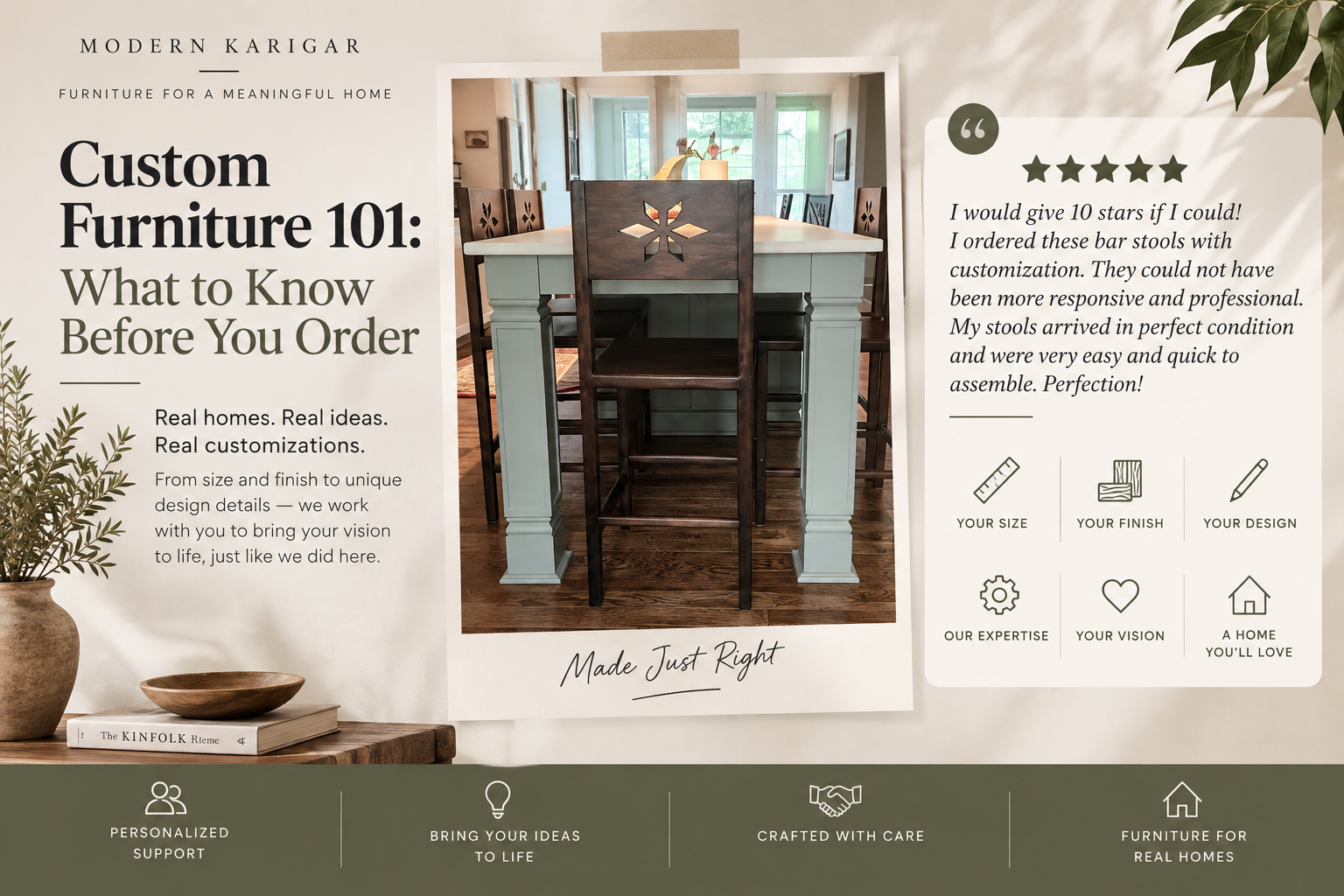
Table of Contents
- What “Custom” Actually Means (It’s Not One Thing)
- Timeline: Why Custom Takes Longer, and How Much Longer
- What to Communicate Before You Order
- Wood, Finish, and Why Photos Aren’t Always Accurate
- Sizing: The Detail Most People Get Wrong
- What You Can’t Fully Control
- From Workshop to Home: How a Custom Order Actually Moves
- A Note on Reclaimed Wood and Custom Work
- FAQ
- Conclusion
What “Custom” Actually Means (It’s Not One Thing)
“Custom furniture” covers a wide range of actual changes, and it helps to know which category you’re in before you order. The lightest version is a size adjustment on an existing design, the same table, just longer or narrower to fit your room. The next level up is a finish or color change, swapping the stain or paint on a piece that’s otherwise unchanged. The most involved version is a fully custom design, built from your own specifications rather than an existing listing.
Each of these has a different impact on timeline and cost. A size adjustment is usually the fastest to accommodate, since the underlying design and joinery don’t need to change. A full custom build takes the longest, because it often starts with a conversation about feasibility before any wood gets cut.
Timeline: Why Custom Takes Longer, and How Much Longer
Standard, ready-made pieces are typically already built or built from a repeatable process, so turnaround is mostly shipping time. Custom pieces start from a later point in that process, sometimes from scratch, which adds real production time before shipping even begins.
As a general range, a size or finish adjustment might add one to two weeks over a standard order, while a fully custom design can add four to eight weeks or more, depending on complexity and how much back-and-forth is needed to finalize the details. Always ask for a specific estimate rather than assuming standard shipping times apply, and build in buffer time if the piece is meant for a deadline like a move-in date or an event.
What to Communicate Before You Order
Exact Measurements, Not Approximate Ones
“About six feet” is not the same as 71.5 inches when you’re placing a custom order. Measure twice, note the exact number, and account for doorways, stairwells, and hallways the piece needs to travel through to reach its final spot, not just the space it’ll sit in.
Photos of the Room, Not Just Numbers
A photo of the space, even a quick phone photo, gives a maker context that a list of dimensions doesn’t. It shows the lighting, the surrounding furniture, and the existing wood tones you’re trying to match or contrast with.
Your Actual Priority
Are you optimizing for an exact color match, a specific size, or a particular wood character? Most makers can accommodate one or two priorities well; trying to lock down every variable at once often extends the back-and-forth without much benefit.
Wood, Finish, and Why Photos Aren’t Always Accurate
Screen colors vary by device, and finish samples photographed under studio lighting can look different from how they’ll read in your home’s natural or artificial light. If a specific color match matters to you, ask for a physical swatch or a close-up photo taken in daylight rather than relying on a listing photo alone.
This matters more with reclaimed and natural wood than with painted furniture, since grain patterns and tone can vary noticeably from board to board. A finish name like “walnut” or “espresso” describes a general direction, not an exact, repeatable color the way a paint chip does.
Sizing: The Detail Most People Get Wrong
Beyond basic dimensions, people often forget to check clearance for actual use, not just fit. A custom dining table sized perfectly for the room might not leave enough space to pull chairs out. A custom console might fit the wall but block a door swing you didn’t think to measure. Before finalizing a custom size, walk through how the piece will actually be used day to day, not just whether it physically fits the footprint.
What You Can’t Fully Control
Even with clear communication, some things about a custom order are inherently variable, especially with natural materials. Wood grain and color will have some variation from the reference photo, since no two boards are identical. Handmade joinery means slight differences in symmetry compared to a machine-cut piece, though this is generally part of the appeal rather than a flaw. Shipping timelines can shift due to international logistics, particularly for pieces built and shipped from overseas workshops.
Knowing which parts of the process are flexible and which aren’t helps set realistic expectations going in, rather than being surprised by normal variation after the piece arrives.
From Workshop to Home: How a Custom Order Actually Moves
A custom piece usually starts with a conversation, not a saw. The maker reviews the requested size, finish, or design change, checks it against what the material and construction method can realistically support, and confirms details before any wood is touched. From there, timber gets selected and sorted, often reclaimed wood chosen specifically for the stability and grain the piece calls for.
Construction happens board by board rather than through a repeatable automated process, which is why custom timelines run longer than standard ones. Once built, the piece is finished by hand, packaged carefully for what’s often a long shipping distance, and sent out. The entire arc, from first conversation to delivery, is longer than buying off a shelf, but it’s also the only way to get a piece built specifically for your space rather than close enough.
A Note on Reclaimed Wood and Custom Work
Reclaimed wood adds a layer of nuance to custom orders that new lumber doesn’t have. Because each board carries its own history, prior use, natural aging, and slightly different grain and color, a custom finish request on reclaimed wood is always going to have some natural variation built in, even with a clear reference photo. That’s generally the point of choosing reclaimed material in the first place, but it’s worth setting that expectation clearly before ordering, especially if you’re trying to match an existing piece of furniture exactly. If you’re exploring what’s possible, it’s worth reaching out to a shop like Modern Karigar directly to talk through what a custom reclaimed wood piece could look like for your space.
FAQ
How much longer does a custom order take compared to a standard one?
It depends on the type of customization. A simple size or finish adjustment might add one to two weeks, while a fully custom design can take four to eight weeks or more.
Can I get an exact color match with a custom order?
Close, but not always exact, especially with natural or reclaimed wood, since grain and tone vary board to board. Ask for a physical swatch or daylight photo rather than relying on a screen image.
What should I measure before requesting a custom size?
Beyond the space the piece will occupy, measure doorways, stairwells, and hallways it needs to pass through, plus clearance needed for actual use, like pulling out chairs or opening a door nearby.
Is custom furniture more expensive than standard pieces?
Usually, yes, since it requires more individual attention during production. The exact difference depends on how extensive the customization is.
Can I request a completely original design, not based on an existing listing?
Many makers can accommodate this, though it typically takes the longest timeline and the most upfront conversation to confirm feasibility before production starts.
Conclusion
Custom furniture rewards patience and clear communication more than almost any other kind of purchase. Know what type of customization you actually need, measure carefully, expect some natural variation with reclaimed materials, and build in realistic time for the process. Get those basics right, and a custom order becomes a piece built specifically for your space, not just something that happened to fit. If you’re considering a custom piece of your own, it’s worth starting that conversation early rather than close to a deadline.