
Ask five people what their entryway is missing, and you’ll get five different answers. Some need somewhere to sit while pulling off boots. Some need a place to drop keys and mail so it stops piling up on the kitchen counter instead. Some just need the wall to stop looking bare every time they walk in the front door.
That’s the part most entryway advice skips over: there isn’t one universal answer, because there isn’t one universal entryway. The right anchor piece depends on your specific space and how you actually use it, not a one-size-fits-all recommendation. This guide walks through how to figure out which single piece will actually solve your entryway’s problem, rather than assuming it’s the same for everyone.
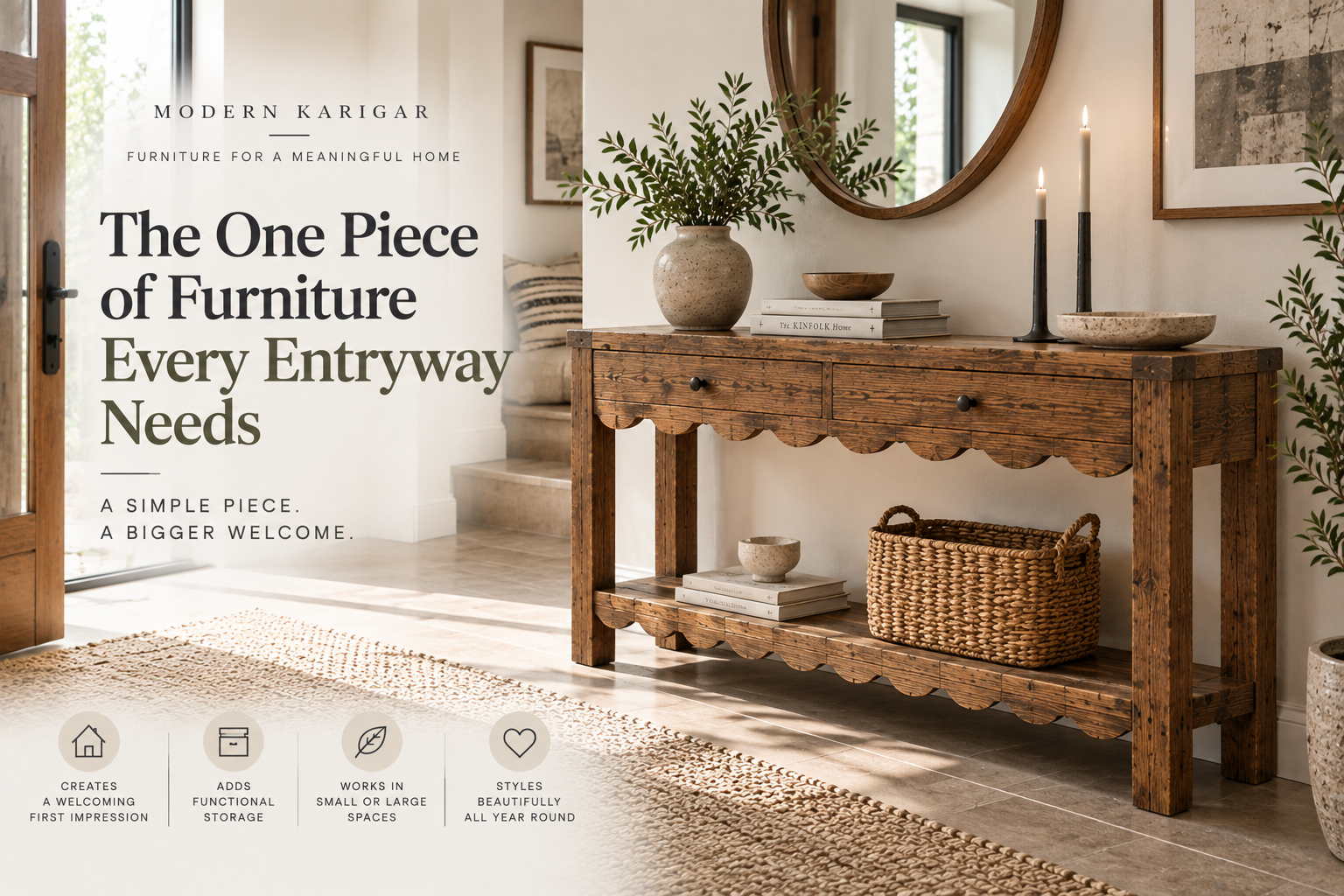
Table of Contents
- Why “One Piece” Advice Usually Falls Short
- Console Table: When It’s the Right Answer
- Bench: When It’s the Right Answer
- Wall-Mounted Storage: When Floor Space Is the Real Problem
- How to Decide Which Piece Your Entryway Actually Needs
- Sizing the Piece to the Space
- From Workshop to Entryway: How These Pieces Get Built
- A Note on Reclaimed Wood as the Anchor Piece
- FAQ
- Conclusion
Why “One Piece” Advice Usually Falls Short
Most articles about entryway furniture default to one recommendation, almost always a bench, and treat it as the universal fix. Benches are genuinely useful, but they solve a specific problem: needing somewhere to sit while dealing with shoes. If that’s not your actual bottleneck, a bench just becomes another piece of furniture taking up floor space without addressing what’s actually going wrong in the room.
The better starting point is identifying your entryway’s real problem first, then matching the piece to that problem, rather than assuming the piece comes first and the function follows.
Console Table: When It’s the Right Answer
A console table is the right anchor when your entryway’s main issue is a lack of a surface, nowhere to set down mail, keys, or a bag for a moment before continuing into the house. It also works well as a visual anchor in entryways that don’t have a natural focal point; otherwise, a console with something styled on top, a lamp, or a small tray gives the eye somewhere to land.
Console tables generally work best in entryways with at least a few feet of unobstructed wall length and no immediate need for seating. They’re also the better option in formal or narrower entryways, where a console’s shallow depth takes up less floor space than a bench typically would.
Bench: When It’s the Right Answer
A bench is the right anchor when seating is the actual missing piece, households with kids who need somewhere to sit while putting on shoes, anyone who regularly changes footwear at the door, or entryways that double as a transition space between outdoor activity and the rest of the house. Benches with built-in storage solve a second problem at the same time, giving shoes and bags a defined spot instead of letting them collect on the floor.
Benches make less sense in entryways where seating isn’t actually needed daily, since the extra floor space they require doesn’t pay off if nobody’s sitting on it.
Wall-Mounted Storage: When Floor Space Is the Real Problem
In genuinely tight entryways, hallways barely wide enough to walk through, and apartment entries with almost no floor space, the right answer might not be a floor piece at all. A wall-mounted cabinet with hooks underneath solves the same core problems: a place to drop keys and somewhere for bags and coats, without requiring any floor footprint.
This is often the overlooked option in entryway advice, since it’s less visually dramatic than a console or bench, but for a genuinely small space, it’s frequently the more practical choice.
How to Decide Which Piece Your Entryway Actually Needs
Ask yourself what actually goes wrong in your entryway right now. If shoes and bags end up scattered on the floor, you likely need storage, a bench with built-in cubbies, or a console with a drawer. If there’s nowhere to set things down for even a moment, a console solves that directly. If the space is too narrow for either, wall-mounted storage is probably the answer, regardless of what most entryway articles default to recommending.
It’s also worth considering how the entryway connects to the rest of your home. An entryway that opens directly into a living room benefits more from a console that doubles as a visual anchor, while one that leads to a mudroom or garage benefits more from bench seating built for daily footwear changes.
Sizing the Piece to the Space
Whichever piece fits your actual need, measure the wall length first and leave at least a foot of clearance on either side if the space allows it. For benches, check seat height; typically 18 to 20 inches works comfortably for most adults, and make sure there’s enough room in front of the bench for someone to sit and lean forward without hitting a wall or door.
For consoles, depth matters more than width in tight spaces. A console under 12 inches deep preserves walking clearance in narrower hallways, while wider entryways can accommodate a deeper, more substantial piece without crowding the space.
From Workshop to Entryway: How These Pieces Get Built
Whether the right piece for your space ends up being a console, a bench, or something else entirely, the construction process behind a solid wood version is largely the same. Reclaimed timber gets sorted by hand for grain and stability before any shaping begins. Builders account for the specific demands each piece type faces, a console’s need to stay sturdy under daily use as a catch-all surface, a bench’s need to support repeated weight-bearing seating, and construct accordingly.
That individual attention is part of why handmade entryway furniture, regardless of which type you choose, tends to hold up to daily wear better than a mass-produced equivalent built from thinner, less considered materials.
A Note on Reclaimed Wood as the Anchor Piece
Whatever type of piece your entryway actually needs, reclaimed wood brings a genuine advantage as the anchor: it’s dense and well-seasoned from years of natural aging, which matters in a high-traffic space that takes more daily impact than almost any other room. It also carries visible grain and character, which does real visual work in a space that’s often otherwise plain. If you’ve identified which type of piece your entryway needs, it’s worth browsing a shop like Modern Karigar for reclaimed wood options in that category.
FAQ
Is a bench always the best choice for an entryway?
No. A bench is the right choice specifically when seating is the missing function. If your entryway’s real problem is a lack of surface space or floor space constraints, a console table or wall-mounted storage may work better.
What if my entryway is too small for a console or bench?
Wall-mounted shelving with hooks underneath solves many of the same problems, a place to drop keys and bags, without requiring floor space, and works well in tight hallways or apartment entries.
How do I know if I need storage built into the piece?
If shoes, bags, or mail regularly end up scattered on the floor or a nearby surface, look for a piece with built-in drawers, cubbies, or shelving rather than a purely decorative option.
What’s the ideal bench height for an entryway?
Typically 18 to 20 inches for comfortable seating for most adults, with enough clearance in front to sit and lean forward without hitting a wall.
Does the anchor piece need to match the rest of my home’s furniture?
Not exactly, but a similar wood tone or finish helps the entryway feel connected to the rest of the house rather than styled as a separate space.
Conclusion
The one piece your entryway needs isn’t a fixed answer; it’s whichever piece actually solves what’s currently going wrong in that specific space. Identify the real problem first, whether it’s seating, surface space, or storage, and let that decide between a console, a bench, or wall-mounted storage. If you’re still working out which one fits your entryway, it’s worth measuring the space and being honest about how the room actually gets used before choosing.