
There’s something about walking into a room where solid wood furniture sits. It doesn’t announce itself. It doesn’t need to. A sturdy bookshelf, a well-made wooden table, and a sturdy bed frame all feel good. They ground an area. They tell you someone cared about what goes into a home.
The problem is figuring out which pieces matter most. You could fill a house with furniture, but certain core pieces do the heavy lifting. They’re the ones you actually live with day to day. They’re the ones that should last more than a few years. And they’re the ones that frame everything else you choose.
This guide walks through the wooden furniture pieces that earn their place in a home not because they’re trendy, but because they actually work. We’ll talk about what makes them essential, what to look for, and why solid wood, especially reclaimed options, creates spaces with character that only get better with time.
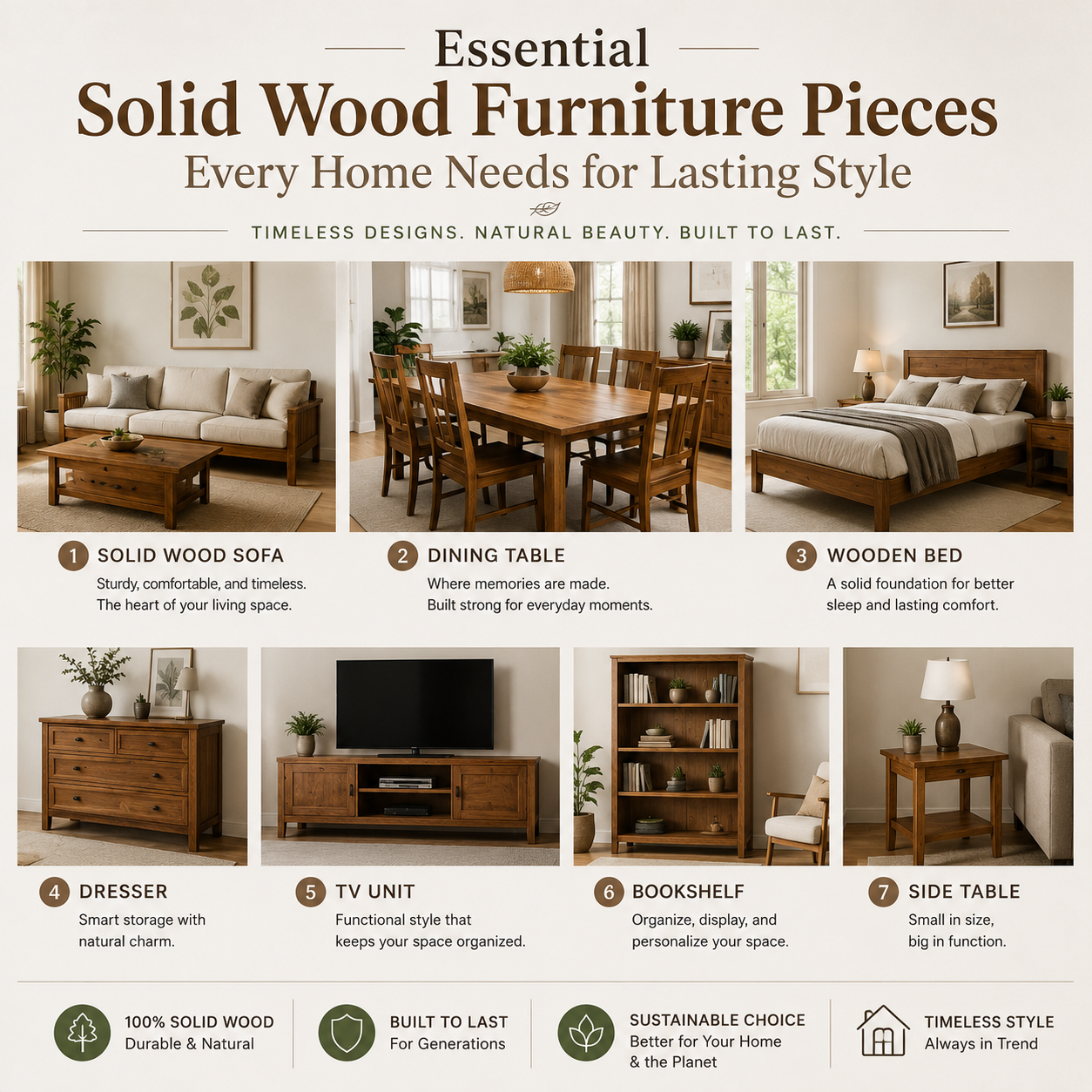
Table of Contents
- The Dining Table: Where Gatherings Begin
- The Bookshelf: Storage That Makes a Statement
- The Coffee Table: The Living Room’s Anchor
- The Console Table: Function Meets Entry Style
- The Nightstand: Small Space, Big Purpose
- The Wooden Bench: Seating Without Fuss
- From Workshop to Home: How Handmade Wood Furniture Gets Made
- Why Reclaimed Wood Matters
- FAQ:
- Final Thoughts
1. The Dining Table: Where Gatherings Begin
A dining table is the first piece most people think about when they consider wooden furniture, and for good reason. It’s more than just functional; it’s the place where memories are made.
The best dining tables are solid all the way through. Not veneered particleboard held together with screws that loosen after two years. Real wood tables carry weight. They don’t flex. They don’t look cheap because they aren’t.
What to look for:
Solid wood construction from a single wood species (teak, sheesham, walnut, oak)
- Wood thickness of at least 2 inches for the top
- Joinery that’s visible: mortise and tenon joints are a sign of quality
- Finish that can be easily refreshed or repaired
- Size that fits your space but doesn’t feel cramped
A 48″ × 30″ table comfortably seats 4–6 people. When space is available, make it broader.
Dining tables earn their keep over decades, especially when they’re made to last. The best ones are passed down.
Where it fits: Center of the dining room or kitchen nook. If space is tight, a narrower 24″–26″ deep table still seats people comfortably on long sides.
2. The Bookshelf: Storage That Makes a Statement
Bookshelves do two things at once. They organize what you own and they telegraph who you are. A good wooden bookshelf becomes the room.
Unlike many furniture pieces, shelving reveals its construction. The wood grain, the joints, the finish, all of it shows. This is why solid wood bookshelves look more expensive than they cost. They’re built to be seen.
What matters:
- Wood species that matches your aesthetic—lighter woods (ash, maple) feel contemporary; darker woods (walnut, teak) read traditional or warm
- Adjustable shelves vs. fixed—fixed shelves are more structurally sound; adjustable gives flexibility
- Shelf depth between 10″–12″ for most books and decor
- Back panel solid backs prevent wall visibility and add structural support
- Quality of wood matters here more than other pieces because you see every surface
Shelves are one of the few pieces where imperfections in the wood become features. Grain variations, natural color shifts, and the texture of solid wood create visual interest that uniform manufactured pieces never can.
Placement: Living rooms, home offices, bedrooms, and entryways. Corner shelves make smart use of awkward spaces.
3. The Coffee Table: The Living Room’s Anchor
A coffee table is often overlooked as a design choice, but it’s your living room’s anchor. It defines the seating arrangement. It sets the tone.
A solid wood coffee table can be the simplest piece in the room or the most striking. Unlike sofas or chairs, you’re not dealing with upholstery preferences. It’s just wood and design.
Key considerations:
- Proportions matter: a table that’s too tall (over 18″) disrupts sightlines; too short (under 14″) feels insubstantial
- The overhang: on legs should be at least 3 inches on each side to avoid kicking it
- Durability: is critical here; coffee tables take the most daily wear
- The finish: should be resistant to water rings and heat marks
Reclaimed wood coffee tables often show their history—visible knots, color variation, and marks from their previous life. Some people see flaws; it’s better to see character.
Sizing rule: Width should be about two-thirds the length of your sofa.
4. The Console Table: Function Meets Entry Style
A console table anchors your entryway, hallway, or behind a sofa. It’s functional without taking up much space.
Consoles are narrower (usually 12″–14″ deep) but still sturdy. They hold keys, mail, lamps, plants, and decor. In hallways, they can be gallery walls for family photos. Behind a sofa, they become display surfaces.
What to prioritize:
- Depth – not too deep to be intrusive
- Height – around 30”–36” depending on use (lower if you’re putting things on top often; higher for a statement piece)
- Shelf storage – underneath for baskets and hidden items
- Stability – it should feel solid when you put your hand on it
Consoles work in almost any room. They’re one of those transition pieces that makes a space feel intentional rather than just furnished.
5. The Nightstand: Small Space, Big Purpose
Nightstands might be the most-used furniture piece in your home. Think about it: you touch one multiple times a day, every day, for years.
This is where solid wood construction pays off most visibly. Cheap nightstands develop wobbles and drawer problems. Good wooden nightstands get firmer with age.
Essential specs:
- Height: level with your mattress (usually 24″–28″)
- Drawer quality: with smooth glides and solid bottoms
- Depth: shallow enough (12″–14″) that you’re not stretching
- Top surface: that can handle moisture and heat from lamps and drinks
One nightstand per person. Even if your bedroom is small, two smaller tables beat one large shared piece.
6. The Wooden Bench: Seating Without Fuss
Benches are the wildcard furniture piece. They work at dining tables, footboards, entryways, and even bedsides.
A simple wooden bench, built solid, is harder to tire of than almost any other seating piece. No upholstery to wear out. No foam padding to compress. Just wood that sits and waits.
Why they work:
- Versatile: move them between rooms easily
- Low maintenance: wipe clean and done
- Longevity: outlast cushioned seating by years
- Character: A well-finished wooden bench becomes more beautiful as it ages
Dimensions vary widely, but “36”–48″ long works for most spaces.
7. From Workshop to Home: How Handmade Wood Furniture Gets Made
Walking through a furniture workshop shows you why handmade matters.
A craftsperson starts by sourcing wood. For reclaimed pieces, this might mean salvaging boards from old structures—barns, factories, and homes. The wood has already lived a life. It has character baked in. A maker cleans it, checks it for stability, and measures grain and color.
Then comes the cutting, where each piece is carefully shaped to the right size and thickness. Master craftspeople anticipate how wood will shift with seasonal humidity, designing joints meant to endure for decades, not just survive delivery to your door.
Next is the assembly: mortise and tenon joints, dowels, and meticulous fitting that can take hours for a single table. This process isn’t rushed, and it shouldn’t be.
Next is assembly. Mortise and tenon joints. Dowels. Thorough assembly that could take several hours for just one table. This isn’t fast. It’s not supposed to be.
Then finishing. Sanding through multiple grits. Stains that bring out wood color. Oil or wax that lets you see the grain and feel the texture. The finish is the last conversation between maker and material.
What you get is a piece that feels different from anything made in a factory. It fits better. It sits better. It feels thought-through.
8. Why Reclaimed Wood Furniture Matters
Reclaimed wood starts with an advantage: history.
When you use wood that’s already been worked and aged barn beams, factory flooring, or salvaged pieces, you’re not starting with raw material. You’re starting with wood that’s been through weather, temperature swings, and use. That makes it more stable. The wood has already moved. It’s done most of its shifting.
But stability isn’t the main reason reclaimed matters.
Reclaimed wood creates something you can’t manufacture: authenticity. The color variations, the marks, the patina—these aren’t flaws to hide. They’re evidence. Clues to the wood’s roots. Evidence of time.
A reclaimed wood table doesn’t look like it was designed to look old. It looks old because it is. That difference is felt the moment you sit down to it.
From an environmental angle, using wood that’s already milled and seasoned means fewer new trees are processed. Less energy is spent. The carbon footprint is lower. But honestly, the real reason to choose reclaimed is simpler: it’s more beautiful, more durable, and more interesting than new wood.
9. FAQ:
Q: How much does quality wooden furniture cost?
A: Entry-level solid wood pieces (smaller tables, single chairs, shelving) start around $300–$500. Larger pieces (dining tables, bedroom sets) run $800–$3,000+ depending on wood type, size, and maker. Reclaimed wood often costs less than exotic hardwoods because sourcing is less regulated. The investment returns itself over 20–30 years of use.
Q: Does solid wood furniture need special care?
A: Not really. Simply wipe it clean with a damp cloth. Use coasters for drinks. Avoid prolonged heat and direct sunlight, as they can fade the wood. Annual oiling or waxing refreshes the finish and nourishes the wood. That’s it.
Q: What’s the difference between solid wood and veneer?
A: Solid wood is, well, solid throughout. Veneer is a fine layer of authentic wood glued over plywood or particleboard. The veneer looks good as new but can’t be repaired. Solid wood can be sanded, stained, and refinished. Solid wood lasts 20–50 years with care; veneered pieces often fall apart in 5–10.
Q: Can I refinish wooden furniture myself?
A: Simple projects like sanding and restaining are doable for beginners. Deeper repairs (structural issues, severe damage) require a professional. Most solid wood can be brought back to life. That’s part of why it’s worth the initial investment.
Q: What’s the most durable wood for furniture?
A: Teak, walnut, oak, and sheesham are among the hardest and most durable. Compared to softer woods (like pine and cedar), they are more durable and resistant to dents. Reclaimed wood from old structures has often already proven its durability over decades.
Q: Should I buy used or new wooden furniture?
A: Both have merit. New pieces give you the maker’s vision and a warranty. Used or vintage pieces are often better quality (older furniture was built to last) and cost less. Antique and reclaimed pieces carry history. Choose what fits the mood you want for your space.
10. Final Thoughts
A home isn’t furnished by filling rooms. It’s built by choosing pieces that matter—pieces made well enough to actually live with, not just look at.https://modernkarigar.etsy.com
Solid wood furniture does this. A good dining table, a sturdy bookshelf, a simple bench, a console table—these pieces work with you. They blend in without vanishing, quietly making their presence known
The best part? They improve with time. A wooden table that’s been lived with for 20 years has developed a patina. Marks from use become part of its story. It looks better at year twenty than it did at year one.
If you’re ready to invest in pieces that last, start with one. A dining table. A bookshelf. A coffee table. Look for solid wood. Consider reclaimed options if you want material with history built in. Find a maker who understands that furniture is more than decoration, it’s where life happens.
The pieces you choose now might be in your home for decades. They might outlive you and go to someone you care about. That’s the promise of solid wood made well.
Where to Find Well-Made Wooden Furniture
When shopping for solid wood pieces, look for makers who source thoughtfully, build with traditional joinery, and stand behind their work. Handmade furniture crafted from reclaimed teak and sheesham brings together durability, character, and sustainability in pieces designed to become heirlooms.
Browse handmade wooden furniture at Modern Karigar