
Table of Contents
- The Word “Handmade” Gets Used a Lot
- It Starts With Choosing the Right Wood
- What Reclaimed Teak Looks Like Before It Becomes a Table
- The Build: Joints, Drawers, and Decisions That Matter
- Surface Finishing: The Step Nobody Talks About
- The Journey From Workshop to Your Kitchen
- Reclaimed Wood Furniture That Lives in Real Homes
- How to Style a Handmade Island Table in a Modern Kitchen
- FAQ
- Final Thoughts
Introduction
There’s a moment when you first touch a well-made piece of solid wood furniture—one that’s been cut, joined, and finished by someone who actually knows what they’re doing—where something shifts. It doesn’t feel like the furniture you’re used to. It feels heavier, more grounded, more permanent. Like it arrived with intentions.
Most kitchen furniture doesn’t feel that way. It looks fine in product photos. It ships fast. But there’s something a little hollow about it, and if you’ve ever tried to describe that to someone, it’s hard to explain precisely—until you handle the alternative.
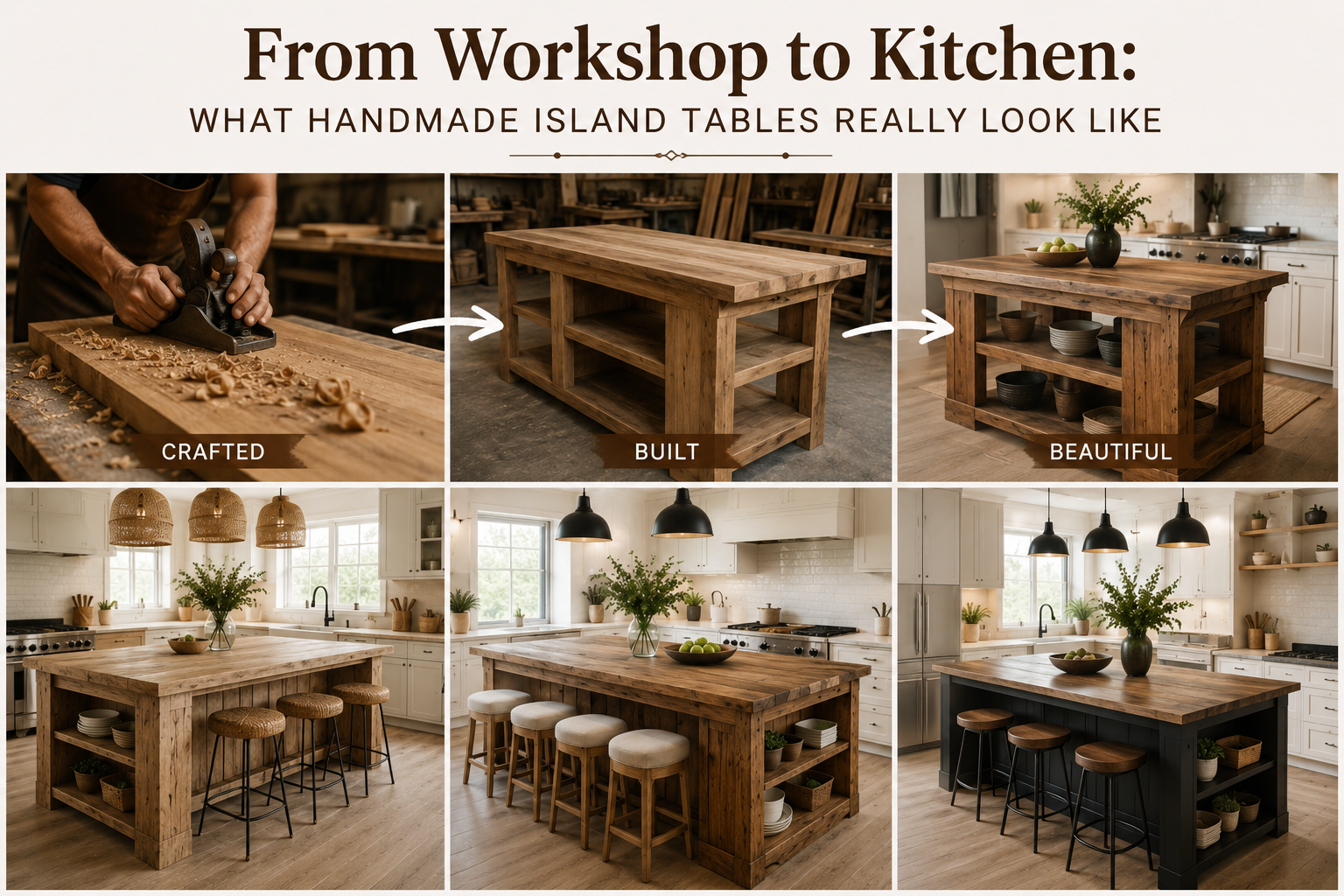
This post is about that alternative: what a handmade reclaimed wood kitchen island table is actually made of, how it’s built, and what happens between the moment a craftsman picks up a piece of salvaged timber and the day your new island lands in your home. No glossy marketing. Just the real process.
The Word “Handmade” Gets Used a Lot
Before anything else, it’s worth being direct about this: “handmade” has been stretched thin by the furniture industry.
A factory worker attaching legs to a pre-cut MDF panel is technically using their hands. So is someone ironing veneer onto a particleboard slab? Neither of those is what we’re talking about here.
Real handmade furniture requires skilled human judgment at every stage—not just the final assembly, but the timber selection, the joinery decisions, the surface treatment, and the finishing. These aren’t steps you can fully automate, because each piece of wood is different. Each one has its own grain direction, its own moisture behavior, and its own quirks that an experienced eye learns to read and work with.
That knowledge — accumulated through years of making, messing up, and getting better — is what you’re actually buying when a piece is genuinely handmade. Not just labor. Judgment.
It Starts With Choosing the Right Wood
Good furniture doesn’t start with a design. It starts with the material.
Reclaimed teak arrives in a workshop not as neat, uniform boards but as salvaged timber—old beams pulled from demolished buildings, structural members from century-old warehouses, and timber reclaimed from boats and bridges. Each piece has its own history, and that history shows up in the wood in ways that matter both aesthetically and structurally.
Before a single cut is made, the timber gets assessed. Is this board structurally sound? Where are the old bolt holes and nail pockets? What’s the grain doing—straight runs that work well for a wide tabletop or wild figure that’s better suited to a feature panel? What’s the moisture content, and is the wood stable enough to work with right now, or does it need more time to acclimatize?
This step gets skipped in cheap production. The result is furniture that warps, splits, or develops cracks a few months after delivery. A maker who rushes a timber assessment is essentially building on a shaky foundation—and it will show up, just later than you’d expect.
What Reclaimed Teak Looks Like Before It Becomes a Table
Raw reclaimed teak is not attractive. It’s grey, weathered, often dirty, and marked with the evidence of its previous life—saw marks from the original mill, staining from decades of exposure, and the ghost outlines of old hardware.
Strip back the surface, and what you find is a different story.
Old-growth teak—timber from trees that were felled a hundred or more years ago—is denser than almost anything you can buy new today. Those trees grew slowly. The growth rings are tight. That density translates directly into dimensional stability (meaning the wood moves less with humidity changes), natural resistance to moisture, and a hardness that makes it excellent for surfaces that see daily use.
The color once worked is something else entirely: warm honey-amber with deeper streaks where minerals concentrated in the grain over decades. Complex, varied, impossible to replicate with new timber. Every board is different. Every tabletop made from this material is, strictly speaking, one of a kind.
The Build: Joints, Drawers, and Decisions That Matter
Cutting wood is easy. Cutting it in a way that accounts for how it will behave over the next twenty years is not.
Solid wood moves — it expands in summer humidity and contracts in winter dryness. Furniture that ignores this will eventually fail. Drawers that stick. Tops that crack. Joints that open up and never close back. A well-made piece is built to allow that movement, not fight it, through joinery methods that have been proven over centuries.
Mortise and tenon joints at the leg-to-apron connections. Properly fitted drawer runners that won’t bind when the wood swells seasonally. Shelf construction that doesn’t rely on glue alone. These details don’t show up in product photos, but they determine whether your kitchen island is still solid in fifteen years or starts to wobble at year four.
For a kitchen island specifically, storage matters as much as the surface. A drawer that’s shallow, poorly fitted, or warps easily is a daily irritation. Get it right, and you stop thinking about it entirely—which is exactly the point.
If you want a kitchen island that pairs built-in storage with reclaimed teak character, the Reclaimed Teak Kitchen Island Table with Drawer & Shelf Storage is a strong example of this done properly—a deep drawer, an open lower shelf, and solid construction throughout.
For those who prefer a wider, more sideboard-like profile, the Reclaimed Teak Console Table — Rustic Sideboard with Drawers & Shelf works equally well as a kitchen island in larger spaces.
Surface Finishing: The Step Nobody Talks About
The finish is the last major step in building a solid wood piece, and it’s the one most people know least about—and where the most corners get cut.
A proper oil finish on teak isn’t one coat brushed on and left to dry. It’s multiple thin applications, each worked into the grain by hand, allowed to penetrate fully, and then wiped back before the next one goes on. The process builds up the wood’s natural resistance gradually while keeping the surface looking like wood — not like plastic.
Teak has a specific advantage here: its natural oil content bonds with an applied finish in a way that creates a protective layer that’s genuinely durable. Water rings from a wet glass. Heat from a pot set down without a trivet. The general chaos of a working kitchen. A properly finished teak surface handles all of this better than most alternatives.
Any old nail holes, small checks (hairline surface cracks), or surface marks from the timber’s previous life get addressed at this stage too. Some makers fill them flush. Others feature them as part of the character of the piece. Neither is wrong—it’s a judgment call made in the workshop for that specific board.
The Journey From Workshop to Your Kitchen
A handmade kitchen island doesn’t ship the day it’s ordered. The timber needs time. The build takes time. The finishing takes time. And then it travels — typically carefully packaged and crated — to wherever you are.
What arrives at your door is heavy. Noticeably heavy. That’s not a warning, it’s a reassurance: this is solid wood, not a hollow-core panel with a wood-look laminate. Put it in place and don’t be alarmed if, in the first few weeks, you notice very minor movement as the piece acclimatises to your home’s humidity. A tiny gap that appears at a joint in week two often closes back up in week six. This is normal behavior for solid wood, and it’s not a defect.
The Rustic Reclaimed Teak Kitchen Island—Solid Wood Counter with Drawer & Shelf is a good example of what a well-built freestanding island looks and feels like when it arrives: substantial, finished, ready to use immediately—no assembly required beyond placing it where you want it.
Reclaimed Wood Furniture That Lives in Real Homes
One thing worth saying plainly: handmade reclaimed wood furniture is not fussy. It’s not the kind of piece you need to protect or worry about. It was built to be used.
Knives put down without a cutting board. Coffee mugs set without coasters. The general accumulation of daily kitchen life. The surface will develop marks over time — and those marks will look like history, not damage. That’s the nature of real wood and real use. It ages differently from factory furniture: better, not worse.
For homeowners who want that lived-in quality from a slightly smaller or more versatile starting point, the Reclaimed Teak Console Table With Drawers works well as an island in narrower kitchens, a sideboard in a dining room, or an entryway piece that can move as your needs do. Good reclaimed wood furniture rarely has just one job.
And for those who want the full farmhouse kitchen experience—island plus seating—the Farmhouse Counter Height Console Table with Stool Set includes everything together: a handmade teak island at counter height with stools that match the aesthetic without needing to source them separately.
How to Style a Handmade Island Table in a Modern Kitchen
A few practical notes from what actually works:
Let the wood breathe visually. A highly figured reclaimed teak top doesn’t need decorative competition. Keep counter accessories minimal—a small tray, a plant, a bowl. Let the grain do the talking.
Match undertones, not surface color. Warm amber teak works best with kitchens that have warm undertones in the hardware, tile grout, or flooring. Put it against cool gray everything, and it’ll fight the room, even if the individual pieces look fine in isolation.
Think about seating before the island arrives. If you plan to seat people at the island, measure your stool height against the island’s height before ordering either. Standard counter height is 36 inches; bar height is 42 inches. Get the wrong combination, and the seating is uncomfortable regardless of how good the individual pieces are.
Don’t over-style on day one. Kitchen islands accumulate things fast—fruit bowls, knife blocks, and small appliances that were supposed to live in a cabinet. Leave it mostly clear when it first arrives. Within a few weeks you’ll find its natural working configuration without forcing it.
FAQ
What makes reclaimed teak a good choice for a kitchen island table?
Old-growth reclaimed teak is denser than plantation-grown timber because those trees grew much more slowly—often over a century. Tighter growth rings mean better dimensional stability, natural moisture resistance from the wood’s own oils, and a hardness that makes it ideal for a surface in daily kitchen use.
Does a solid wood kitchen island require a lot of maintenance?
No. Wipe it down with a damp cloth for regular cleaning. Avoid harsh chemical cleaners, which strip the wood’s natural oils. Every six to twelve months, apply a thin coat of food-safe teak oil or hardwax oil. That’s it.
Will the wood warp or crack over time?
Any solid wood moves seasonally in response to humidity changes. A well-built island accounts for this through proper joinery—the goal is to allow movement, not stop it. Minor seasonal variation is normal in a quality piece; structural failure is not and shouldn’t happen in a properly made table.
Can I use a freestanding kitchen island table as a dining table too?
Yes, freestanding handmade islands work well as dual-purpose pieces. Check that the height suits your seating before ordering. Counter height (36 inches) works with bar stools; standard dining height (30 inches) works with regular chairs.
Is reclaimed teak food-safe for a kitchen surface?
Yes, when properly finished. A food-safe oil or hardwax oil finish seals the surface without introducing anything harmful. The same hygiene rules apply as with any wood surface — wipe down regularly and don’t leave raw meat sitting directly on unsealed wood.
How long does a handmade teak kitchen island last?
With basic maintenance, decades. Old-growth reclaimed teak is one of the most durable hardwoods available. The joinery quality matters as much as the material—a well-joined piece should outlast most other furniture in the house.
Final Thoughts
There’s a straightforward logic to handmade reclaimed wood furniture that gets obscured by how it’s usually marketed. It’s not about romance or nostalgia, though those things aren’t absent. It’s about material that’s genuinely better, built in a way that accounts for how wood actually behaves, by people who have learned through practice what works and what doesn’t.
A kitchen island is a daily-use piece. It should be able to handle that use — not just for a few years, but for the long haul. Solid reclaimed teak, built properly, does exactly that. It doesn’t need to be babied. It just needs to be used.
If you’re looking for something like that, start here:
- Reclaimed Teak Kitchen Island Table — Drawer & Shelf Storage
- Rustic Reclaimed Teak Kitchen Island — Solid Wood Counter
- Reclaimed Teak Console Table — Sideboard with Drawers & Shelf
- Reclaimed Teak Console Table With Drawers — Slim Profile
- Farmhouse Counter Height Table — With Stool Set
Every piece ships from the workshop. Every one is different.