
Table of Contents
- Why Wood Choice Actually Matters
- Hardwood vs. Softwood — Get This Right First
- The Most Popular Woods for Furniture (and What They’re Actually Good For)
- What “Grain” Means and Why You Should Care
- The Hidden Life Inside Reclaimed Wood
- From Workshop to Your Home — What That Journey Looks Like
- Practical Tips Before You Buy
- FAQ
- Conclusion
Why Wood Choice Actually Matters
When you visit any furniture store, you’ll often hear terms like “solid wood,” “wood veneer,” and “engineered wood” used as if they all mean the same thing. They don’t. And the difference between picking the right wood and the wrong one can mean a piece that lasts three generations versus one that warps, scratches, or just looks tired after five years.
Here’s the honest version: most people don’t think about wood species at all. They see a nice finish and a reasonable price tag, and they buy. And some of those purchases work out fine. But if you’re investing in solid wood furniture—the kind built to actually last—the species, grain pattern, and the wood’s history all matter more than the color of the stain on top.
This guide cuts through the usual fluff and tells you what to actually look for.
Hardwood vs. Softwood — Get This Right First
First and foremost, know this: hardwood and softwood don’t describe the actual hardness of the wood. They’re botanical categories. Balsa wood, for example, is technically a hardwood—but it’s lighter than most softwoods. Confusing, right?
What actually matters for furniture:
Hardwoods (oak, teak, walnut, mahogany, and ash) come from deciduous trees—the ones that lose their leaves. They grow slowly, which makes the wood denser and more durable. For furniture that gets daily use—dining tables, chairs, and bed frames—hardwood is almost always the right call.
Softwoods (pine, cedar, fir) come from conifers. They’re lighter, easier to work with, and cheaper. They can make beautiful furniture, but they dent and scratch more easily. A pine dining table in a house with kids will show every mark. It’s not necessarily a drawback; many appreciate that natural patina—but make sure you’re fully aware before deciding.
For most solid wood furniture meant to survive real life, hardwood is where you want to be.
The Most Popular Woods for Furniture (and What They’re Actually Good For)
Teak
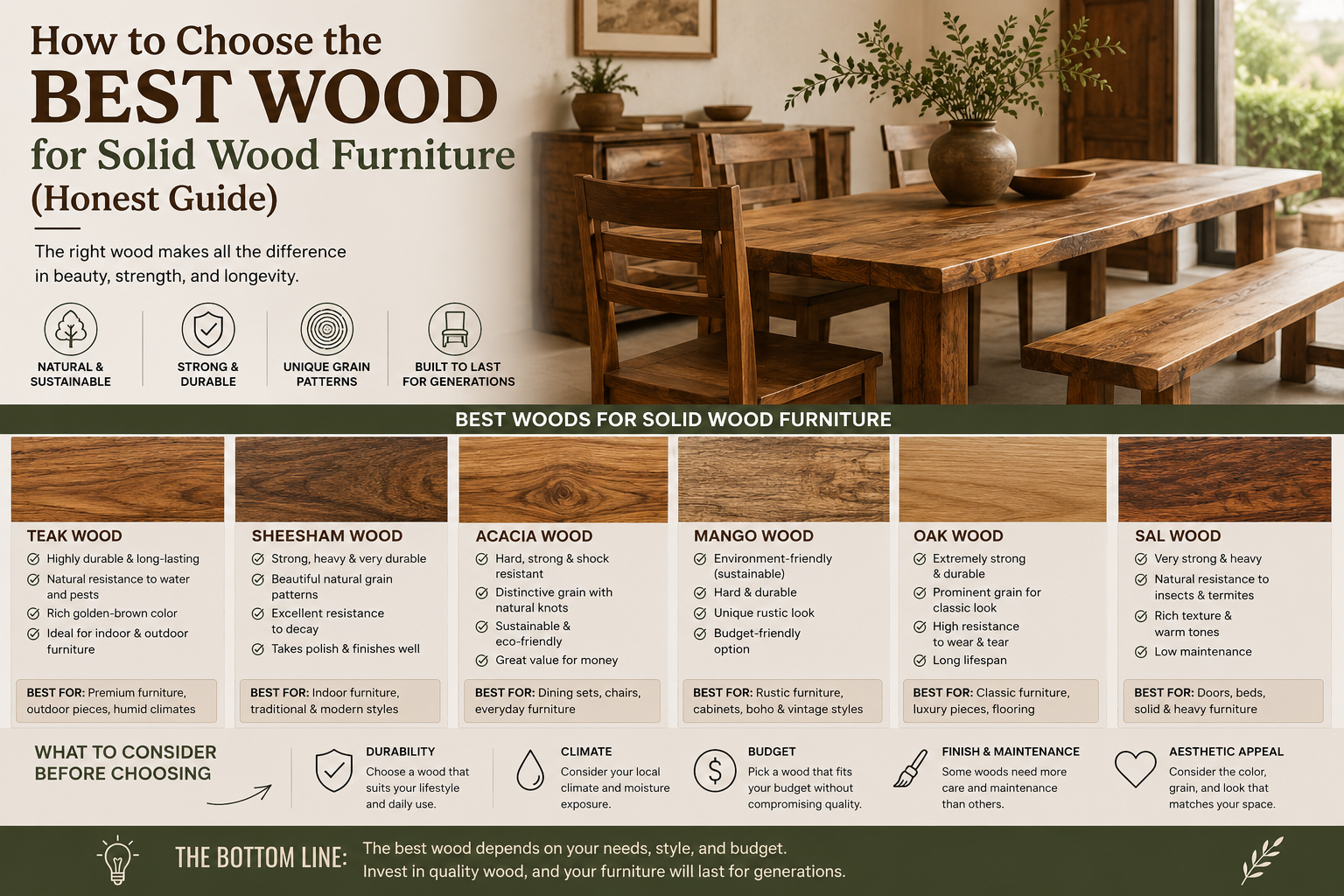
Teak is a different beast. It’s naturally oily, which makes it extraordinarily resistant to moisture, insects, and warping. It’s one of the few woods you can leave outside with minimal treatment. For indoor furniture, that same density makes it extremely durable — and the warm golden-brown tones age beautifully. Reclaimed teak in particular carries a richness that new teak simply can’t replicate. The grain tightens over decades, and old-growth teak sourced from demolished structures is some of the most stable wood you’ll find anywhere.
Oak
Oak is the workhorse of furniture wood. Red oak and white oak are the two main types; white oak is slightly denser and more water-resistant, which is why it’s often preferred for dining tables and floors. The grain is pronounced and distinctive. It takes stain well but also looks excellent natural or with just a light oil finish.
Walnut
If you want furniture that feels genuinely luxurious without screaming about it, walnut is hard to beat. It features a darker color with a grain that ranges from straight to gently wavy. It doesn’t need staining — walnut’s natural color is the point. It’s also one of the most dimensionally stable hardwoods, meaning it resists warping as humidity changes. The downside: it’s expensive, and lighter scratches can show against the dark background.
Mahogany
Mahogany has been a furniture staple for centuries. It’s lightweight relative to its strength, works easily, and has a fine, even grain that finishes beautifully. Genuine mahogany is getting harder to source responsibly, which is one reason reclaimed mahogany has become so valuable — it’s the same excellent wood without the ethical baggage.
Pine
Cheaper, lighter, and softer. Great for painted furniture or pieces where the wood grain isn’t the point. Not ideal for heavy-use surfaces. But in the right application—a farmhouse-style bench, a painted cabinet—it works perfectly well.
What “Grain” Means and Why You Should Care
Wood grain is the pattern created by the arrangement of the wood fibers. And while it might seem purely aesthetic, it affects how the wood behaves over time.
Straight grain = more predictable, more stable. Less likely to warp or crack.
Interlocked or wavy grain is often more visually striking but can be trickier to work with and may require more care as it ages.
Tight grain (lots of annual rings packed closely) usually indicates slower growth, which typically means denser, harder wood. This is why old-growth or reclaimed wood often outperforms new-growth lumber — those trees spent decades growing before they were harvested.
When you’re looking at a piece of furniture, run your hand across the surface. Good grain should feel consistent. Watch for knots—they’re not always bad (some people love the character), but a knot in a structural area of a table leg or chair joint is a weak point.
The Hidden Life Inside Reclaimed Wood
The furniture industry often overlooks this: reclaimed wood has already endured its toughest phase.
When timber comes from old buildings, demolished structures, or salvaged sources, it’s typically been through decades of natural acclimatization. It’s dried out slowly. It’s already moved and settled with changes in humidity and temperature. New wood, even kiln-dried new wood, is still in the process of doing that. Which is why new-wood furniture sometimes warps or develops gaps in the first year or two, and well-made reclaimed wood furniture often doesn’t.
Beyond the practical side, reclaimed wood carries real history. The marks on the surface—small nail holes, saw marks, and the occasional mortise from an old joint—aren’t defects. They’re proof that the material lived a life before becoming your dining table. Some craftsmen fill those marks; others leave them intentionally.
A solid reclaimed teak dining table, for instance, might be built from timber that was originally part of a building that stood for sixty or seventy years. The wood itself is old-growth, which means it was harvested when the forest was ancient and the growth rings were packed tight. That density is part of why pieces built from it last.
From Workshop to Your Home — What That Journey Looks Like
Most people don’t think about what happens between the raw timber and the finished piece sitting in their living room. It’s worth understanding.
First, the wood gets assessed. Not all reclaimed timber is usable for furniture—some is too damaged, some has structural weaknesses, and some has been exposed to things you don’t want in your home. Skilled craftsmen sort through it carefully.
Then comes milling — cutting the timber down to usable dimensions, removing the weathered surface to expose the clean wood underneath. This is where the grain pattern and color really reveal themselves.
After milling, the wood needs time. Even reclaimed wood benefits from a period of rest in the workshop, acclimatizing to the indoor humidity before it’s worked. Rushing this step is one of the most common shortcuts that leads to furniture that moves or cracks later.
Then the actual building. Handmade solid wood furniture is built with proper joinery—mortise and tenon, dovetail, and dowel methods that have been used for centuries because they work. The finish is applied last, whether that’s an oil that soaks into the wood, a wax that sits on top, or a harder lacquer for more protection.
What arrives at your home is the result of that whole process. And when it’s done right, it shows.
Practical Tips Before You Buy
A few things worth checking before any solid wood furniture purchase:
Ask about the joinery. If a seller can’t tell you how the joints are made, that’s worth noting. Screws and staples are fine for flat-pack furniture. Real solid wood furniture should use mechanical joinery.
Check for movement gaps. Some small seasonal movement is normal and expected in solid wood — even desired. But large uneven gaps, or panels that have already cupped or bowed, suggest the wood wasn’t properly dried or acclimatized.
Ask where the wood came from. Sustainability matters, and so does quality. Reclaimed or FSC-certified wood is worth the slight premium. Old-growth reclaimed timber in particular is genuinely better material.
Look at the end grain. On a table or thick slab, you can sometimes see the end grain at the edges. Tight rings = slower growth = denser wood. It’s a quick quality indicator most buyers never think to check.
Don’t over-prioritize finish color. Stains can make cheap wood look expensive and good wood look ordinary. What’s underneath matters more. Ask if you can see an unfinished or lightly finished sample.
FAQ
What is the most durable wood for solid wood furniture?
Teak, white oak, and hard maple are consistently among the most durable hardwoods for furniture. Teak leads for moisture resistance; hard maple leads for scratch resistance. For general use, white oak is an excellent all-around choice.
Is reclaimed wood better than new wood for furniture?
For most applications, yes — particularly if it’s old-growth reclaimed timber. It’s already dimensionally stable, often denser than modern new-growth wood, and it doesn’t require new tree harvesting. The caveats are proper sourcing and inspection for structural soundness.
What’s the difference between solid wood and engineered wood furniture?
Solid wood is cut from a single piece of timber throughout. Engineered wood (like plywood or MDF) is layers of material bonded together. Both have legitimate uses, but solid wood is more repairable, often more durable, and typically increases in value over time rather than decreasing.
What are the best ways to maintain solid wood furniture?
Keep it away from direct sunlight and heating vents, which dry it out. Use a coaster. Wipe spills promptly. Oil it once or twice a year depending on the finish type. That’s really most of it.
Does wood species affect how furniture ages?
Significantly. Teak and walnut develop a beautiful patina over time. Oak lightens with age and UV exposure. Pine yellows. Cherry starts relatively light and darkens dramatically over years. If you care how the piece will look in 20 years, ask about how that specific species ages.
Can solid wood furniture warp?
Any solid wood can move with significant humidity changes. Good furniture making minimizes this through proper drying, acclimatization, and construction techniques that allow for natural movement. Reclaimed wood that’s already been through decades of seasonal change is particularly stable.
Conclusion
Choosing wood for furniture isn’t complicated once you understand the basics—but those basics actually matter. Hardwood over softwood for anything that takes daily use. Old-growth or reclaimed timber over fast-grown new lumber when you can get it. Tight grain over loose. Proper joinery over shortcuts. Finish last, not first.
The pieces worth owning are the ones made with enough care that someone twenty years from now will still want to keep them.
If you’re looking for solid reclaimed teak furniture built the right way, Modern Karigar each piece is handmade from responsibly sourced reclaimed timber, built with traditional joinery, and finished to last.