
It’s an easy mistake to make: you measure your counter, search “bar stools,” and order something that looks right in the photo. Then it arrives, and either your knees are jammed up under the counter or you’re perched a few inches too high with your elbows nowhere near the surface. The stool isn’t defective. It’s just the wrong category for your counter.
Counter stools and bar stools get used interchangeably in casual conversation, but they’re built to different heights for different surfaces, and mixing them up is one of the most common furniture-buying mistakes people make without realizing it until the piece is already in the room. Here’s the actual difference, how to tell which one you need, and what else separates a stool that just works from one that looks right in a photo and wrong in your kitchen.
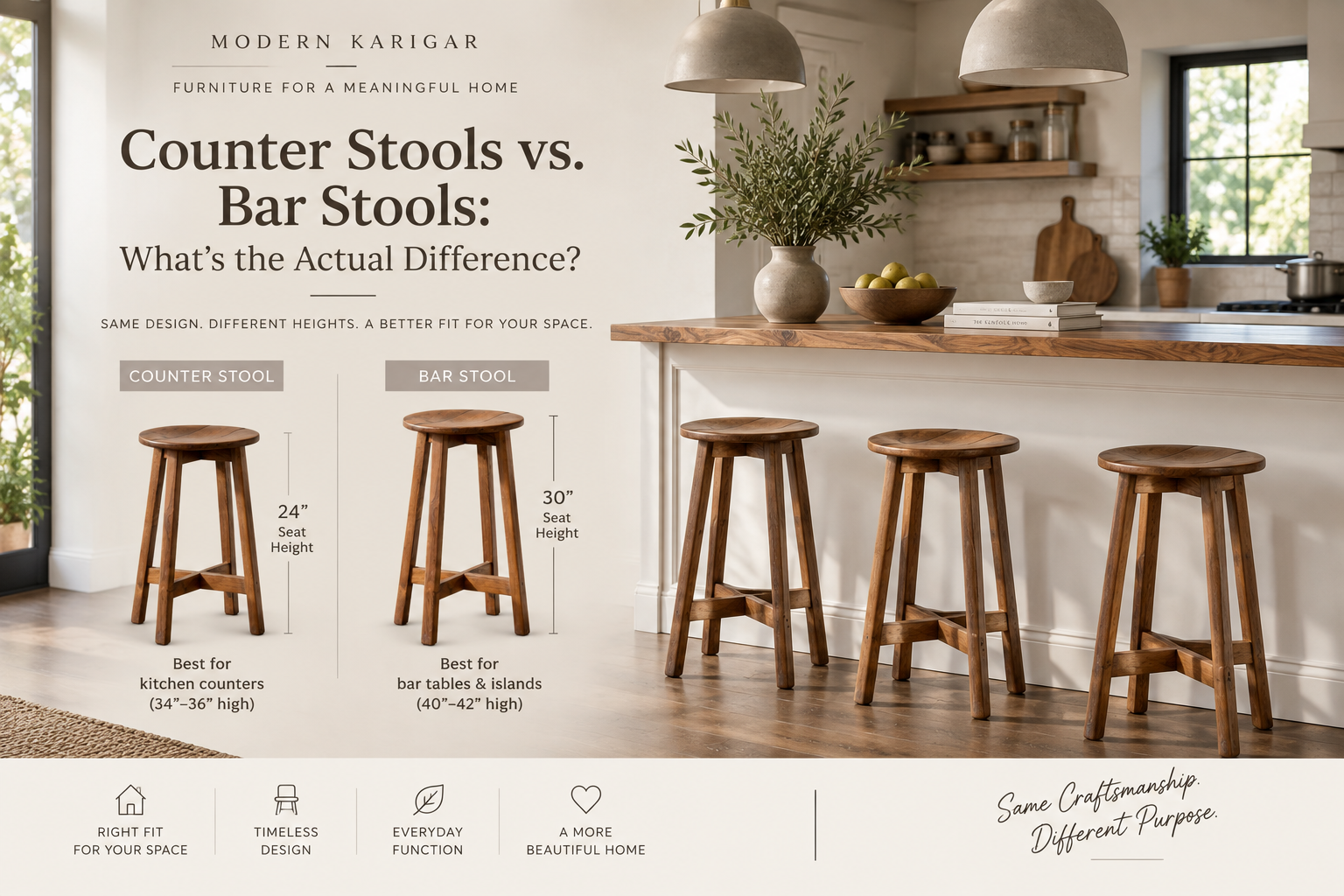
Table of Contents
- The Core Difference: It’s All About Height
- Counter Stools Explained
- Bar Stools Explained
- How to Measure Your Space Correctly
- Style and Material Considerations
- Mixing Heights in an Open Kitchen
- From Workshop to Kitchen: How Solid Wood Stools Are Made
- A Note on Reclaimed Wood for Everyday Seating
- FAQ
- Conclusion
The Core Difference: It’s All About Height
The distinction between counter stools and bar stools has nothing to do with style, design, or material. It’s purely a measurement category, tied to the height of the surface they’re meant to sit at.
Counter stools are built for standard kitchen counter height, which typically runs between 34 and 36 inches. Bar stools are built for a taller surface, typically 40 to 42 inches, matching the height of a home bar, a pub table, or a raised kitchen island with a bar-height overhang. The stool heights follow accordingly: counter stools generally sit around 24 to 26 inches, while bar stools run closer to 28 to 30 inches.
Get this wrong, and no amount of styling saves the piece. A bar stool at a standard counter puts your knees too high and your elbows above the surface; a counter stool at bar height leaves you reaching up for everything.
Counter Stools Explained
Counter stools are the more common choice for most kitchens, since standard counters and most kitchen islands are built to counter height by default. If your kitchen island doesn’t have a raised bar-height section, counter stools are almost certainly what you need, regardless of what the piece is labeled online.
Ideal Seat Height Range
24 to 26 inches from the floor to the top of the seat, with roughly 9 to 13 inches of clearance between the seat and the underside of the counter for comfortable knee room.
Bar Stools Explained
Bar stools are taller and are meant for a genuinely elevated surface, a home bar, a raised counter overhang (common in kitchens with a two-tier island), or a pub-style table. They’re less common in standard kitchens than people assume, since most kitchen counters aren’t actually bar height unless the island was specifically built with a raised ledge.
Ideal Seat Height Range
28 to 30 inches from the floor to the seat top, again with 9 to 13 inches of clearance to whatever surface they’re paired with.
How to Measure Your Space Correctly
This is the step most people skip, and it’s the one that actually prevents the wrong purchase. Measure from the floor to the underside of your counter or island overhang, then subtract 10 to 12 inches. That number is your target seat height. If it lands around 24 to 26 inches, you need counter stools. If it lands closer to 28 to 30 inches, you need bar stools.
Also check the width of the overhang. You need at least 12 inches of counter overhang per stool for knee clearance, and ideally 24 to 26 inches of width per seated person so guests aren’t shoulder to shoulder.
Style and Material Considerations
Once you know the height category, the rest is a normal furniture decision, but a few things matter more for stools than for other seating. Backless stools tend to work better for kitchens where the seating gets tucked away and pulled out often, since they slide fully under the counter. Stools with a back are more comfortable for longer sitting, like a breakfast bar people actually linger at, but they take up more visual space and need to be accounted for when measuring clearance behind the seating area.
Solid wood stools also handle daily wear better than upholstered ones in a kitchen setting, since spills and crumbs are inevitable near a counter. A wood seat wipes clean; a fabric one doesn’t.
Mixing Heights in an Open Kitchen
Some kitchens genuinely have two zones, a standard counter-height section and a raised bar-height section, often on the same island. In that case, the two seating heights aren’t a mistake; they’re intentional, and mixing counter stools on one side with bar stools on the other is the correct approach, not a design compromise.
The key is keeping the wood tone or finish consistent between the two groups, even if the heights differ. A matched material across both makes the mixed heights read as planned rather than accidental.
From Workshop to Kitchen: How Solid Wood Stools Are Made
A solid wood counter or bar stool starts, in a lot of cases, as reclaimed timber, wood that’s already had a full life somewhere else before being sorted, shaped, and joined into something new. Builders account for the specific stresses a stool needs to handle: repeated weight-bearing use, legs that get kicked and scooted daily, and a seat that needs to stay solid for years rather than wobble after a season of regular use.
That kind of construction takes longer than mass-produced stools built from uniform, machine-cut material. Every leg and joint on a handmade stool is shaped and fitted individually, which is part of why the finished piece tends to feel noticeably more solid underfoot than a flat-pack equivalent.
A Note on Reclaimed Wood for Everyday Seating
Stools take more repeated physical stress than almost any other piece of furniture in a kitchen, with constant sitting, standing, scooting, and kicking against the legs. Reclaimed wood tends to be denser and more seasoned than new-cut lumber, which gives it an advantage here: it’s already been through years of natural expansion and contraction, so it holds up better to daily handling. It also brings visible grain and character to a piece of furniture that’s often treated as purely functional, which is worth considering if you’re browsing a shop like Modern Karigar for stools that need to do double duty as both seating and a design detail.
FAQ
Can I use bar stools at a standard kitchen counter?
Not comfortably. Bar stools are built for a taller surface, and using them at standard counter height usually puts your elbows above the counter and your knees too high underneath it.
How do I know if my kitchen island is counter height or bar height?
Measure from the floor to the underside of the counter. Standard counter height is 34 to 36 inches; bar height is typically 40 to 42 inches.
Is it okay to mix counter stools and bar stools in the same kitchen?
Yes, if your island actually has two different height zones. Keep the material or finish consistent across both groups so the mix reads as intentional.
Do backless stools work better than stools with a back?
It depends on use. Backless stools tuck fully under the counter and suit spaces where seating needs to disappear when not in use. Stools with a back are more comfortable for longer sitting but need more clearance.
Is solid wood a good material for kitchen stools?
Yes, particularly reclaimed wood, which tends to be more stable and durable under daily use than newer, less-seasoned lumber, and it wipes clean easily compared to upholstered options.
Conclusion
The difference between a counter stool and a bar stool isn’t a style choice; it’s a measurement, and getting it right the first time saves you the hassle of returning a piece that looked perfect online but didn’t fit the room. Measure your counter, check the clearance, and pick the height category that actually matches your space. If you’re shopping for stools that need to hold up to daily use as well as look right, it’s worth looking at solid wood options built with that kind of wear in mind.