
A bookshelf is one of those pieces that quietly decides whether a room feels lived-in or just filled up. Most of us start with good intentions, then a year later we’re staring at three crooked stacks of paperbacks, a tangle of phone chargers, and a candle we never light. Sound familiar?
Here’s the good news: stylists don’t rely on expensive props or a magazine budget. They rely on a handful of repeatable habits. Once you understand those, you can style a wooden bookshelf in an afternoon and have it look intentional for years. And when the shelf itself has real character, like solid wood with visible grain, you’re already halfway there. Let me walk you through how the pros actually do it.
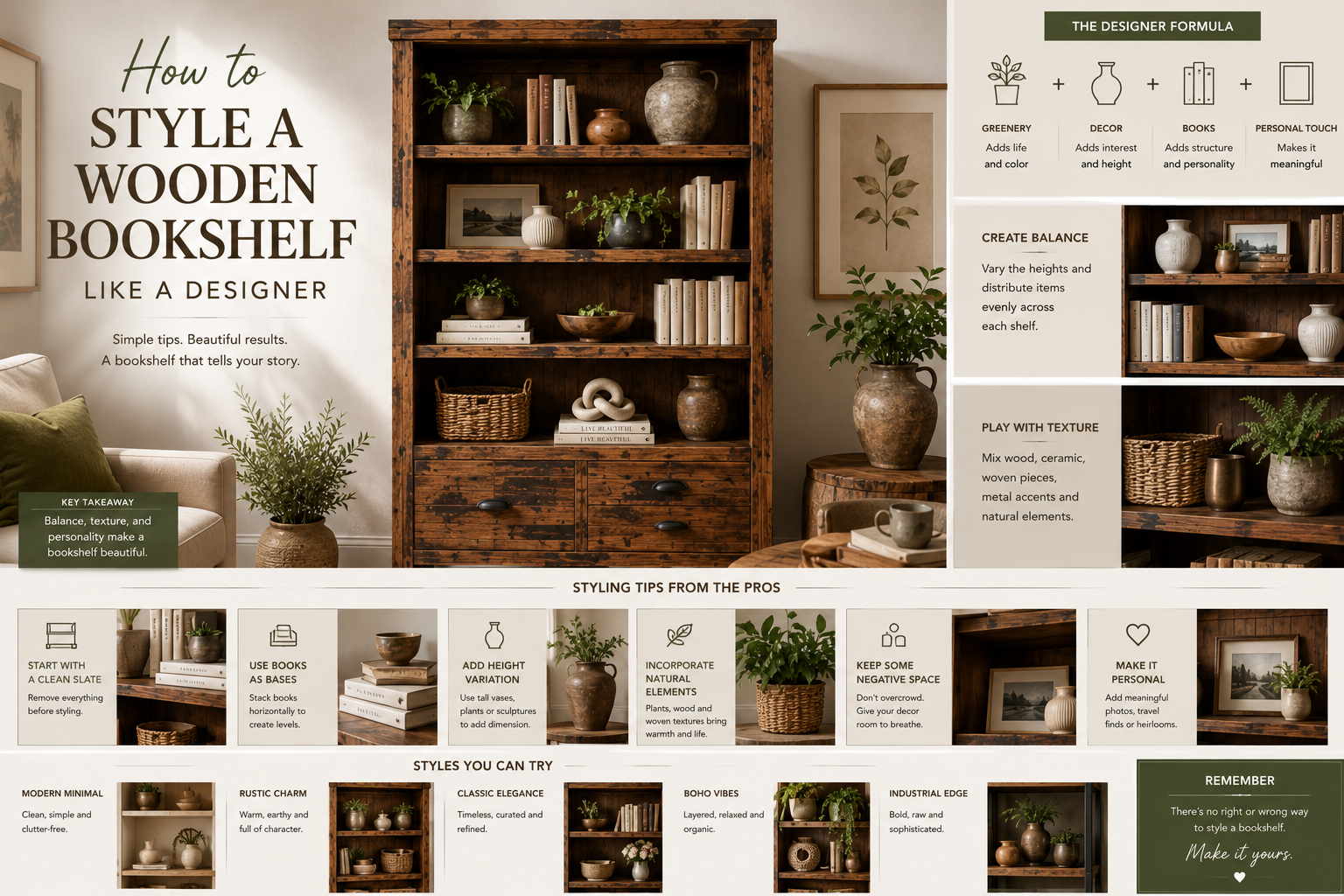
Table of Contents
- Start With the Shelf, Not the Stuff
- The Designer’s Layering Method
- Balance Without Symmetry
- Mixing Books, Objects, and Negative Space
- Bringing in Warmth With Reclaimed Wood
- From Workshop to Your Living Room
- Common Styling Mistakes to Avoid
- Frequently Asked Questions
- Final Thoughts
Start With the Shelf, Not the Stuff
Before you arrange a single object, look hard at the bookshelf itself. The frame sets the tone for everything you place on it. A piece made from solid or reclaimed wood brings texture and depth that a glossy laminate unit simply can’t fake. Those knots, saw marks, and tonal shifts in the grain? They read as quiet luxury, and they do a lot of the styling work for you.
If you’re shopping for a new shelf, choose one with a finish that complements your floors and larger furniture rather than matching them exactly. A slight contrast keeps the wood from disappearing into the background. Think about scale too. A compact unit suits a reading nook or hallway, while a taller multi-tier piece can anchor a whole wall and become the focal point of the room.
The Designer’s Layering Method
Think in Three Dimensions
Amateur shelves are flat. Everything sits in a neat little row, lined up against the back like a class photo. Designer shelves have depth. The trick is to layer.
Place a larger anchor item toward the back, such as a framed print or a piece of art leaning against the wall. Then bring in a mid-height object, maybe a ceramic vase or a small wooden box. Finish with something low and at the front edge, such as a flat stack of two or three books with a little object on top. That front-to-back rhythm tricks the eye into reading the whole shelf as curated.
Use the Rule of Threes
Odd numbers feel relaxed and natural; even numbers feel rigid. Group objects in clusters of three, varying their height and shape. One tall, one medium, one short. Repeat that pattern loosely across the shelf and you’ll get cohesion without everything looking matched.
A simple way to practice is to start small. A compact piece like this handmade three-step bookshelf is ideal for testing the technique before you tackle a larger unit, and its stepped tiers naturally build in the height variation designers love.
Balance Without Symmetry
Symmetry feels formal, almost stiff. What you actually want is visual balance, which is different. Imagine each shelf as a tiny seesaw. If you put a heavy, dark object on the left, balance it with a cluster of lighter pieces on the right, not a mirror image.
Spread color and visual weight across the whole unit instead of concentrating it in one corner. If all your dark book spines end up on the bottom shelf, the piece will feel like it’s tipping over. Move a few up. Tuck a leafy plant somewhere in the upper third to lift the eye. Step back every few minutes and squint, because squinting blurs the details and shows you the overall composition.
Mixing Books, Objects, and Negative Space
Books are the foundation, so use them both ways. Stand some vertically, lay others flat in short stacks to create little pedestals for small objects. Turning a few spines inward for a neutral, tonal look is a popular trick, though I’d keep at least some titles visible. A shelf with zero readable books can feel more like a stage set than a home.
Then mix in objects with different textures: smooth ceramics, woven baskets, a brass candlestick, and a trailing plant. Texture is what makes a display feel collected over time rather than bought in one trip.
And please, leave gaps. Negative space is not wasted space. Empty pockets give your eye somewhere to rest and make the objects you do display feel more important. A shelf packed wall to wall just reads as clutter, no matter how nice the individual pieces are.
Bringing in Warmth With Reclaimed Wood
Here’s where the material really earns its keep. Handmade furniture made from reclaimed wood carries a history that brand-new timber can’t replicate. Each board has lived a previous life, so you get weathered patinas, gentle imperfections, and tonal variation that designers spend real money trying to recreate.
Scale is where reclaimed pieces shine. If you want the shelf to become the room’s centerpiece, a taller multi-tier design gives you the vertical drama to do it. Something like this five-step reclaimed wood bookshelf offers enough levels to play with the layering and balance tricks above while still feeling warm and grounded thanks to the salvaged timber. When your shelving shares a family of tones with the rest of your wood furniture, the room feels considered rather than coincidental.
From Workshop to Your Living Room
It’s easy to forget that a wooden shelf started as something else entirely. With reclaimed pieces, that something might have been a barn beam, an old door, or factory flooring that spent decades being walked on.
In a small workshop, a maker sorts through that salvaged timber by hand, choosing boards for their grain and their story. The wood is cleaned, planed, and joined, often using traditional joinery rather than a row of staples. Then comes sanding, finishing, and the slow drying that lets the wood settle. By the time the shelf reaches your living room, it carries the marks of two lives: the one before and the one a craftsperson gave it. That’s why a handmade piece feels different the moment you touch it. You’re not just buying storage. You’re inheriting a small piece of someone’s care.
Common Styling Mistakes to Avoid
- Overcrowding every inch. Editing is styling. Remove a third of what you think you need.
- Lining everything up in rows. Push some objects forward and slide others back.
- Ignoring height. Flat displays look unfinished. Mix tall, medium, and short.
- Forgetting the lower shelves. They get neglected, then look like storage. Style them with intention.
- Matching everything perfectly. A little contrast in tone and texture is what makes a space feel real.
Frequently Asked Questions
How do I style a bookshelf if I don’t have many decorative objects?
Lean into books and a few natural elements. Stack books in varied directions, add one or two plants, a single woven basket, and let negative space do the rest. You need far fewer objects than you think. A restrained shelf almost always looks more expensive than a busy one.
Which type of wood works best for bookcases?
The most durable and visually appealing elements are reclaimed wood and solid hardwoods. Reclaimed wood adds instant character through its existing patina and grain, which is hard to replicate with new materials, and it’s a more sustainable choice since it reuses existing timber.
How often should I restyle my shelves?
Refreshing a shelf on a seasonal basis keeps it feeling current, but there’s no set rule. Move pieces, turn books, and swap a few items. Small changes every few months keep the display from fading into the background.
Can a bookshelf work in a small room?
Absolutely. In tight spaces, choose a slim or stepped design and keep the styling minimal so the piece feels light. A compact three-step bookshelf gives you display space without crowding the floor, while a taller multi-tier piece works better when you have a full wall to fill.
Final Thoughts
Styling a wooden bookshelf isn’t about owning the right trinkets. It’s about layering with intention, balancing visual weight, and giving each piece a little room to breathe. Start with a shelf that already has soul, work in your books and objects in loose groups of three, and trust the negative space.
If you’ve been thinking about anchoring your room with a piece that carries real warmth and history, take a quiet look at what handmade reclaimed wood furniture can bring to the space. The right shelf doesn’t just hold your favorite things. It becomes one of them. When you find a piece that feels like it belongs, the styling tends to fall into place on its own.