
A rustic wood table looks solid and unchanging, but it’s quietly responding to the air around it all the time. In a humid summer, the boards swell a little. In a dry winter, they shrink. Most of this is invisible, and it’s completely normal. Occasionally, though, it shows up as a thin gap between planks, a faint creak, or a hairline crack, and owners wonder whether something has gone wrong.
Usually nothing has. The wood is just doing what wood does. Understanding how humidity affects a rustic table helps you tell normal movement from a real problem and makes it easy to keep the table stable. This guide covers how tables respond to moisture, how to measure and manage humidity, and what to do when a table arrives from a very different climate.
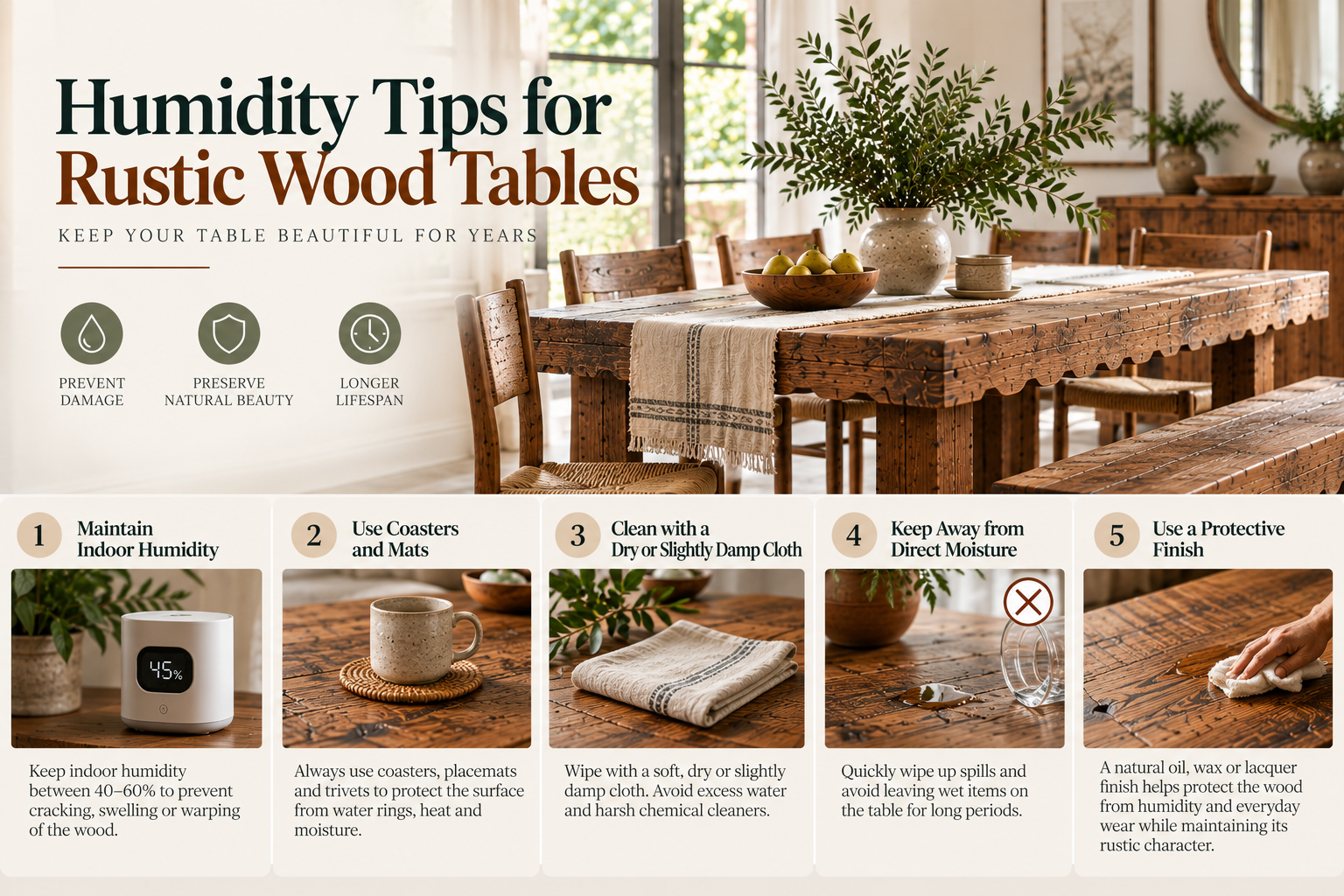
Table of Contents
- Why Wood Responds to Humidity
- How a Plank Tabletop Moves
- The Humidity Range to Aim For
- Measuring Humidity With a Hygrometer
- Dry Air: Winter and Heated Homes
- Humid Air: Summer and Wet Climates
- When a Table Arrives From a Different Climate
- Placement and Everyday Habits
- Normal Movement vs. a Real Problem
- From Workshop to Home: How Construction Allows for Movement
- A Note on Reclaimed Wood
- FAQ
- Conclusion
Why Wood Responds to Humidity
Wood is made of fibres that absorb and release water vapour until they match the humidity of the surrounding air. When the air is damp, the wood takes on moisture and swells. When the air is dry, it gives up moisture and shrinks. This constant adjustment is natural, and it’s the main reason wood furniture moves a little through the year.
The change isn’t equal in every direction. Wood changes most across its width and thickness, and very little along its length. That’s why the visible effects usually show up between planks, not in the length of the table.
How a Plank Tabletop Moves
A rustic tabletop is usually made of several boards joined side by side. Each board swells and shrinks across its width, so the overall top gets slightly wider in humid weather and narrower in dry weather. This is why thin gaps can open between planks in winter and close again in summer.
Quality tabletops are secured in a way that allows the boards to shift without cracking. Using rigid fasteners across the entire surface can hinder the natural movement of the wood, often leading to splits. If you’re interested, it’s perfectly acceptable to enquire with the craftsman about how the tabletop is secured and if it accommodates seasonal expansion and contraction.
The Humidity Range to Aim For
Solid wood furniture generally does best at a relative humidity of about 35 to 55 percent. Within that range, the wood stays fairly stable, and movement is gentle. Outside it, movement becomes more noticeable, and extremes can cause problems.
You don’t need to hit these numbers exactly all the time. The goal is to avoid long stretches at the extremes and to avoid sudden swings, since fast changes stress wood more than slow ones.
Measuring Humidity With a Hygrometer
You can’t judge humidity by feel, so a small digital hygrometer is worth having. They’re inexpensive and easy to find. Place it in the same room as the table, away from vents, windows, and direct sunlight, and check it over a few days to see typical readings.
After determining your humidity range, you can take action. If it drops below 30 percent during winter, a humidifier is likely necessary. Conversely, if it remains above 60 percent for extended periods in summer, consider using a dehumidifier or improving airflow.
Dry Air: Winter and Heated Homes
Indoor heating can dry the air dramatically, sometimes dropping humidity into the 20s in cold climates. Dry air pulls moisture out of wood, so tables shrink, gaps open, and in severe cases, small cracks can develop.
A humidifier in the room helps, as does keeping the table away from heating vents, radiators, and fireplaces, which dry the wood locally and unevenly. If you notice a gap opening in winter, it often closes again in spring as the air gets more humid, and you don’t need to do anything beyond keeping conditions steadier.
Humid Air: Summer and Wet Climates
In very humid conditions, wood absorbs moisture and swells. A tabletop may feel slightly tighter, and drawers or leaves can stick. Sustained high humidity, above roughly 60 percent for long periods, can also encourage mildew on damp surfaces.
Good airflow, air conditioning, or a dehumidifier helps. Avoid putting the table against an outside wall that gets damp or in a room with poor ventilation. Wipe up spills promptly, and don’t leave wet items or covers sitting on the wood.
When a Table Arrives From a Different Climate
This one matters for handmade furniture that ships long distances. A table built in a humid region and delivered to a dry climate, or the reverse, goes through a sudden environmental change. The wood needs time to acclimate to its new environment.
When it arrives, let it settle. Unpack it and place it in the room where it will live, away from direct sun, heating vents, and air conditioning. Give it a few days to a few weeks to acclimate before you judge it. You may see small changes, such as a slight gap or a faint tightening, as it equalises. Keep room humidity steady during this period, and avoid shocking it with a sudden blast of heat.
Placement and Everyday Habits
Where you put the table matters. Keep it away from direct sunlight, which dries the surface unevenly, and from heat sources. Avoid placing it right beside a window that gets condensation or under an air conditioning vent that blows directly across it.
Everyday habits help, too. Use coasters and trivets, wipe spills quickly, and avoid leaving damp objects on the surface. A finish in good condition slows moisture exchange, so refresh the finish when it looks dull or water stops beading.
Normal Movement vs. a Real Problem
Some changes are normal: thin gaps between planks that open and close with the seasons, a faint creak as the wood adjusts, a slight change in how tight the top feels. These don’t need action.
Reach out to the maker if you notice any significant cracks that continue to expand, a top that visibly warps or cups, joints that are separating, or any indications of mildew or insect presence. Be sure to take photos and note when you first observed these issues, as this information can assist in determining whether the cause is environmental or structural.
From Workshop to Home: How Construction Allows for Movement
How a table is built determines how well it handles humidity. Makers season, and sort the boards so they’re stable before joining them, and fasten the top in a way that lets it expand and contract. Joinery that allows for movement, instead of locking the top rigidly in place, helps prevent cracks.
That construction thinking is part of what separates a well-made table from a quick one. A piece built with seasonal movement in mind can handle changing humidity for decades, while a rigidly fastened top is more likely to split.
A Note on Reclaimed Wood
Reclaimed wood has usually been seasoned for years, so much of its initial moisture adjustment has already happened, which tends to make it relatively stable. It’s still wood, and it still responds to humidity, so the same habits apply. Its natural variation and old joinery marks are part of the character, and small seasonal movement is normal. If you’re considering a rustic table and want to see how reclaimed wood tops look and are built, you can browse Modern Karigar and ask the maker how a particular top is constructed.
FAQ
What humidity is best for a wood table?
Roughly 35 to 55 percent relative humidity keeps solid wood stable. Avoid long stretches at the extremes and sudden swings.
Why is there a gap in my wood table in winter?
Dry air makes the boards shrink, which can open thin gaps between planks. These often close again when humidity rises in spring.
What is the adjustment period for a table after it is delivered?
It varies, but allow a few days to a few weeks in the room where it will live, with steady conditions and away from heat or direct sun.
Do I need a humidifier for a wood table?
If your indoor humidity drops well below 30 percent in winter, one can help. Check with a hygrometer first.
Is a hairline crack in a wood table a problem?
Small hairline movement is often normal, but wide, growing cracks or a warping top should be checked by the maker.
Conclusion
Humidity is the quiet force behind most of the little changes in a rustic wood table. Keep the air in a moderate range, avoid sudden swings and direct heat, let a new table settle when it arrives, and learn to tell normal seasonal movement from a real problem. A hygrometer and a bit of patience go a long way. If you’re shopping for a table, it’s worth asking the maker how the top is built to handle movement.