
It’s easy to see a finished piece of furniture, a dining table, a console, or a chest of drawers, and have no real sense of what happened before it arrived. Product photos show the result, not the process, which means most of the actual work involved in making a piece of solid wood furniture stays invisible to the person who eventually buys it.
We wanted to pull that process into the open. Reclaimed wood furniture isn’t built the way most furniture is built today, on a repeatable, automated line with identical parts. It starts with material that already has a history, and it goes through a series of manual, hands-on steps before it becomes something new. Here’s what that actually looks like, from the timber’s first life to the piece that eventually reaches your home.
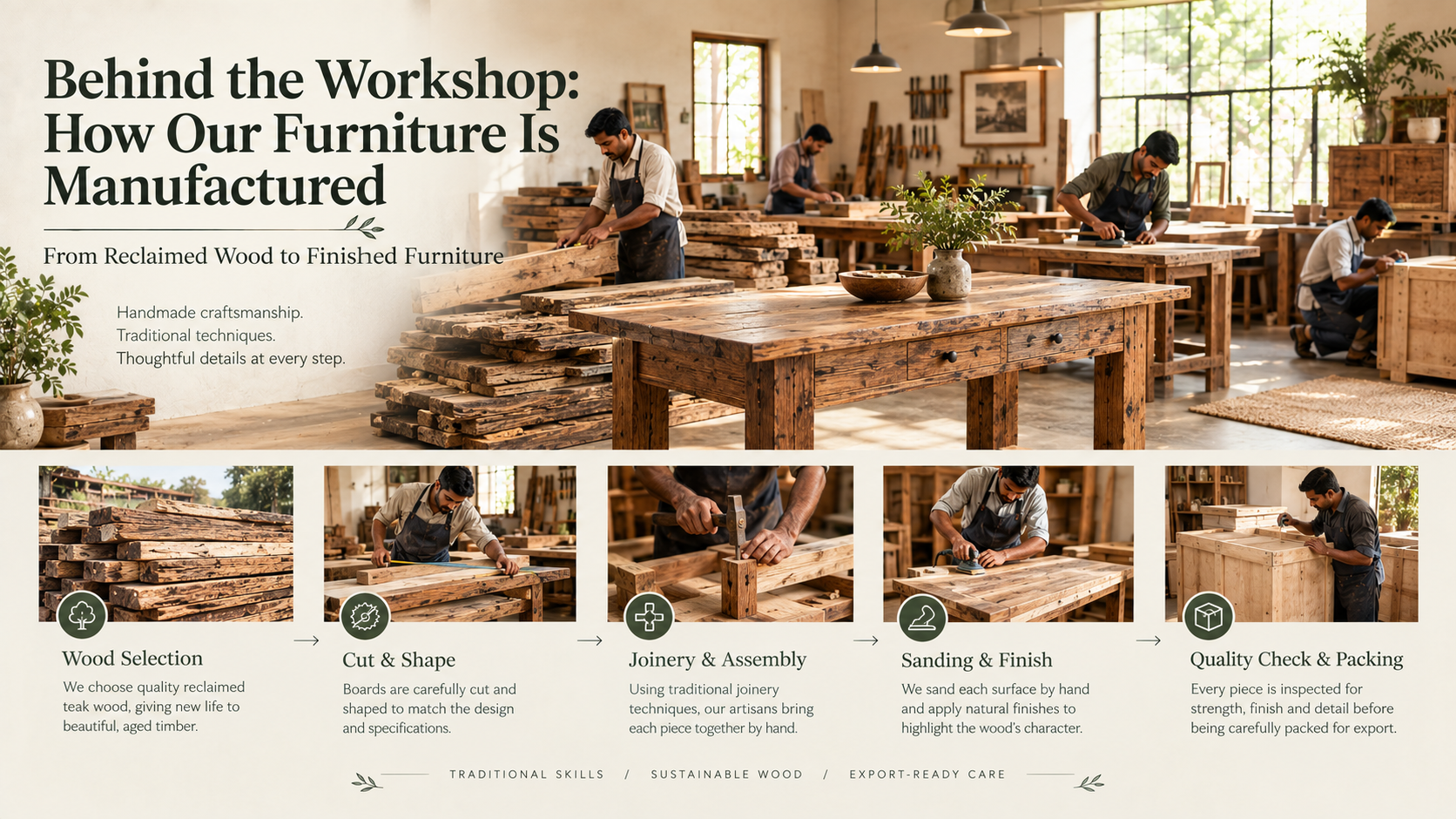
Table of Contents
- Where the Wood Comes From
- Sorting and Selecting Timber
- Cutting and Shaping
- Joinery: Where Handmade Actually Shows
- Sanding and Surface Preparation
- Finishing by Hand
- Quality Checks Before a Piece Ships
- From Workshop to Your Door
- A Note on What Makes This Process Different
- FAQ
- Conclusion
Where the Wood Comes From
Reclaimed wood furniture starts with material that’s already lived a full life before it ever becomes furniture: timber salvaged from old structures, retired boats, or furniture that had reached the end of its original use. That wood carries years, sometimes decades, of natural aging and settling, which is part of why it behaves differently than freshly milled lumber once it’s shaped into something new.
Sourcing this kind of material takes more effort than ordering uniform, pre-cut boards from a supplier. It means working with reclaimed timber suppliers, inspecting what’s actually available, and making judgment calls about which salvaged wood is structurally sound enough to become furniture rather than simply reused as-is.
Sorting and Selecting Timber
Not every reclaimed board is suitable for every piece of furniture, and this is where a lot of the manual judgment in the process happens. Each board gets inspected for stability, checked for grain quality, and evaluated for how it’ll behave once it’s cut and joined into a finished piece. Boards with the right density and minimal internal stress get set aside for structural components, table legs, chair frames, and drawer sides, while boards with more visible character and interesting grain patterns and natural color variation get considered for visible surfaces where that character will actually be seen.
This sorting step is almost entirely a matter of trained eyes and hands, not something easily automated, since every piece of reclaimed timber is genuinely different from the next.
Cutting and Shaping
Once timber is sorted, it gets cut to the dimensions needed for a specific piece, whether that’s a standard design or a custom size requested by a customer. This is where a piece of furniture starts to take physical shape, with legs, tabletops, and frame components all cut and rough-shaped from the selected boards.
Unlike mass-produced furniture, where identical parts get cut in bulk from uniform material, each piece here needs individual attention, since reclaimed boards vary in thickness, grain direction, and condition even within the same batch.
Joinery: Where Handmade Actually Shows
Joinery is one of the clearest places where handmade construction differs from mass-produced furniture. Rather than relying purely on glue, staples, or fasteners, well-built solid wood furniture uses joints, dovetails, mortise and tenon, and similar traditional methods that are cut and fitted by hand to interlock the wood’s structure directly rather than depending entirely on adhesive to hold pieces together.
This step takes considerably more time than machine-repeated joinery, but it’s also part of why well-built handmade furniture tends to hold up structurally for decades rather than loosening or failing at the joints within just a few years.
Sanding and Surface Preparation
Before any finish gets applied, every surface goes through multiple rounds of sanding, starting with a coarser grit to smooth out rough cuts and working progressively finer to prepare the wood for finishing. This step also involves addressing any old nail holes, cracks, or imperfections in the reclaimed material, sometimes filled to stabilize the wood, sometimes left visible intentionally as part of the piece’s natural character.
This is a manual, time-intensive stage, since uneven sanding or rushed surface prep shows clearly once a finish is applied, particularly on wood with visible grain.
Finishing by Hand
The finish gets applied in stages rather than all at once, allowing each coat, whether oil, wax, or a sealed lacquer, to properly cure before the next layer goes on. This is one of the steps most likely to be rushed in lower-cost furniture production, and it’s also one of the most important for long-term durability, since a properly cured, multi-coat finish protects the wood far better than a single, quickly applied layer.
Hand-finishing also allows for adjustments specific to each board, since reclaimed wood can absorb finish differently depending on its density and prior history.
Quality Checks Before a Piece Ships
Before a finished piece is packaged, it typically gets inspected for structural stability, checking joints, drawer function, and overall balance, to confirm everything performs the way it’s meant to before it leaves the workshop. Given that many handmade furniture pieces travel long distances to reach customers, this step matters more than it might for furniture that’s simply moving to a nearby retail floor.
From Workshop to Your Door
Once a piece passes final inspection, it gets carefully packaged, often with reinforced crating or padding specifically suited to protect a large, heavy item during transit. From there, it moves through shipping, which for furniture crossing international distances typically involves freight handling and customs processing before final delivery.
The entire arc, from selecting the original timber to a finished piece arriving at someone’s home, reflects a fundamentally different process than mass-produced furniture, one where individual judgment and manual skill are involved at nearly every stage rather than concentrated only at the beginning of a repeatable production line.
A Note on What Makes This Process Different
What separates this process from mass manufacturing isn’t any single step; it’s that manual judgment and hand skill show up at almost every stage, sorting timber, cutting joints, sanding, and finishing, rather than being replaced by automation after an initial setup. That’s part of why two pieces built to the same design specifications can still look slightly different from each other, since the reclaimed material itself varies, and the process is built to work with that variation rather than eliminate it. If you’re curious to see more of this process directly, we regularly share workshop footage on Instagram, and you can browse finished pieces at Modern Karigar.
FAQ
How long does it take to build a piece of handmade reclaimed wood furniture?
It varies significantly based on the piece’s size and complexity and whether it involves any customization, since each stage of the process is done individually rather than through automated repetition.
Does reclaimed wood need special handling during construction compared to new lumber?
Yes. Reclaimed boards vary more in thickness, grain, and condition than uniform milled lumber, which means more manual inspection and individual attention during cutting, joinery, and finishing.
Why does joinery matter so much in handmade furniture?
Hand-cut joints like dovetails or mortise and tenon interlock the wood’s structure directly, which tends to hold up better over years of use than furniture relying primarily on glue or fasteners.
Are old marks or imperfections in reclaimed wood left in on purpose?
Often, yes. Some imperfections are stabilized and left visible as part of the wood’s natural character, while structural issues are addressed to ensure the piece holds up over time.
Can I see the actual manufacturing process, not just the finished furniture?
Yes, workshop footage showing sourcing, construction, and finishing is shared on Instagram, which offers a more direct look at the process than product photos alone can provide.
Conclusion
A finished piece of furniture rarely shows the work that went into it: sourcing the right timber, sorting it by hand, cutting joints that lock together without relying purely on glue, and applying finish in careful stages. That process is slower than mass production, but it’s also why handmade reclaimed wood furniture tends to hold up the way it does. If you’re curious to see more of what actually happens behind a finished piece, it’s worth following along on Instagram or browsing the shop directly.