
Most entryways don’t get planned. They get inherited, whatever furniture happened to fit near the door, a shoe pile that grew over time, and a coat hook that’s been overloaded since the day it went up. It’s the first room anyone sees when they walk into your house, and it’s usually the least intentional space in it.
The good news is that an entryway makeover doesn’t have to mean tearing everything out and starting over. In a lot of cases, one well-chosen piece, a solid wood bench with built-in storage, does more to fix the space than a full redesign would. This guide walks through what actually changes in an entryway once a bench like that goes in and how to plan the rest of the space around it.
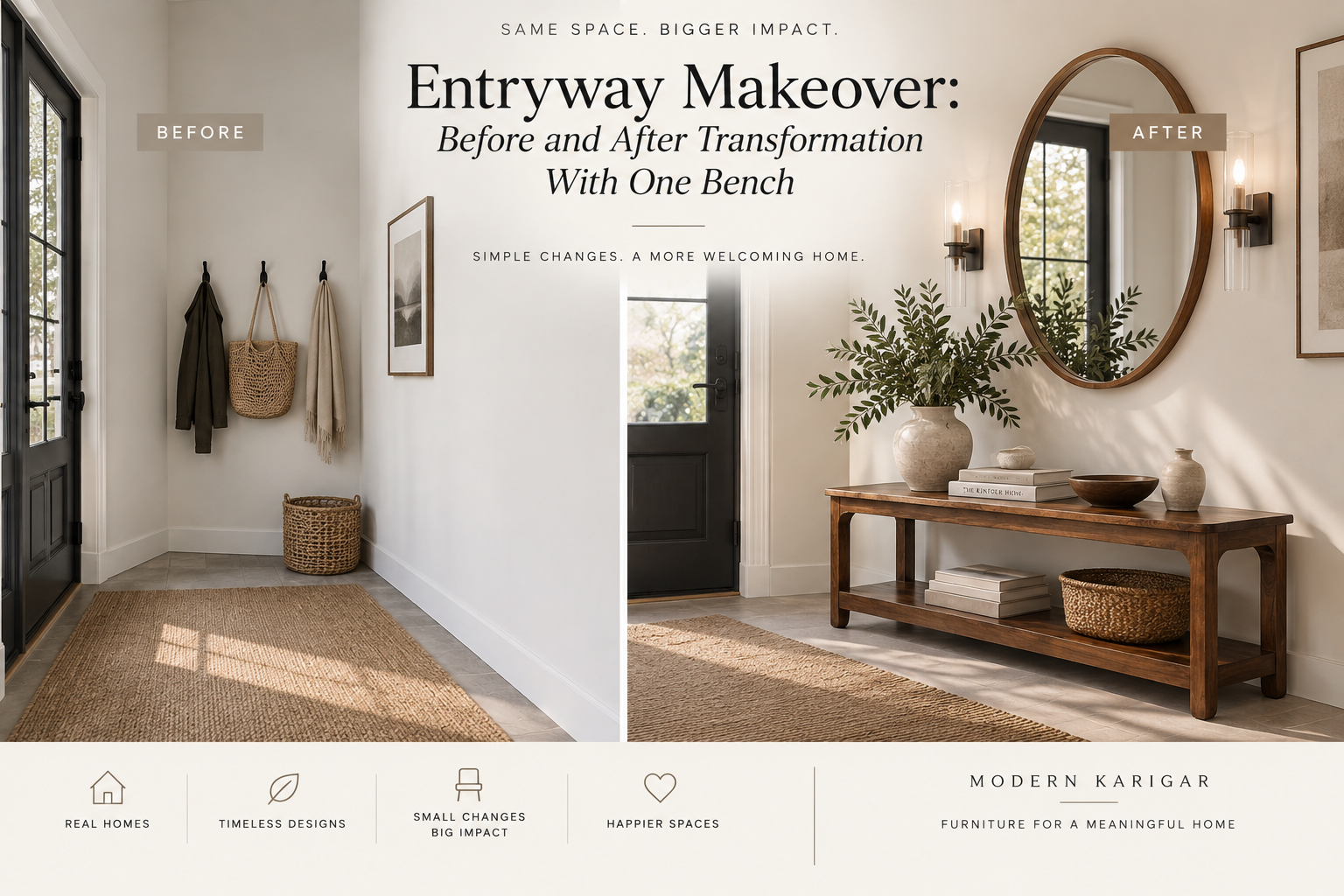
Table of Contents
- Why the Entryway Is Usually the Hardest Room to Style
- What a Bench Actually Solves
- Before: The Common Entryway Problems
- After: What Changes With the Right Bench
- Choosing the Right Size and Style
- Layering In the Rest of the Space
- From Workshop to Entryway: How These Pieces Are Made
- A Note on Reclaimed Wood in High-Traffic Spaces
- FAQ
- Conclusion
Why the Entryway Is Usually the Hardest Room to Style
Entryways get treated differently than every other room in the house, mostly because they’re a transition space rather than a destination. Nobody sits down and spends an evening in the entryway, so it’s easy to deprioritize when furnishing a home. But it’s also the room that sets the first impression, both for guests and for you, every single time you walk through the door.
The other problem is function. An entryway has to absorb shoes, bags, coats, mail, keys, and whatever else gets dropped the second someone walks in. Without a piece of furniture built to catch that clutter, it just piles up on the floor or spreads across whatever surface is closest, which is usually why entryways end up looking chaotic even in otherwise well-decorated homes.
What a Bench Actually Solves
A bench with built-in storage, shelving underneath, and sometimes a lower cubby for baskets solves two entryway problems at once: seating for putting on or taking off shoes and a defined place for the stuff that would otherwise land on the floor. That combination is why a bench tends to do more for an entryway than almost any other single piece of furniture you could add.
It also gives the room a visual anchor. Entryways are often narrow, oddly shaped, or interrupted by a staircase, closet door, or hallway opening, which makes it hard to build a full furniture arrangement. A single bench doesn’t need much floor space, but it gives the eye something to land on the moment you walk in, instead of a blank wall or a scattered pile of shoes.
Before: The Common Entryway Problems
Shoes and Bags With No Defined Spot
Without a bench or shelf, shoes tend to end up in a loose row by the door, and bags get dropped wherever there’s floor space. There’s nothing wrong with that functionally, but it reads as unfinished the moment anyone walks in.
No Place to Sit
Putting on boots or shoes while standing and leaning against a wall is a small daily annoyance that a lot of people don’t think to fix until they have somewhere to sit.
A Wall That’s Doing Nothing
Most entryways have at least one blank wall that never gets addressed because there’s no obvious furniture that fits a narrow space. That’s usually where a bench belongs.
After: What Changes With the Right Bench
Once a bench goes in, the shift is less about decoration and more about behavior. Shoes get put under or on the bench instead of scattered across the floor, because there’s now a visible, convenient place for them. Bags and coats have a temporary landing spot on the seat itself while someone’s getting settled, instead of ending up on the nearest chair in another room.
Visually, the wall stops being empty and starts being a considered part of the house. Adding a mirror or a row of hooks above the bench extends that effect further, turning one wall into a functional station instead of a stretch of unused space.
Choosing the Right Size and Style
Measure Before You Shop
A bench that’s too long for the space will feel like it’s blocking the entry; one that’s too short won’t give you enough storage or seating. Measure the wall length and subtract at least a foot on either side for clearance, especially if the door swings toward that wall.
Match the Storage to What You Actually Need
Open shelving underneath works well for shoes you want visible and easy to grab. A bench with a closed cubby or drawer is better if you’d rather keep that storage out of sight, especially in a small entryway where every surface is visible from the front door.
Consider the Wood Tone Against Your Flooring
A bench in a warm reclaimed wood tone tends to read as grounding against light or neutral flooring, while a lighter wood tone can help open up a darker, more enclosed entry. If your flooring already has strong warm or cool undertones, matching the bench’s wood tone to that undertone usually looks more intentional than fighting against it.
Layering In the Rest of the Space
Once the bench is in place, the rest of the entryway makeover is mostly small additions built around it. A low basket on the floor beside the bench catches overflow shoes without needing extra furniture. A small tray on the seat corner holds keys and mail. A mirror above the bench does double duty, practical for a last-minute check before heading out, and visually it makes a narrow entryway feel less closed in.
Resist the urge to add too much at once. An entryway that’s trying to do too many things full gallery wall, oversized rug, multiple furniture pieces, often ends up feeling more cluttered than the one it replaced, even with better furniture in it.
From Workshop to Entryway: How These Pieces Are Made
A solid wood bench with built-in storage starts well before it’s shaped into its final form. Reclaimed timber gets sorted by hand first, checked for stability and character, before any cutting or joinery begins. Builders shape the bench frame, fit the shelving, and hand-finish the surface individually rather than running it through an automated process, which is part of why a handmade bench takes longer to produce than a flat-pack version bought off a shelf.
That process matters more in an entryway than in most other rooms, because entryway furniture takes a disproportionate amount of daily wear, shoes scuffing the base, bags dropped on the seat, and doors swinging close by. A bench built with solid joinery and a durable finish holds up to that traffic in a way that lighter, mass-produced furniture often doesn’t.
A Note on Reclaimed Wood in High-Traffic Spaces
Reclaimed wood tends to be well-seasoned by the time it becomes furniture, which makes it more stable under the kind of daily impact and temperature shifts an entryway sees near an exterior door. A piece like this reclaimed teak wood bench with shelf also brings visible character to a space that’s often the plainest room in the house, with grain variation, natural color shifts between boards, and the kind of texture that a painted or laminate bench simply doesn’t have.
FAQ
What size bench works best for a small entryway?
A bench between 36 and 48 inches usually works for tighter entryways, leaving enough clearance on either side for the door to swing and for people to pass by comfortably.
Should the bench have open or closed storage?
It depends on how tidy you want the space to look. Open shelving is easier to use daily but shows everything stored on it; closed storage keeps things out of sight but takes a bit more effort to access.
Is a wood bench durable enough for daily entryway use?
Yes, particularly reclaimed wood, which tends to be more stable and well-seasoned than newly milled lumber. A good finish helps it hold up to the moisture, dirt, and impact that come with daily entryway traffic.
Do I need a mirror above an entryway bench?
Not strictly, but it’s a common pairing because it adds function without taking up floor space, and it tends to make narrow entryways feel a bit more open.
How do I keep an entryway from getting cluttered again after the makeover?
Assign a specific spot for each category of item: shoes under the bench, bags on the seat, and keys and mail in a small tray, so there’s always an obvious place for things to go instead of a flat surface they can pile up on.
Conclusion
An entryway makeover doesn’t need a full renovation to feel like a real change. Add a solid wood bench with the right storage, give shoes and bags a defined spot, and the rest of the space tends to fall into place around it. If your entryway has been on the list of rooms to fix, it might be worth starting with just the bench and seeing how much of the problem it actually solves.