
Most desks are designed for rooms that have space to spare: wide tops, deep profiles, and room for a filing drawer on either side. Apartments rarely offer that kind of space, and a desk built for a spare bedroom office usually looks and feels wrong crammed into a studio or a narrow bedroom corner. The result is that many apartment dwellers either skip a desk entirely or work from the kitchen table, neither of which is a great long-term solution.
A slim writing desk solves this without compromising usability. It’s not a smaller version of a regular desk so much as a different category built specifically around a narrow footprint, enough surface for a laptop, some paperwork, and a lamp, without needing the depth or width a traditional desk assumes you have. Here’s how to find one that actually works.
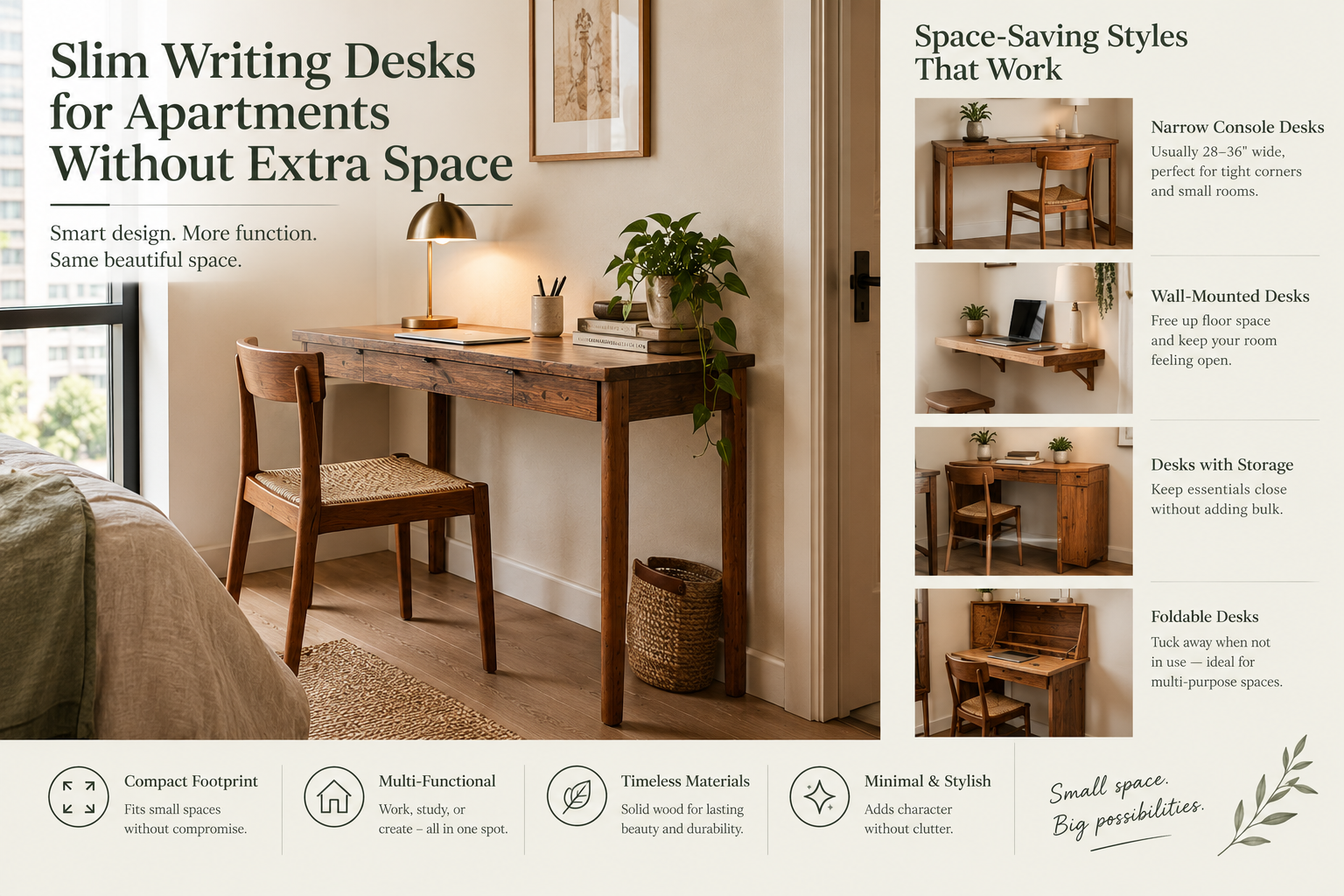
Table of Contents
- What Makes a Desk “Slim” Rather Than Just Small
- The Depth Number That Matters Most
- Where Slim Desks Fit Best in an Apartment
- Storage Without Adding Bulk
- Leg Style and Why It Affects How the Room Feels
- What to Check Before You Buy
- From Workshop to Apartment: How These Desks Are Built
- A Note on Reclaimed Wood for Compact Furniture
- FAQ
- Conclusion
What Makes a Desk “Slim” Rather Than Just Small
A slim desk isn’t just a shorter version of a standard one; it’s built around a narrower depth specifically, usually 18 to 24 inches front to back, compared to the 28 to 30 inches common on a traditional office desk. That difference matters more than overall width, since depth is what determines how much a desk actually protrudes into a room’s walkway or floor space.
A desk that’s narrow in width but still deep doesn’t solve the actual problem most apartments have, which is rarely a lack of horizontal wall space and almost always a lack of room to spare in front of the piece.
The Depth Number That Matters Most
For a genuinely tight apartment, look for a desk no deeper than 20 inches. That’s enough surface for a laptop, a notebook, and a small lamp, while leaving meaningfully more floor space than a standard desk would. If you regularly need a larger monitor or more surface area for paperwork, 22 to 24 inches is a reasonable compromise that still reads as slim compared to standard options.
Measure the actual space you’re considering before shopping, wall to wall if it’s going against a flat wall, or the specific corner or alcove if that’s where it’s headed, and subtract a few inches for clearance around any nearby door swing or walking path.
Where Slim Desks Fit Best in an Apartment
Against a Narrow Wall Segment
Many apartments have an awkward strip of wall between a window and a closet or beside a bed, too narrow for most furniture but perfect for a slim desk.
Behind a Door
If a door swings less than 90 degrees into a room, the wall space directly behind it when open often goes completely unused. A slim desk can occupy that space without interfering with the door.
In a Closet
A reasonably sized closet with the doors removed or left open can become a compact home office nook, especially with a desk shallow enough to fit comfortably within the closet’s depth.
Storage Without Adding Bulk
A single shallow drawer is usually the right amount of storage for a slim desk, enough for pens, a notebook, and small supplies without requiring the depth a filing drawer would need. Open shelving on one side can work too, provided it stays shallow enough to match the desk’s overall slim profile rather than adding bulk back in.
Resist the urge to add a lot of storage to a slim desk. The entire point of the category is minimal footprint, and overloading it with drawers or shelving usually means sacrificing the depth that made it work in the first place.
Leg Style and Why It Affects How the Room Feels
In a small apartment, open and slender desk legs let more floor and light pass visually underneath the piece, which helps a compact room feel less crowded than a desk with a solid, boxy base of the same footprint. Turned or tapered legs in particular read as lighter, which matters in a room where every piece of furniture is contributing to how spacious or cramped the space feels overall.
This is a small detail that makes a real visual difference, especially in a studio apartment where the desk is likely visible from most of the room.
What to Check Before You Buy
Beyond depth, check the desk’s overall height against your chair; standard desk height runs 28 to 30 inches, and confirm it matches comfortably with whatever seating you’re using. Also check stability specifically, since a narrower desk has a smaller base to distribute weight across, and a poorly built slim desk can wobble more than a standard-depth one would under the same use.
If you plan to use the desk for video calls or work that requires more screen space, consider a slightly wider but still shallow option rather than sacrificing width along with depth, since those are separate trade-offs.
From Workshop to Apartment: How These Desks Are Built
A slim desk requires more precise construction than its size might suggest, since there’s less overall material to distribute structural stress across while still needing the piece to stay steady under daily use. Builders working with reclaimed timber select boards for density and shape each joint individually, accounting for the narrower profile from the start rather than simply cutting down a standard desk design.
That attention to joinery is part of why a well-built slim desk holds up to daily typing, writing, and general use without the wobble that a lower-quality, mass-produced narrow desk often develops within a short time.
A Note on Reclaimed Wood for Compact Furniture
Reclaimed wood works particularly well for slim furniture, since the material’s density and stability help a piece stay structurally sound even with less material to work with than a standard-sized design. It also brings warmth and visible character to a desk that’s often otherwise purely functional, which matters in a small apartment where the desk is frequently one of the more visible pieces in the room. If you’re furnishing a compact space and want a desk built to handle daily use without taking up space it doesn’t need to, it’s worth browsing a shop like Modern Karigar for reclaimed wood options built with that kind of precision.
FAQ
What’s the ideal depth for a slim writing desk in a small apartment?
Around 18 to 20 inches works well for most compact spaces, while 22 to 24 inches offers a bit more surface area if you need it, while still reading as slim compared to standard desks.
Can a slim desk really hold a laptop and other work essentials comfortably?
Yes, for most everyday use, a laptop, notebook, and small lamp fit comfortably even on an 18 to 20-inch-deep surface, though a larger monitor setup may need slightly more depth.
Are slim desks sturdy enough for daily use?
A well-built one is, provided the joinery is solid, since a narrower base distributes weight across less material than a standard desk. Check for stability specifically before buying.
Where in an apartment does a slim desk fit best?
Narrow wall segments, the space behind a door that swings less than 90 degrees, or even a closet with the doors removed are all common, practical spots.
Is reclaimed wood a good material for a slim desk?
Yes. Its density and stability help a narrower piece stay structurally sound, and it brings visible grain and character to a desk that’s often otherwise purely functional.
Conclusion
A slim writing desk solves a real problem in small apartments: the need for a dedicated work surface without the floor space a traditional desk demands. Focus on depth first, keep storage minimal, and choose open, slender legs to help the piece feel light in the room. If your apartment has been going without a proper desk for lack of space, it’s worth measuring that overlooked wall segment or closet; it might be exactly the spot a slim desk was built for.