
L-shaped desks have a reputation for needing a lot of square footage, which makes sense if you’ve only ever seen them photographed in spacious home offices with room to spare on every side. But the shape itself isn’t the problem. Used correctly, an L-shaped desk can actually work better in a small room than a straight desk would, because it uses a corner that would otherwise sit empty.
The issue isn’t whether an L-shaped desk fits a small room; it’s whether the specific desk you’re looking at fits your specific room. Dimensions vary a lot within this category, and a lot of what’s marketed as compact still isn’t sized for a genuinely small space. Here’s how to actually find one that works.
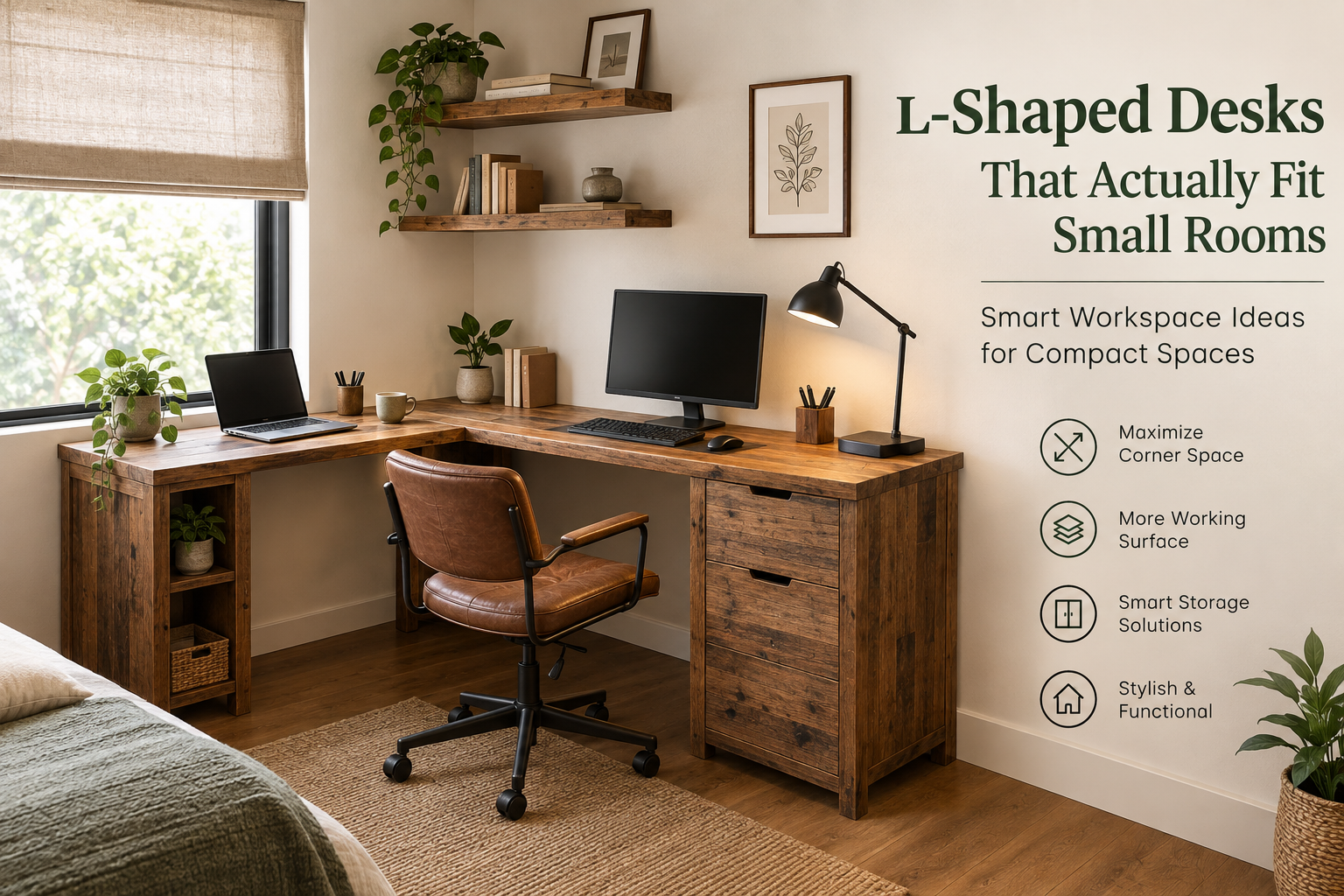
Table of Contents
- Why Corners Are the Most Underused Space in Small Rooms
- The Real Dimensions That Matter
- Choosing Between a Symmetrical and Asymmetrical L-Shape
- Placement Strategies for Tight Rooms
- What to Look for Beyond Size
- Making the Most of the Corner Itself
- From Workshop to Home Office: How These Desks Are Built
- A Note on Reclaimed Wood for Desk Furniture
- FAQ
- Conclusion
Why Corners Are the Most Underused Space in Small Rooms
Most small rooms have at least one corner that goes completely unused, because a lot of standard furniture is built for flat walls, not corners. That’s actually the argument for an L-shaped desk in a small space rather than against it. A straight desk against one wall leaves the corner empty. An L-shaped desk built to the right scale uses that corner directly, giving you more usable surface area within the same overall footprint a straight desk would occupy along one wall alone.
The mistake people make is assuming L-shaped automatically means large. Scale is what actually determines whether it fits, not the basic shape.
The Real Dimensions That Matter
For a genuinely small room, look for an L-shaped desk where each leg of the L measures no more than 40 to 48 inches, rather than the 60-plus-inch legs common in desks built for larger home offices. Depth matters just as much as length: 20 to 24 inches deep is workable for most tasks, while anything over 28 inches starts eating into a small room’s already limited floor space.
Before shopping, measure the actual corner you’re planning to use, wall to wall in both directions, and subtract at least a few inches for baseboards, outlets, or trim that might interfere with a flush fit.
Choosing Between a Symmetrical and Asymmetrical L-Shape
A symmetrical L-shape, with both legs roughly equal in length, works well when you need balanced space for two separate functions, a laptop setup on one side, reference materials or a printer on the other. An asymmetrical L-shape, with one longer leg and one shorter return, often fits small rooms better, since the shorter leg can tuck into a tighter section of the room while the longer leg provides your main working surface.
If your room has an oddly shaped corner, near a window, next to a closet, an asymmetrical option, like this L-shaped reclaimed wood desk with turned legs, tends to adapt more easily than a rigidly symmetrical one.
Placement Strategies for Tight Rooms
Anchor to the Room’s True Corner
Positioning the desk flush against the actual wall corner, rather than floating it away from the walls, maximizes the floor space saved and keeps the room feeling more open.
Face the Longer Leg Toward the Room’s Focal Point
If the room has a window or a door you regularly use, orient the desk so the longer leg runs alongside it rather than perpendicular to it, which usually preserves a clearer walking path.
Leave at Least 30 Inches for a Chair
Measure chair clearance before finalizing placement. A desk that fits the corner perfectly but leaves no room to pull out a chair defeats the purpose of the space-saving shape.
What to Look for Beyond Size
Leg style matters more in a small room than in a larger one, since open, slender legs let more floor and light pass visually underneath the desk, which can make a small room feel less enclosed than a desk with a solid, boxy base. A design with turned or tapered legs tends to read as lighter in a compact space, even at the same overall footprint as a heavier-looking alternative.
Storage built into the desk, a drawer, and a small shelf can also reduce the need for a separate storage piece elsewhere in the room, which matters when floor space is already limited.
Making the Most of the Corner Itself
Once the desk is in place, think about vertical space above it. A small shelf mounted on the wall above the shorter leg of the L can hold books or supplies without requiring any additional floor footprint. Task lighting mounted to the wall, rather than a floor or desk lamp taking up surface space, also helps a small L-shaped setup feel less cramped.
From Workshop to Home Office: How These Desks Are Built
An L-shaped desk built from solid reclaimed wood takes more planning than a straight desk, since the corner joint where the two legs meet needs to be structurally sound while still looking seamless. Builders start with reclaimed timber, sorted by hand for grain and stability, then shape and join each leg of the desk individually, accounting for how the piece will actually sit against a real room’s corner rather than a perfectly uniform showroom space.
That level of individual attention is part of why a handmade L-shaped desk tends to hold up better structurally over years of daily use than a mass-produced version built from engineered board and standardized joints.
A Note on Reclaimed Wood for Desk Furniture
A desk gets more sustained daily contact than most furniture, hours of typing, writing, and resting elbows on the same surface. Reclaimed wood holds up well to that kind of repeated use, since it’s already well-seasoned and stable by the time it becomes furniture. It also brings visible grain and warmth to a piece that’s often purely functional, which matters in a small room where the desk is likely to be one of the more visible pieces of furniture in the space. A piece like this reclaimed teak wood L-shaped desk brings that character to a small home office without requiring more square footage than the room actually has.
FAQ
Can an L-shaped desk really fit in a small bedroom or home office?
Yes, provided the individual leg dimensions are scaled down, generally 40 to 48 inches per leg rather than the larger sizes built for spacious home offices.
Is an asymmetrical L-shape better for small rooms than a symmetrical one?
Often, yes, since an asymmetrical shape can adapt to an irregular corner, tucking a shorter leg into a tighter section of the room while keeping a longer leg as the main work surface.
How much chair clearance do I need behind an L-shaped desk?
At least 30 inches to comfortably pull out and sit in a chair without feeling cramped against a nearby wall or piece of furniture.
Do open-leg desk designs really make a small room feel bigger?
Yes, to a meaningful degree. Slender or turned legs let more visual space pass underneath the desk compared to a solid, boxy base, which helps a small room feel less enclosed.
Is reclaimed wood a good material for a heavily used desk?
Yes. It tends to be denser and more stable than newer lumber, which helps it hold up to years of daily typing, writing, and general desk use without warping.
Conclusion
An L-shaped desk can absolutely work in a small room, as long as the dimensions actually match the space rather than being scaled for a larger home office. Measure your corner, choose the leg configuration that fits your room’s shape, and look for a design with open, slender legs to keep the space feeling light. If your small room has an unused corner, it might be exactly the spot an L-shaped desk was meant for.