
Buying a dining chair based on how it looks is how most people end up with chairs that don’t quite work. The proportions look right in a showroom or a product photograph, but once they’re around your actual table, something is off. The seat is too high, and your knees press against the apron. The back is too tall and catches on the edge of the table when you push in. Four chairs are one more than the table comfortably fits.
Dining chair dimensions are one of those things where a small error makes a large daily difference. You sit at these chairs for meals, for work, and for conversations that run long; the wrong size doesn’t fade into the background. It’s noticed every time.
This guide covers every measurement that matters: what to check on the chair, what to check on your table, how the two relate, and what the common mistakes look like before you make them. Whether you’re buying off-the-shelf or commissioning something handmade, the numbers here give you the framework to get it right.
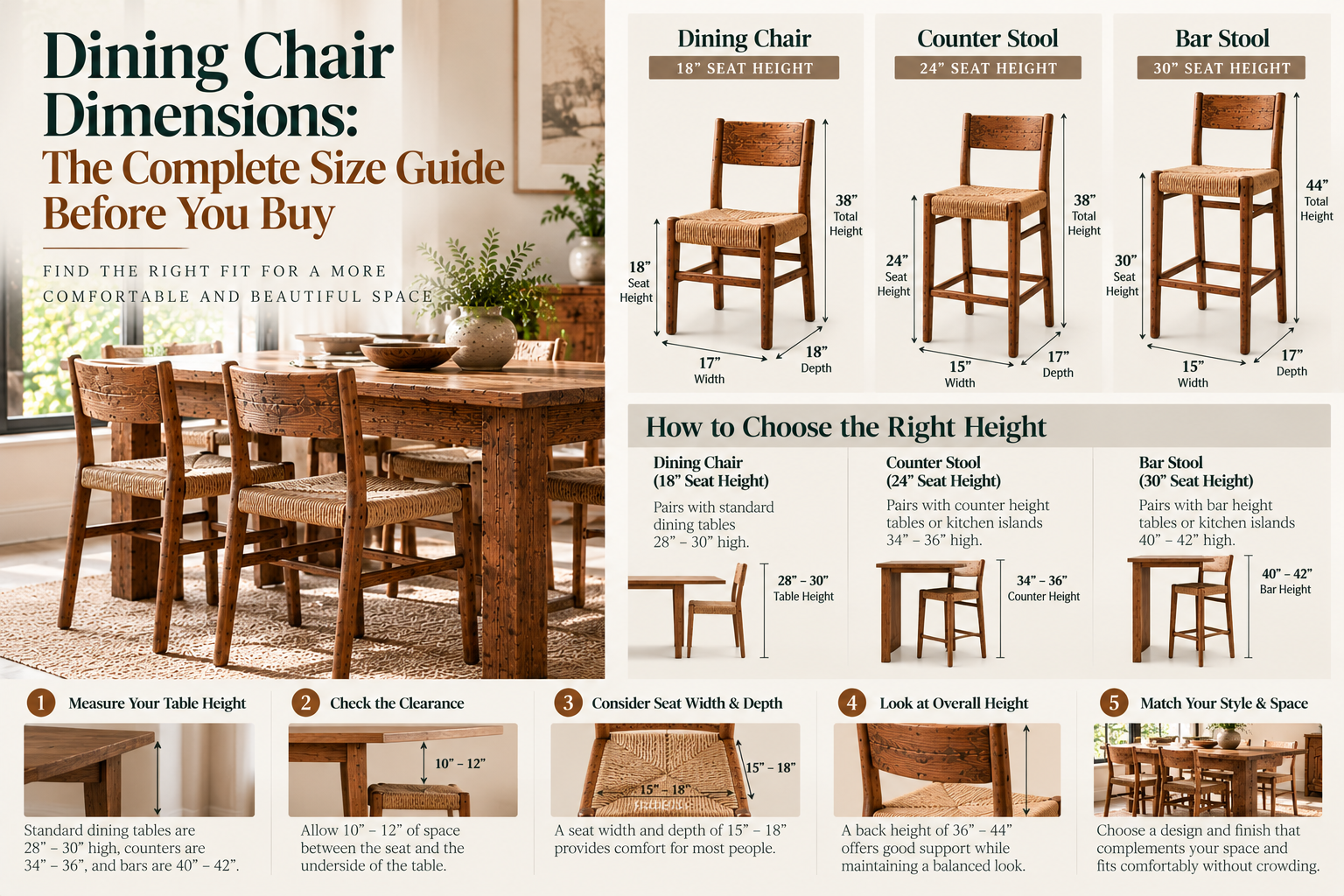
Table of Contents
- Why Dimensions Matter More Than Most Buyers Realise
- The Key Measurements Explained
- How to Match Chair Dimensions to Your Dining Table
- From the Workshop to Your Dining Room
- Common Sizing Mistakes and How to Avoid Them
- FAQ
- Final Thoughts
Why Dimensions Matter More Than Most Buyers Realise
Furniture shopping tends to happen visually. You look at the shape, the material, and the finish, and if something looks right, you buy it. For many pieces, that approach works well enough. For dining chairs, it reliably doesn’t.
A dining chair exists in a system. It has to work with a specific table, a table that has its own height, its own apron depth, and its own leg placement. A chair that’s beautiful in isolation can be genuinely uncomfortable or even unusable around a specific table. This is why dimensions come before aesthetics in the decision sequence, not after.
There’s also a comfort argument that’s separate from the table-matching question. A seat that’s too deep makes shorter people perch at the front edge rather than sit back. A back height that’s too low provides no actual lumbar support. A seat that’s too wide wastes space at the table and makes the room feel harder to move through. These aren’t edge cases; they’re common outcomes of buying chairs without checking the numbers first.
Fortunately, achieving the correct fit is quite straightforward. It requires measuring your table, understanding five or six key chair dimensions, and checking a handful of clearance rules. Ten minutes of work that prevents years of low-grade dining discomfort.
The Key Measurements Explained
Every dining chair has six dimensions that matter. Here’s what each one means and what range to look for.
Seat Height
This is the distance from the floor to the top of the seat surface, and it’s the most critical measurement for both comfort and table compatibility. The standard range for dining chairs is 43–48cm (17–19 inches).
For most adults, a seat height of 45–46cm hits the sweet spot: thighs roughly parallel to the floor, feet flat, and no strain at the knee. Shorter adults (under about 160cm) will be more comfortable toward the lower end of the range. Taller adults often prefer 47–48cm. The key constraint is your table height; more on that in the next section.
Seat Depth
Seat depth is the front-to-back measurement of the usable seat surface from the front edge to where the back begins. Standard range: 40–45cm (16–18 inches).
This measurement is more about comfort than table compatibility. A seat that’s too shallow (under 40cm) doesn’t support the full thigh and becomes uncomfortable within twenty minutes. Too deep (over 47cm) and shorter people can’t reach the back support while keeping their feet flat; they end up perching rather than sitting. For a household with varied heights, 42–44cm is a reliable middle ground.
Seat Width
Seat width is the side-to-side measurement at the widest point of the seat. Standard range: 40–50cm (16–20 inches).
Narrow seats feel restrictive and don’t work well for larger-framed adults. Tight spacing is uncomfortable, and very wide seats reduce the amount of table space available for each person. The practical sweet spot is 43–47cm for most dining chairs. For armchairs at a dining table, add roughly 10cm for the armrests, and plan accordingly.
Back Height
Back height is measured from the seat surface to the top of the backrest. Standard range: 35–50cm above the seat (giving a total chair height of roughly 80–98cm).
Low-back chairs (35–40cm above the seat) look clean and modern but provide limited lumbar support; they’re fine for shorter meals but become uncomfortable over longer sittings. Mid-back chairs (40–50cm above the seat) are the most versatile: enough support for comfortable extended sitting without the visual bulk of a high back. High-back chairs (over 50cm above seat) are statement pieces and beautiful, but they need table height and room proportions to carry them.
Armrests
Not all dining chairs have them, and whether yours should is a practical question before an aesthetic one. The key check: armrest height should be below the table surface, typically 65–70cm from the floor, against a standard table at 75–78cm. If the armrests are at or above table height, the chair won’t push under the table at all.
For everyday dining chairs, armrests are often omitted precisely because of this constraint. They work best on end-of-table ‘carver’ chairs, where the chair is approached from the side rather than slid under from the front.
Overall Footprint
The combined width of the seat, backrest, and leg spread influences how many chairs can be accommodated around a table and how the space functions when chairs are moved. It is advisable to allocate a minimum of 55–60cm of table width for each person and anticipate that chairs will extend approximately 40–50cm from the table edge when pulled out. In a compact dining area, this clearance is crucial.
How to Match Chair Dimensions to Your Dining Table
The chair doesn’t exist in isolation; it exists in relation to a specific table. This is where most sizing errors happen, so it’s worth going through the key relationships explicitly.
The Seat-to-Tabletop Gap
The most crucial measurement for comfort and functionality is the space between the top of the chair seat and the underside of the tabletop, which should be 25–30cm. Less than 25cm and your thighs press against the table. More than 30cm and you’re reaching up to eat, which strains the shoulders and makes the table feel too high.
For a typical dining table height of 75–78cm, a chair seat should ideally be between 45–48cm, aligning with standard seat height guidelines. However, issues can occur with non-standard tables: some farm tables may be taller (80–82 cm), while low-profile tables can measure 72–73cm. It’s essential to measure your specific table instead of relying on standard assumptions.
The Apron Clearance
Numerous dining tables feature a structural apron, which is the horizontal frame located beneath the tabletop and between the legs. This apron decreases the usable clearance between the table and the floor, restricting the thickness of a seat that can fit underneath.
Verify the space between the apron and the underside of the table, not merely the distance to the tabletop. A chair with a seat thickness of 4–5cm (common for solid wood seats) requires sufficient clearance to slide completely under the table when not in use. For instance, if the apron height is 65cm and your chair seat measures 46cm plus 5cm in thickness, you will have 14cm of clearance, which is generally acceptable. If the apron is positioned lower, be sure to check thoroughly.
Table Width and Chair Spacing
Standard dining tables are 85–100cm wide. At 90cm, two people can sit opposite each other without their place settings overlapping. Narrower than 80 cm, it starts to feel cramped.
Along the table length, allow a minimum of 55–60cm per person; this is the space from one person’s center to the next person’s center. For four chairs along a 120 cm table side, you need 4 × 55 cm = 220 cm, so a table that length is needed for eight diners (four per side). Planning for 60 cm per person gives more elbow room and a considerably more comfortable experience.
Leg Placement
Examine the positioning of the table legs. A table featuring four corner legs offers the greatest flexibility for arranging chairs. A pedestal table allows for unobstructed space all around. Conversely, a table with legs set inward from the corners (or with a central crossbar) may hinder chairs from being fully tucked in, irrespective of the seat size. It’s important to verify this before making a purchase, particularly for extendable tables.
From the Workshop to Your Dining Room
When dining chairs are made by hand from solid reclaimed wood, the dimensions of the conversation change slightly and in ways that work in the buyer’s favor.
Factory-produced chairs are built to tolerances. The seat height specification is 46 cm, so the production target is 46cm, with an acceptable variance of a few millimeters in either direction. The seats are typically MDF or thin ply flat, consistent, and light. Everything about the process is optimized for repeatability rather than precision for a specific use.
Handmade solid wood chairs are made with the same dimensional targets, but the material itself introduces something different: the seats are genuinely thick solid timber, often 3–4 cm, which means they have real mass, and the seat height is the height it is, not a hollow frame with a thin skin that might compress over time. When a craftsman builds a dining chair from reclaimed teak or acacia, the seat thickness and the leg length are cut to produce a specific, consistent seat height, and solid wood holds those dimensions indefinitely without sagging or compressing.
There’s also a practical benefit to buying handmade from a craftsman who can discuss dimensions directly. If your table sits at a non-standard height, a tall farm table or a low-profile contemporary design can often be adjusted. That’s a conversation that simply doesn’t happen with mass-produced furniture.
The reclaimed wood itself adds another dimension: because the material is denser than plantation-grown timber, handmade reclaimed wood chairs tend to be more stable under load. A chair that doesn’t flex or rack contributes to the perception of being well-fitted to the space; it stays where it’s put, pushes in flush, and doesn’t develop the wobble that loose-jointed factory chairs are prone to over time.
Browse handmade solid wood dining chairs at Modern Karigar →
Common Sizing Mistakes and How to Avoid Them
These are the errors that come up most often, and all of them are avoidable with a tape measure and ten minutes.
Buying Without Measuring the Table Height
Assumptions about table height are wrong surprisingly often. Older tables, bespoke tables, and tables from outside mainstream furniture retailers frequently aren’t the standard 75–78 cm. Measure yours. Everything else follows from this number.
Ignoring the Apron When Choosing Seat Thickness
Solid wood seats are significantly thicker than those made of upholstery or pressed wood, measuring 3–5 cm compared to 1–2 cm. This thickness is important if the table has a low apron. Be sure to measure the space between the apron’s underside and the seat, not just the distance to the tabletop.
Over-Ordering on Chair Count
Four chairs around a 120 cm table are comfortable. Six is not. The minimum 55 cm-per-person rule is worth respecting; squeezing in an extra chair produces a table that nobody enjoys sitting at. If you’re tempted to order more chairs than the table comfortably fits, consider whether a longer table might be the better solution.
Choosing Armchairs for All Positions
Armchairs at a dining table are generous and comfortable, but they require more width than standard chairs and need to be used with a table that has enough clearance above the armrests. A common mistake is specifying armchairs for all four sides of a table that doesn’t have the length or the right leg placement to accommodate them. Use armchairs at the ends; use standard chairs (or carver chairs) along the sides.
Neglecting Chair Space Between the Wall
In a smaller dining room, the distance between the table edge and the wall determines whether diners can pull out their chairs and sit down. The minimum for comfort is about 90–100 cm between the table edge and a wall or other obstruction; this allows the chair to be pulled out (40–50 cm) and a person to walk behind. Under 90 cm, and people are climbing into their seats. This constraint often catches buyers of extending tables: the extended position that seats eight may not be usable in the actual room.
FAQ
What is the typical height of a dining chair seat?
The standard range is 43–48 cm (17–19 inches) from the floor to the top of the seat surface. For most dining tables at 75–78 cm height, a seat at 45–46 cm produces comfortable knee clearance and the right ergonomic relationship between the diner and the table surface. The precise ideal depends on the individual’s height: taller people are more comfortable at the upper end of the range, and shorter people at the lower.
What is the ideal distance between a dining chair seat and the table?
It is advisable to have a gap of 25–30 cm between the seat surface and the bottom of the tabletop. This space allows for comfortable leg positioning without the thighs hitting the table frame. A gap smaller than 25 cm can feel cramped, while a gap larger than 30 cm may cause diners to have to reach up to eat, leading to shoulder strain during extended meals.
How many dining chairs fit around a table?
The comfortable rule is a minimum of 55–60 cm of table length per person. A 120 cm round table seats four. A 180cm rectangular table seats six (three per side) or eight with chairs at the ends. Always measure the actual table length and divide by 55 cm to get a realistic maximum; resist the temptation to squeeze in one more.
Is it possible to combine different chair heights at a single dining table?
Technically yes; practically, it’s rarely comfortable. Different seat heights mean different sightlines and different relationships to the table surface; people at different heights are eating at effectively different tables. If mixing is intentional for design reasons (benches on one side, chairs on the other), make sure both options have the same seat height. The only exception where variation is acceptable is end-of-table carver chairs, which are often slightly taller or wider than the side chairs.
Does seat depth matter as much as seat height?
For comfort over longer meals, yes. Seat depth determines whether the full thigh is supported or whether a person perches at the front edge. The standard range of 40–45cm works for most adult heights, but shorter adults (under 160cm) tend to be more comfortable at 40–42cm, and taller people at 44–46cm. For a mixed-height household, 42–44 cm is the most forgiving range.
What is the standard dining chair width?
Standard dining chairs usually have a seat width ranging from 40 to 50 cm. The ideal width falls between 43 and 47 cm, providing comfort for most adults while allowing four chairs to fit around a 180 cm table without feeling cramped. Armchairs and carver chairs are generally 10 to 15 cm wider because of their armrests, so it’s important to consider this when arranging table spacing.
Final Thoughts
Dining chairs are used more consistently than almost any other piece of furniture in a home. Getting the dimensions wrong means living with that mistake at every meal: a chair that doesn’t push in flush, a seat that’s too high, and a back that catches on the table edge. These things are noticed every day, and they’re entirely avoidable.
Measure your table. Check the seat-to-tabletop clearance. Confirm the apron depth. Count the space per person before you count the chairs. These steps take minutes and produce a dining room that works the way a dining room should, comfortably, for as long as the furniture lasts.
If you’re looking for dining chairs made from solid reclaimed wood, where the dimensions are real, the material is genuine, and the joinery is built to last the Modern Karigar collection on Etsy is worth exploring.