
A kitchen counter lacking the appropriate stools is merely a surface longing for purpose. Introduce the wrong choices: flimsy plastic seats that bend under pressure, chrome legs that disrupt the aesthetic, and cushions that can be wiped clean but never truly appear fresh again, and you’ve detracted from the space instead of enhancing it. Choose the right stools, and the entire atmosphere transforms. A kitchen evolves into a place where people genuinely want to gather.
Wooden bar stools, particularly those made from solid reclaimed timber, have a quality that synthetic and metal alternatives don’t: they bring warmth into a space that’s already full of hard surfaces. Stone countertops, tiled floors, and stainless appliances in kitchens tend toward the cool and the reflective. A solid wood stool interrupts that in exactly the right way.
These seven stools are each made from reclaimed teak or acacia dense, characterful hardwoods with long histories and long futures. They span a range of forms and heights, but they share the same essential quality: they were made by hand, from real wood, to be used every day. Here’s what makes each one worth considering.
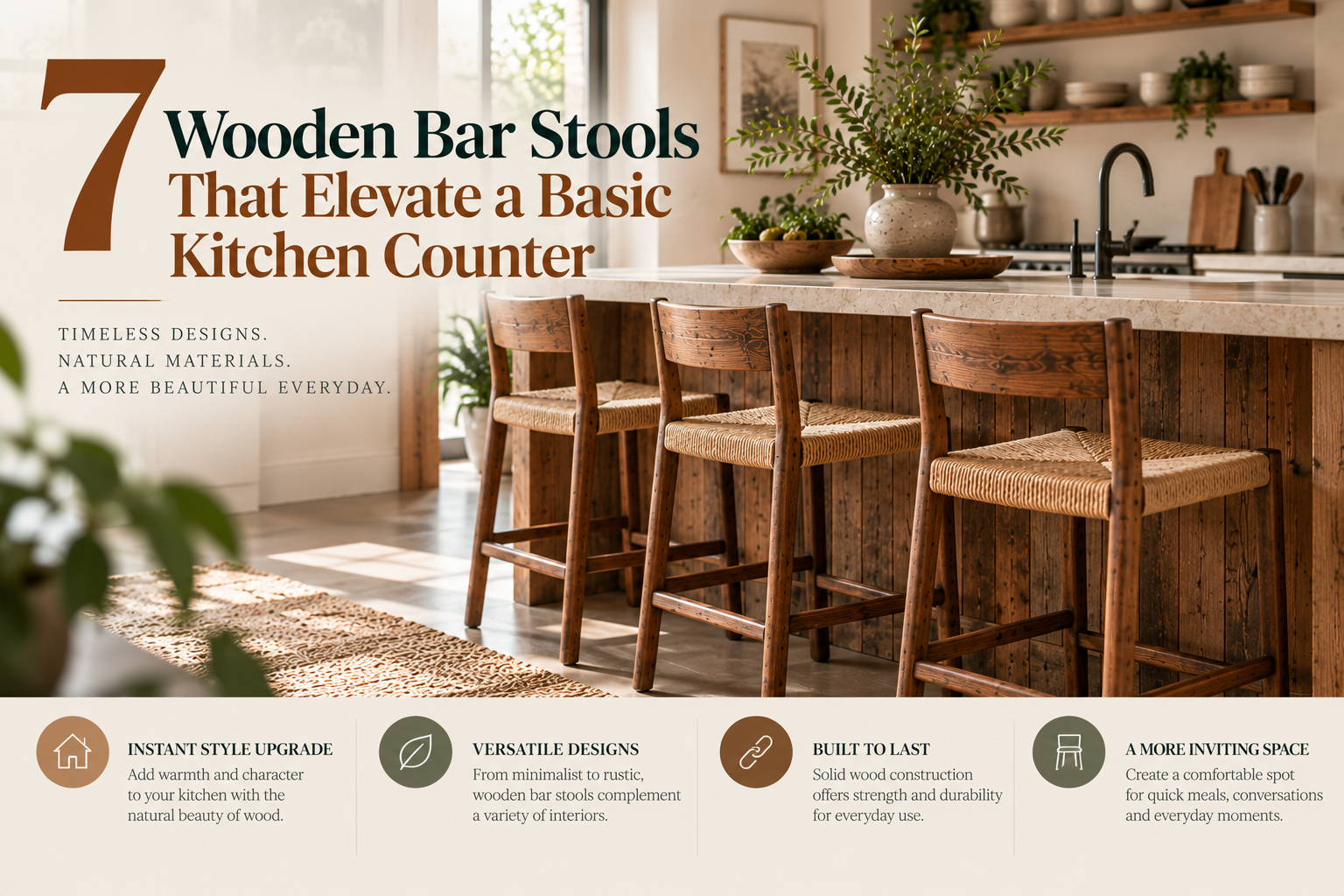
Table of Contents
- Why the Bar Stool Is the Most Overlooked Kitchen Decision
- The 7 Stools
- From the Workshop to Your Kitchen
- How to Choose the Right Bar Stool for Your Counter
- FAQ
- Final Thoughts
Why the Bar Stool Is the Most Overlooked Kitchen Decision
Kitchens receive enormous design attention: layout, appliances, cabinetry, countertop material and then the stools get chosen in ten minutes from whatever ships fastest. It’s a strange oversight, given that bar stools are often the first thing a guest sees when they walk into an open-plan kitchen and the thing they interact with most physically.
A bar stool is also one of the more demanding pieces of furniture in a home. It gets pulled out and pushed back dozens of times a day. People lean on it, stand on the rungs, drop things on the seat, and occasionally treat it as a step stool. The material and construction need to hold up to that, which is precisely where solid reclaimed hardwood, with its density and natural durability, earns its place in a kitchen setting.
Beyond durability, there’s an aesthetic argument. Kitchen counters and islands are typically designed in neutral tones: white cabinetry, grey stone, and pale tile. A wooden bar stool introduces grain, warmth, and the kind of natural variation that softens what can otherwise be a cold, hard-surfaced room. It’s one of the most cost-effective ways to change how a kitchen feels, and one that doesn’t require a renovation.
The 7 Stools
1. Reclaimed Teak Counter-Height Bar Stool
Counter-height seating occupies a tricky space that many stools struggle to accommodate too high for dining but not quite at bar height. This reclaimed teak bar stool is designed specifically for this purpose. Its proportions are thoughtfully crafted: the seat is at the ideal height for a standard kitchen counter, and the footrest is positioned to ensure your legs aren’t left dangling after just a few minutes.
The reclaimed teak showcases unique grain variations and inherent character in each seat. No two stools will appear the same, even from the same production run, and that’s intentional. This material possesses a density and warmth that cannot be matched by new-growth timber.
Best for: Standard counter heights (85–90cm), Japandi kitchens, anyone who prioritises seat comfort over sleek minimalism.
2. Reclaimed Teak Round Counter Stool
The round seat is a small but meaningful design choice. It removes directionality; there’s no ‘front’ to align with the counter, which makes it easier to swing around for conversation without the stool feeling awkward. It also reads as softer and less rigid in a kitchen setting, which works well when the rest of the room is all right angles.
Round solid reclaimed teak stool throughout, with that characteristic warm honey-to-amber grain variation. The turned legs give it a slightly more artisanal quality than a straight-legged alternative.
Best for: Kitchen islands with seating on multiple sides, informal kitchens, and anyone who prefers a seat they can spin on.
3. Handmade Reclaimed Teak Bar Stool
This bar stool embodies a timeless design, seamlessly fitting into both traditional and modern kitchens. Its spacious seat and sturdy construction ensure durability, while the natural oil content of the teak allows it to withstand moisture and wear from kitchen use without requiring a protective finish.
Handmade means no two are the same. It also means the joinery was done once, correctly, by someone who understood what they were building rather than assembled from components on a production line.
Best for: Bar-height counters and islands, farmhouse or traditional kitchen styles, buyers who want a classic form in premium material.
4. Reclaimed Acacia Counter Chair — Natural with Back
This is where the range shifts from stool to counter chair, a subtle but significant distinction. A back changes the experience of sitting at a counter completely: it becomes a seat you settle into rather than perch on. For households where kitchen counter seating doubles as a workspace or a place to eat properly, the back makes all the difference.
Reclaimed acacia has a slightly more varied grain than teak, with broader sweeps of colour and more visible figure. In natural finish, it reads warm and organic, with that quality of genuine wood that’s impossible to fake with veneer.
Best for: Kitchen counters used for longer sit-downs, work-from-kitchen setups, and family homes where comfort matters as much as style.
5. Reclaimed Acacia
Counter Chair — Curved Seat
The curved seat form is a comfort detail that’s easy to overlook in photographs but immediately noticeable in use. A slightly shaped seat distributes weight differently from a flat one. One less pressure concentration, more natural posture over longer sittings. For a counter that gets used for breakfast, working, and late-night conversations, that’s not a small thing.
Solid reclaimed acacia, natural finish, characterful grain. The kind of piece that looks better with use rather than worse.
Best for: Everyday kitchen seating, anyone who spends real time sitting at their counter, kitchens with a warm or natural material palette.
6. Reclaimed Acacia Counter Chair — Dark Finish
The darker finish on this acacia chair changes its character entirely; the same wood reads as more sophisticated, more deliberate. Where the natural finish version is warm and rustic, this one edges toward contemporary without losing the organic quality that only real wood can provide.
It pairs particularly well with darker cabinetry, concrete countertops, or kitchens with a moodier, more modern aesthetic. A piece that proves wooden stools don’t have to mean farmhouse.
Best for: Dark or moody kitchen palettes, modern-rustic interiors, anyone who wants the warmth of wood without the traditional aesthetic.
7. Reclaimed Acacia Counter Chair — Natural with Footrest
The footrest is, surprisingly, one of the most practically important details in a counter chair. Sitting at counter height with nowhere to rest your feet is uncomfortable within minutes; the weight distribution is wrong, and legs that dangle quickly become legs that fidget and swing. A solid integrated footrest solves that entirely.
Reclaimed acacia in natural finish, with a back for support and a seat that handles real daily use. This is the most practical all-rounder of the seven pieces, the one you’d pick if you needed one stool to do everything well.
Best for: Households where the counter is used constantly, buyers who prioritise long-term comfort, any kitchen where people actually sit for longer than five minutes.
From the Workshop to Your Kitchen
A handmade bar stool is a more considered object than it might appear. Before it becomes seating, it’s a piece of reclaimed teak timber pulled from a demolished structure, acacia salvaged from a source with decades of use behind it. The wood arrives dense, characterful, and already proven. It’s been through more stress cycles than most furniture will ever face in a domestic setting.
The job of the craftsman is to understand that material and work with it. Reclaimed teak and acacia both have strong grain and natural oils that affect how they take tools, how they accept finish, and how they’ll behave over time in the specific humidity conditions of a kitchen. These aren’t details that get figured out by a factory specification sheet; they’re learned through repeated handling of the material, through knowing what a particular plank is likely to do once it’s shaped and loaded.
Handmade reclaimed wood furniture made this way by one craftsman, one piece of specific timber, each stage assessed and decided rather than automated, produces an object that functions differently from its factory-made equivalent. The joints are cut to fit rather than forced into tolerance. The finish is applied to a surface that was prepared by hand, not sanded by an automated belt that can’t distinguish between tight grain and open grain. The weight distribution of the finished stool reflects choices made at the bench.
When it arrives in your kitchen, it arrives already a piece that doesn’t need to be broken in or adjusted to. It will look different from a photograph because it’s a specific object made from a specific piece of wood, and no two are the same. That individuality isn’t a compromise. It’s what you’re actually buying.
How to Choose the Right Bar Stool for Your Counter
Choosing the wrong stool for your counter can be a costly oversight. Here are some important factors to consider before making a purchase:
Get the Height Right First
It is essential to get this right. The general guideline is to maintain a 25–30 cm space between the seat and the bottom of the counter. Typical kitchen counters are 85–90 cm high, so you should look for a counter-height stool with a seat height of approximately 60–65 cm. For bar-height surfaces, which are 100–105 cm tall, a seat height of about 73–76 cm is ideal. Always measure your counter first; this is the priority before considering anything else.
Consider the Back Question Honestly
Backless stools offer a sleek appearance and can be neatly stored under the counter when not in use. Counter Stools with backs provide greater comfort for extended periods and are better suited for counters that serve as dining or work areas. If your kitchen island is primarily used for quick breakfasts lasting around fifteen minutes, a backless stool will suffice. However, if people tend to linger for an hour, having a back on the stool becomes important.
Think About Spacing Between Stools
The comfortable minimum between stool centres is about 60cm. Below that, seated people are in each other’s way. Two stools for a 120 cm island. For 180 cm, three is comfortable. Getting greedy with the stool count makes the counter feel crowded and the stools themselves harder to use.
Match the Material to the Room
Reclaimed teak features a darker, denser appearance that conveys warmth; it complements white or neutral cabinetry, stone countertops, and kitchens with a Japandi or organic modern aesthetic. On the other hand, reclaimed acacia showcases a more diverse grain pattern and a lighter natural hue; it fits well in farmhouse kitchens, wood-centric environments, and spaces where the stool is intended to stand out as a visual element rather than blend into the background. In darker finishes, acacia leans towards a contemporary style and harmonizes with moodier kitchen colour schemes.
Plan for Use, Not Just Looks
Kitchen stools endure a lot of wear and tear. Children often pull them out to reach for items, adults may push them back carelessly, and they sometimes serve as makeshift step stools for accessing higher shelves. Stools made from solid hardwood with strong joinery can withstand this treatment, while MDF and softwood typically cannot over time. Choose materials that align with the actual usage of the piece rather than how it appears in idealized kitchen images.
FAQ
What size bar stool is appropriate for a kitchen counter?
For a standard kitchen counter at 85–90 cm, you need a stool with a seat height of 60–65 cm. This leaves the 25–30 cm knee clearance that makes counter seating comfortable. For bar-height surfaces at 100–105 cm, seat height should be around 73–76 cm. Always measure your specific counter before buying rather than relying on generic size descriptions, since ‘counter height’ and ‘bar height’ are used inconsistently across different sellers.
Is reclaimed wood durable enough for bar stools?
Sufficient for kitchen seating, reclaimed hardwoods such as teak and acacia rank among the densest and most impact-resistant timber types available. They were initially chosen for structural purposes due to these qualities. A bar stool crafted from reclaimed teak or acacia can withstand the daily rigours of kitchen use, including pulling, pushing, and the typical wear and tear of home life, much more effectively than MDF or softwood options. The reclaimed nature of the wood further enhances its density, as old-growth timber features tighter growth rings compared to those from plantations.
How do I care for solid wood kitchen stools?
Little maintenance is needed. Clean up spills quickly to prevent moisture from lingering on the surface. Applying a light coat of teak oil (for teak stools) or natural beeswax once or twice a year helps nourish the wood and preserve its colour. Steer clear of silicone-based furniture sprays, as they accumulate over time and dull the natural finish without truly caring for the wood. If the surface becomes scratched or appears dull after years of use, a gentle sanding with fine-grit paper followed by a fresh coat of oil will restore it completely.
Should I choose stools with or without a back?
It depends on how the counter is used. Backless stools are cleaner in appearance, tuck fully under the counter, and are appropriate for surfaces where people sit briefly for coffee, a quick breakfast, or a drink. Counter chairs with backs are more appropriate when the counter functions as a proper eating or working surface, or when the household includes older adults or young children who benefit from back support. If in doubt, the backed version is the more versatile choice.
What’s the difference between teak and acacia for bar stools?
Both are robust hardwoods, yet they differ in appearance and characteristics. Teak is heavier, contains more natural oils, and offers superior moisture resistance, making it ideal for kitchens where spills and humidity are frequent. Its hue leans towards warm honey and amber shades. In contrast, acacia features a more intricate grain pattern and is somewhat lighter in colour, showcasing warm browns and golds. While it has less oil content than teak, it remains a durable wood. Ultimately, the decision is mostly based on visual preference: teak appears warmer and more consistent, whereas acacia presents a more diverse and unique look.
Final Thoughts
The right bar stools don’t just fill the space at your kitchen counter; they change how the counter feels to use and how the room reads to everyone who walks into it. That’s a disproportionate return on what is, compared to a kitchen renovation, a relatively modest investment.
Solid reclaimed hardwood stools are not the same proposition as their mass-produced equivalents. They’re heavier, more individual, and built with joinery that holds rather than fasteners that eventually loosen. They get better with age rather than worse. And they bring something to a kitchen that no amount of cabinetry specification can match: the warmth and character of wood that’s already had a long, honest life.
If one of the seven here feels right for your kitchen, the full collection is available at the Modern Karigar shop on Etsy. Each piece is made by hand from reclaimed timber and ships directly from the workshop.