
A bedroom has a different job from every other room in the house. It isn’t meant to impress guests or hold an activity; it’s meant to help you stop. Stop working, stop scrolling, and stop thinking about tomorrow. Yet most bedrooms end up as the place where everything without a home gets stored: the laundry chair, the stack of books, and the exercise equipment that never got put away.
Most people are unaware of how much furniture contributes to that. A bedroom full of mismatched, heavy, or visually busy pieces keeps the mind quietly working, even when the room is technically tidy. A few simple solid wood pieces, chosen with restraint, do the opposite. They give the eye a calm place to land and make the room feel settled, not crowded. Here’s how to build that, one piece at a time.
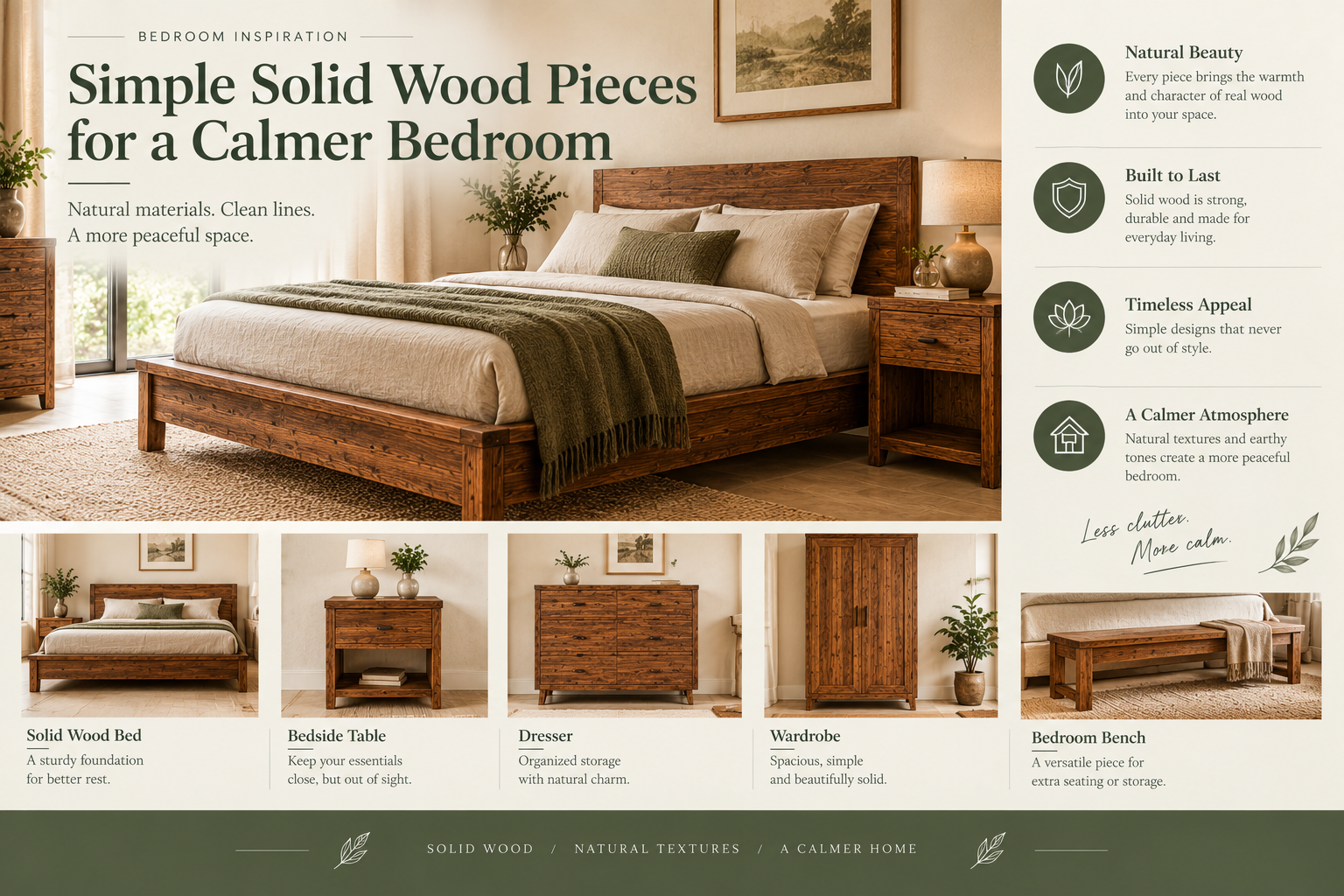
Table of Contents
- How Furniture Influences the Restfulness of a Bedroom
- The Bed Frame: The Anchor That Sets the Tone
- Nightstands That Stay Quiet
- Storage That Hides More Than It Shows
- A Bench or Chair That Earns Its Place
- Choosing a Wood Tone That Calms Rather Than Competes
- What to Leave Out
- From Workshop to Bedroom: Why Handmade Feels Different
- A Note on Reclaimed Wood in a Restful Room
- FAQ
- Conclusion
How Furniture Influences the Restfulness of a Bedroom
A room feels calm when the eye doesn’t have to work. Too many competing colors, finishes, or shapes keep the brain quietly processing the space, even if you’re not consciously noticing it. Furniture is the largest source of that visual input in a bedroom, which means the pieces you choose matter more than almost any decor you add afterward.
Solid wood helps for a simple reason: it’s a single, consistent material with natural variation rather than a mix of glossy laminate, metal, and fabric all fighting for attention. A bedroom built around two or three wood pieces in related tones reads as one cohesive thought instead of a collection of unrelated purchases.
The Bed Frame: The Anchor That Sets the Tone
The bed is the largest piece in the room and the one you look at last before sleep, so the frame sets the tone for everything else. A simple solid wood frame, with a straightforward headboard and minimal detailing, gives the room a stable focal point without demanding attention. Avoid heavily carved or ornately shaped headboards if calm is the goal, since visual complexity at the head of the bed tends to read as busy.
Height matters too. A lower-profile frame generally feels more restful than a tall, imposing one, since it keeps the room’s sightlines open and the overall feel grounded rather than dominant.
Nightstands That Stay Quiet
A nightstand’s job is to hold a few essentials without becoming a feature. Look for simple lines, a drawer or small shelf to keep things out of sight, and a surface large enough for a lamp and one or two items. Matching the wood tone to the bed frame, or choosing a closely related tone, keeps the bedside area cohesive rather than assembled.
Resist the urge to treat the nightstand as a display surface. A calm bedside has a lamp, maybe a book, and not much else. Everything beyond that belongs in the drawer.
Storage That Hides More Than It Shows
Bedrooms feel calmest when clutter has a closed home. A solid wood chest or dresser with simple drawer fronts and minimal hardware does this better than open shelving, since closed storage removes visual noise rather than displaying it. Keep the top of the piece mostly clear; a single tray or one object is plenty, so the surface reads as a quiet space rather than another thing to look at.
Choose a size that fits the room with breathing space on every side. A storage piece that’s too large for the wall makes the whole room feel tight, regardless of how simple the design is.
A Bench or Chair That Earns Its Place
A small bench at the foot of the bed or a simple wood chair in a corner can add function without clutter, but only if it’s genuinely used. A bench is useful for sitting while dressing and keeps clothes from piling on the bed. A chair that only collects discarded clothes becomes a visual stressor rather than a calm presence.
If you add one, keep it simple, in line, and matching in tone to the rest of the wood in the room. It should feel like part of the same quiet picture.
Choosing a Wood Tone That Calms Rather Than Competes
Mid-tone, warm woods tend to feel the most restful in a bedroom, rich enough to feel grounded without the heaviness of very dark finishes or the starkness of very pale ones. A consistent tone across the major pieces matters more than the exact shade, since mismatched woods create the kind of visual friction that keeps a room from settling.
If you already own pieces in different wood tones, tying them together with a consistent accent, a single textile color, or a repeated metal finish can soften the difference without requiring you to replace anything.
What to Leave Out
A calm bedroom is defined as much by absence as presence. Skip the extra side tables, decorative storage pieces, and furniture added just to fill empty walls. Every additional piece is another thing the eye has to register. If a piece doesn’t have a clear job, it’s probably adding noise.
Wall decor follows the same logic. One or two pieces of art with generous space around them calm a room more than a gallery wall of many small frames.
From Workshop to Bedroom: Why Handmade Feels Different
A handmade solid wood piece begins as timber sorted by hand for grain and stability, then shaped and joined individually rather than run through a repeated machine process. That slower approach tends to produce furniture with a quieter presence, clean joinery, honest surfaces, and proportions that feel considered rather than formulaic.
That quality matters in a bedroom specifically. Furniture that looks and feels well made tends to recede into the room instead of drawing attention, which is exactly what a restful space needs from its largest objects.
A Note on Reclaimed Wood in a Restful Room
Reclaimed wood suits a calm bedroom because its character is built in; the grain variation and subtle tonal shifts give the room warmth and texture without needing extra decoration to supply it. That means you can keep everything else simple and let the wood do the quiet visual work. If you’re building a bedroom around fewer, better pieces, it’s worth browsing a shop like Modern Karigar for reclaimed wood furniture with that kind of understated, natural character.
FAQ
What type of furniture makes a bedroom feel calmer?
Simple, solid wood pieces with clean lines and minimal detailing, in a consistent, mid-toned finish, generally create a more restful feeling than a mix of ornate or mismatched furniture.
Should bedroom furniture all match?
Not exactly, but the wood tones should be closely related. Consistency in tone matters more than identical matching sets.
How many pieces should a calm bedroom have?
Generally, a bed, nightstands, and one storage piece are enough, with an optional bench or chair only if it serves a real daily purpose.
Is open or closed storage better for a restful bedroom?
Closed storage tends to feel calmer, since it hides clutter rather than displaying it.
Does reclaimed wood work in a calm, minimal bedroom?
Yes. Its natural grain and warmth add texture without requiring extra decoration, which suits a restrained, restful room well.
Conclusion
A calmer bedroom comes less from adding things and more from choosing a few simple, well-made pieces and leaving the rest out. A solid wood bed frame, quiet nightstands, closed storage, and a restrained wood palette do more for a room’s atmosphere than any amount of decor. If your bedroom has been feeling busier than it should, it might be worth starting by removing what doesn’t serve a purpose and replacing one piece at a time with something simpler and better made.