
It’s a familiar moment for anyone who’s furnished a room gradually, piece by piece, over a year or two: everything is fine, nothing is wrong exactly, but the room doesn’t quite feel finished. Then one new piece goes in, often the dining table, the coffee table, or something substantial enough to anchor the space, and suddenly the whole room reads differently. Nothing else changed. The table did the work.
This isn’t just a styling trick or a coincidence. A statement table changes a room through a few specific mechanisms scale, material, and visual hierarchy, that are worth understanding if you’re hoping for that same shift in your own space. Here’s how it actually works, and what to look for if you want one piece to genuinely transform a room rather than just add another object to it.
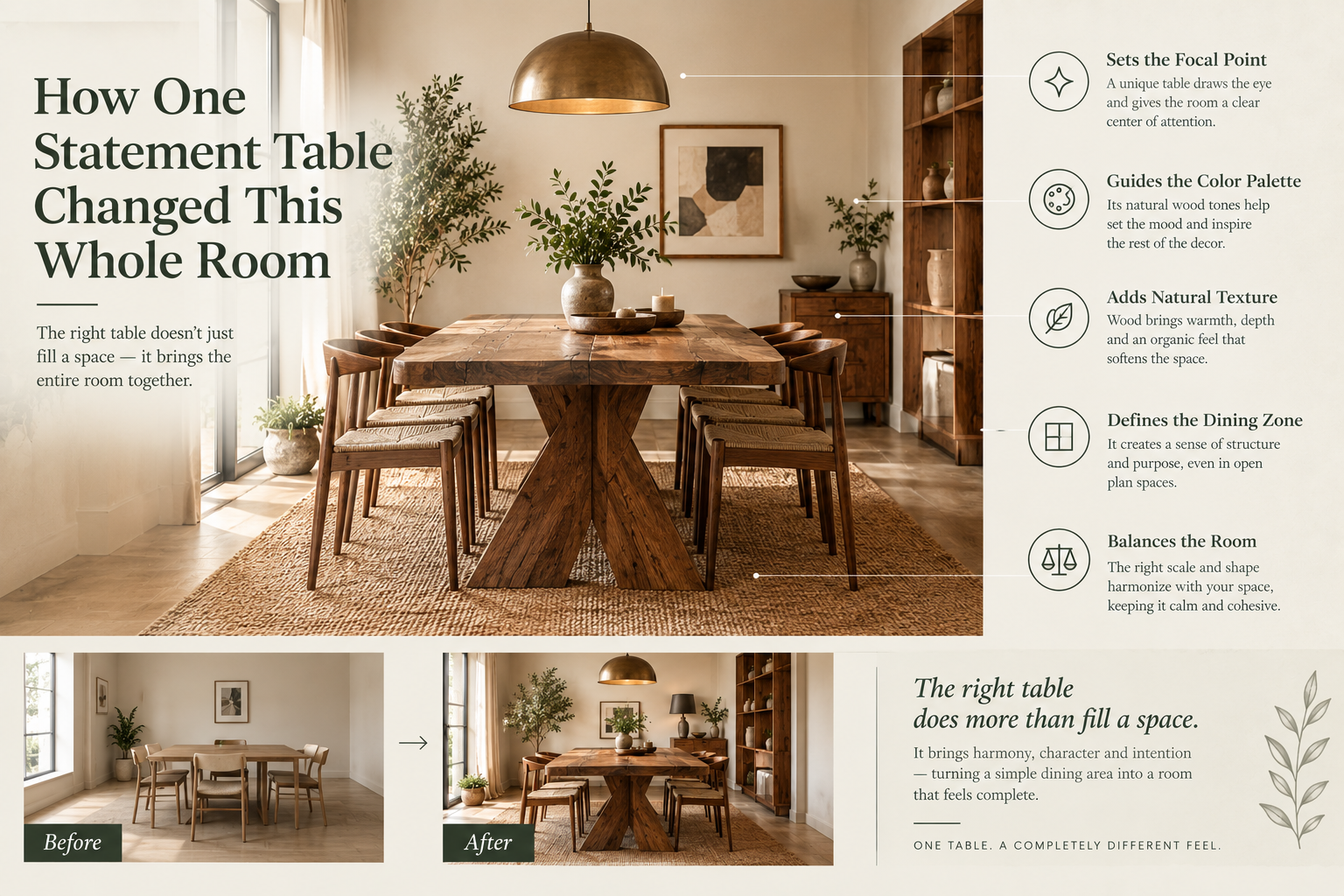
Table of Contents
- Why One Piece Can Shift an Entire Room
- Scale: The Most Underrated Factor
- Material as the Room’s New Anchor
- How a Statement Table Resets the Color Story
- What Changes Around the Table, Not Just at It
- Choosing a Table That Can Actually Do This
- From Workshop to Living Room: Why Craftsmanship Shows
- A Note on Reclaimed Wood as a Statement Material
- FAQ
- Conclusion
Why One Piece Can Shift an Entire Room
Most rooms are furnished with a collection of medium-sized pieces, a sofa, a few chairs, and some shelving, none of which individually commands much attention. A statement table breaks that pattern by being large enough, textured enough, or visually distinct enough that it becomes the first thing the eye lands on when entering the room. Once that happens, everything else in the space starts getting read in relation to the table rather than as a collection of separate choices.
This is a basic principle of visual hierarchy: a room needs one clear focal point for the eye to organize everything else around. Without one, a room can feel scattered even when every individual piece in it is nice. A strong table gives the eye that anchor.
Scale: The Most Underrated Factor
The single biggest factor in whether a table reads as a statement piece is scale relative to the room, not the table’s design details. A table sized appropriately, filling the space the way the room actually calls for rather than a slightly undersized option chosen out of caution, almost always makes more visual impact than a smaller table with more ornate detailing.
This is counterintuitive to a lot of people, who assume a smaller table leaves “more room to breathe.” In practice, an undersized table in a room built to hold something larger often reads as unfinished or tentative, while a properly scaled table fills its role with confidence, even with a relatively simple design.
Material as the Room’s New Anchor
Once a table’s scale earns the room’s attention, material is what it actually says once people are looking. A solid wood table with real grain and texture brings warmth and a sense of permanence that a glass or laminate table generally can’t match in the same way. That shift matters especially in rooms that previously leaned cooler or more neutral, since a warm, textured wood surface changes the emotional temperature of the whole space, not just the table itself.
This is part of why swapping a glass or laminate dining table for a solid wood one is one of the most commonly reported “the room suddenly feels different” moments in home styling. The material itself is doing real work, not just the shape or size.
How a Statement Table Resets the Color Story
A substantial wood table introduces a dominant tone into the room, and everything else, wall color, other furniture, textiles, starts getting read against that tone rather than existing independently. A warm reclaimed wood table can make a neutral room feel cozier by association, while a lighter wood tone can open up a room that previously felt visually heavy.
This is why people sometimes find that other furniture they already owned looks better after adding a statement table, even though nothing about those other pieces changed. The table gave the room a dominant reference point, and everything else started relating to it.
What Changes Around the Table, Not Just at It
A genuinely transformative table often triggers smaller changes elsewhere in the room almost automatically. Seating gets reconsidered to match the table’s new scale and presence. Lighting above the table becomes more noticeable once there’s a substantial piece beneath it to illuminate properly. Even wall art or decor placement nearby starts getting evaluated against the table’s visual weight rather than independently.
This ripple effect is part of why a single table purchase can feel like it changed an entire room, even when it’s technically the only new object added. The table resets how everything else in the space is being read.
Choosing a Table That Can Actually Do This
Not every table has this capacity, and it’s worth being deliberate if this is the effect you’re going for. Choose a size that genuinely fills the role the room calls for, rather than a cautious, undersized option. Prioritize real material with visible texture or grain over a flat, uniform surface, since texture is a large part of what gives a table presence. And consider shape in relation to the room: a round table for a square-leaning space, and a longer rectangular table for a room with a clear linear flow.
A reclaimed teak wood round dining table illustrates this well, combining appropriate scale with the kind of visible grain and natural variation that gives a room a genuine focal point rather than just another piece of furniture.
From Workshop to Living Room: Why Craftsmanship Shows
Part of why a handmade table carries more visual presence than a mass-produced one comes down to how it’s actually built. Builders working with reclaimed timber select boards specifically for grain character and stability, then shape and join the piece individually, which results in a surface with real depth and variation rather than the uniform, repeated texture of a factory-produced tabletop.
That individual construction is part of what gives a statement table its weight in a room, both literally and visually. It doesn’t read as one of many identical units; it reads as a specific, considered object, which is exactly the quality that makes a room feel transformed rather than simply furnished.
A Note on Reclaimed Wood as a Statement Material
Reclaimed wood is particularly well suited to this kind of transformative role, since no two boards are identical, and the natural history visible in the grain, prior markings, color variation, and subtle texture gives a table a presence that new, uniform lumber generally can’t replicate. A reclaimed teak wood dining table carries that same quality, bringing genuine material character into a room rather than a flat, repeated surface. If you’re hoping for this kind of shift in your own space, it’s worth exploring a shop like Modern Karigar for pieces with that level of natural variation built in.
FAQ
What makes a table a “statement piece” rather than just furniture?
Primarily scale relative to the room and material with real texture or presence. A table that’s appropriately sized and has visible grain or character tends to anchor a room’s visual hierarchy more effectively than a smaller, flatter alternative.
Can a statement table really change how the rest of a room looks?
Yes, indirectly. A dominant piece resets the room’s color and material story, which means existing furniture and decor often get read differently in relation to it, even without changing anything else.
Is a bigger table always more of a statement?
Not necessarily bigger, more appropriately scaled. An oversized table that doesn’t fit the room comfortably can feel overwhelming rather than intentional, while a well-proportioned table that fills its role confidently tends to have more impact.
Does the table’s shape matter for this effect?
Yes. Round tables tend to suit squarer rooms, while rectangular tables generally work better in rooms with a clear linear flow, and choosing the right shape for the space contributes to how effectively the table anchors the room.
Why does reclaimed wood work especially well for a statement table?
Because no two boards are identical, reclaimed wood brings natural grain variation and visible history that uniform, newly milled lumber doesn’t have, which gives the piece more individual presence.
Conclusion
A single table can genuinely shift how an entire room feels, not through any trick, but through scale, material, and the visual hierarchy it creates once it’s in place. Choose a size that actually fills the room’s role, prioritize real material with visible character, and the rest of the space often starts falling into place around it. If your room has been waiting for that one piece to tie everything together, it might be worth starting with the table.