“Modern sideboard” covers more design ground than the phrase suggests. Some lean toward clean minimalism with almost no visible detailing. Others take a more rustic-modern approach, pairing simple lines with raw, textured wood. A third direction leans into mid-century or vintage-inspired shapes updated with a more contemporary finish. All three get called modern, and all three look meaningfully different once they’re actually in a room.
Knowing which of these directions you’re actually drawn to, rather than shopping under the single broad label of “modern,” makes the decision a lot easier. This guide breaks down the three main styles currently defining modern sideboard design, what separates them, and how to pick the one that actually fits your space.
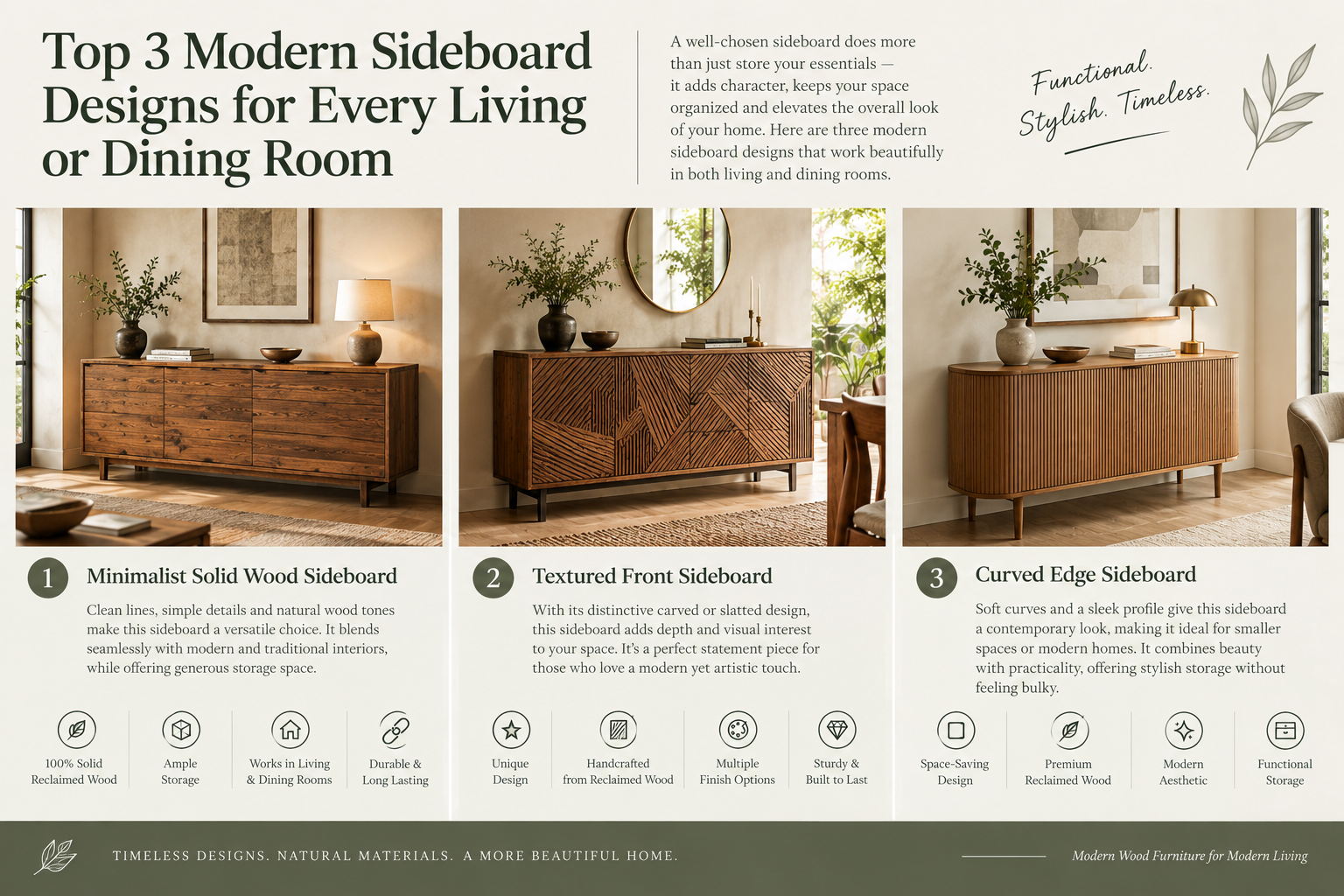
Table of Contents
- Why “Modern” Covers Three Distinct Looks
- Style One: Minimalist Modern
- Style Two: Rustic-Modern
- Style Three: Mid-Century and Vintage-Inspired
- How to Choose Between the Three
- Sizing a Sideboard to Your Room
- From Workshop to Living Room: How These Pieces Are Made
- A Note on Reclaimed Wood Across All Three Styles
- FAQ
- Conclusion
Why “Modern” Covers Three Distinct Looks
The word “modern” in furniture often gets used loosely to mean anything that isn’t overtly traditional or ornate, which leaves room for several genuinely different design approaches to all claim the label. A sideboard with razor-clean lines and no visible hardware and a sideboard with raw wood texture and exposed joinery can both be marketed as modern, but they’ll read completely differently once placed in a room.
Understanding the specific direction you want, rather than shopping for “modern” as a single category, is the difference between a sideboard that feels intentional and one that feels like it was picked somewhat at random from a broad search result.
Style One: Minimalist Modern
Minimalist modern sideboards favor flat, unadorned fronts, often with push-to-open mechanisms instead of visible hardware, straight legs or a low plinth base, and a restrained color palette, usually a single wood tone or a matte painted finish. The emphasis is on clean geometry and quiet presence rather than texture or detail.
This style works best in rooms that are already fairly streamlined, where the goal is for the sideboard to blend in as a functional surface rather than draw attention on its own. It’s also a strong choice for smaller spaces, since the lack of visual detail can make a piece feel less bulky even at a substantial size.
Style Two: Rustic-Modern
Rustic-modern sideboards combine simple, modern silhouettes with visibly textured, often reclaimed wood, letting the grain and natural character of the material carry the design rather than relying on hardware or paint. Straight lines and minimal ornamentation keep it from tipping into a fully traditional or farmhouse look, while the raw wood surface gives it warmth and texture that pure minimalist design doesn’t have.
A rustic reclaimed teak wood sideboard is a clear example of this direction, pairing a straightforward, modern shape with the kind of natural grain variation that gives the piece real visual depth. This style tends to suit rooms that already lean warm or earthy, where a flat, painted minimalist piece would feel slightly out of place.
Style Three: Mid-Century and Vintage-Inspired
This direction borrows from mid-century design, tapered or angled legs, often set slightly inward from the corners, warm wood tones, and sometimes subtle detailing like fluted fronts or brass accents, while staying restrained enough to read as contemporary rather than a direct period reproduction. It splits the difference between the clean lines of minimalist modern and the texture of rustic-modern, typically with a more polished, finished surface than either.
A vintage-inspired reclaimed teak wood sideboard reflects this approach well, carrying recognizable mid-century shaping while staying grounded in a natural wood finish rather than leaning into a fully retro color palette. This style tends to work particularly well as a statement piece in a living or dining room that wants a bit more visual interest than pure minimalism offers.
How to Choose Between the Three
Think about what the rest of the room is already doing. A space with a lot of clean, simple lines and minimal texture elsewhere, furniture, wall color, and flooring generally suits minimalist modern, since a heavily textured sideboard would stand out as the one busy element in an otherwise quiet room. A room with warmer tones, natural materials, and some textile layering tends to suit rustic-modern better, since the sideboard’s grain and texture echo what’s already happening elsewhere.
Mid-century and vintage-inspired pieces work well as the room’s one clear focal point, particularly in spaces that are otherwise fairly neutral and could use a piece with more personality to anchor them.
Sizing a Sideboard to Your Room
Regardless of style, proportion matters more than most people expect. A sideboard should generally span no more than about two-thirds of the wall it sits against, leaving breathing room on either side rather than running edge to edge. Height-wise, most sideboards fall between 30 and 34 inches, which works well beneath a piece of wall art or a mirror hung with the standard clearance of 6 to 8 inches above the furniture.
Depth matters for function as much as fit. A sideboard under 16 inches deep works for display and lighter storage, while anything meant to hold serving dishes or linens generally needs at least 18 to 20 inches to be genuinely useful.
From Workshop to Living Room: How These Pieces Are Made
Across all three design directions, the construction process behind a solid wood sideboard shares the same foundation. Builders start with timber, often reclaimed, sorted by hand for grain and stability, then shape and join each piece individually rather than relying on a repeatable, machine-only process. The specific style, minimalist, rustic-modern, or mid-century, mostly affects the finishing and detailing stage, while the underlying joinery and construction quality matter the same regardless of which aesthetic direction a piece leans toward.
That structural consistency is part of why a well-built sideboard in any of these three styles can hold up to years of daily use as both storage and a visual anchor in a room.
A Note on Reclaimed Wood Across All Three Styles
Reclaimed wood works across all three modern sideboard directions, though it shows up differently in each. In minimalist modern pieces, it’s often a quieter, more uniform grain that doesn’t distract from the clean lines. In rustic-modern pieces, the grain and natural character become the design’s main feature. In mid-century and vintage-inspired pieces, reclaimed wood brings warmth that complements the style’s period-adjacent detailing without tipping into a strictly retro look. If you’re deciding between these directions, browse a shop like Modern Karigar to see how reclaimed wood works across different sideboard styles before settling on one.
FAQ
What’s the difference between minimalist modern and rustic-modern sideboards?
Minimalist modern favors flat, unadorned surfaces with little visible texture, while rustic-modern pairs similarly simple shapes with visibly grained, often reclaimed wood that carries more natural texture and character.
Is a mid-century sideboard considered modern?
Mid-century and vintage-inspired designs are often marketed under the modern umbrella since they avoid heavy ornamentation, though they carry more period-specific detailing, like tapered legs, than minimalist or rustic-modern pieces.
How do I know which style fits my room?
Look at what your room is already doing. Clean, quiet spaces suit minimalist modern; warmer and more textured spaces suit rustic-modern; and neutral rooms that need a focal point often suit mid-century or vintage-inspired pieces.
What’s the ideal sideboard depth for storage?
At least 18 to 20 inches if you plan to store serving dishes, linens, or similar items. Anything under 16 inches works better for display than functional storage.
Does reclaimed wood work in all three sideboard styles?
Yes, though it shows up differently depending on the style, more subtle in minimalist designs and more prominent as the main visual feature in rustic-modern pieces.
Conclusion
A “modern sideboard” isn’t one look; it’s at least three distinct directions, each suited to a different kind of room. Minimalist modern, rustic-modern, and mid-century or vintage-inspired designs each offer something different in texture, detailing, and overall presence. If you’re shopping for a sideboard, it’s worth figuring out which of these three directions actually matches your room before narrowing down specific pieces.