
Real wood brings a unique warmth to a space that cannot be matched. Unlike the artificial warmth of laminate or the chill of glass and metal, it offers a deeper, more genuine feeling. This warmth emanates from wood that has a history, having lived a life before finding its place in your home.
Reclaimed teak has that quality in abundance. Salvaged from old structures barns, bridges, and demolished homesteads, each plank carries visible grain patterns, mineral streaks, and small surface stories that a freshly milled board simply can’t replicate. When that material becomes a coffee table, placed at the centre of where you actually live, something shifts in a room. It becomes less of a showroom and more of a home.
This post walks through three reclaimed teak coffee tables worth knowing about — each different in form, each doing something specific for the spaces they inhabit. Whether you’re drawn to the perfect circle, a quietly elegant arch, or an organic oval, there’s likely one here that already feels like yours.
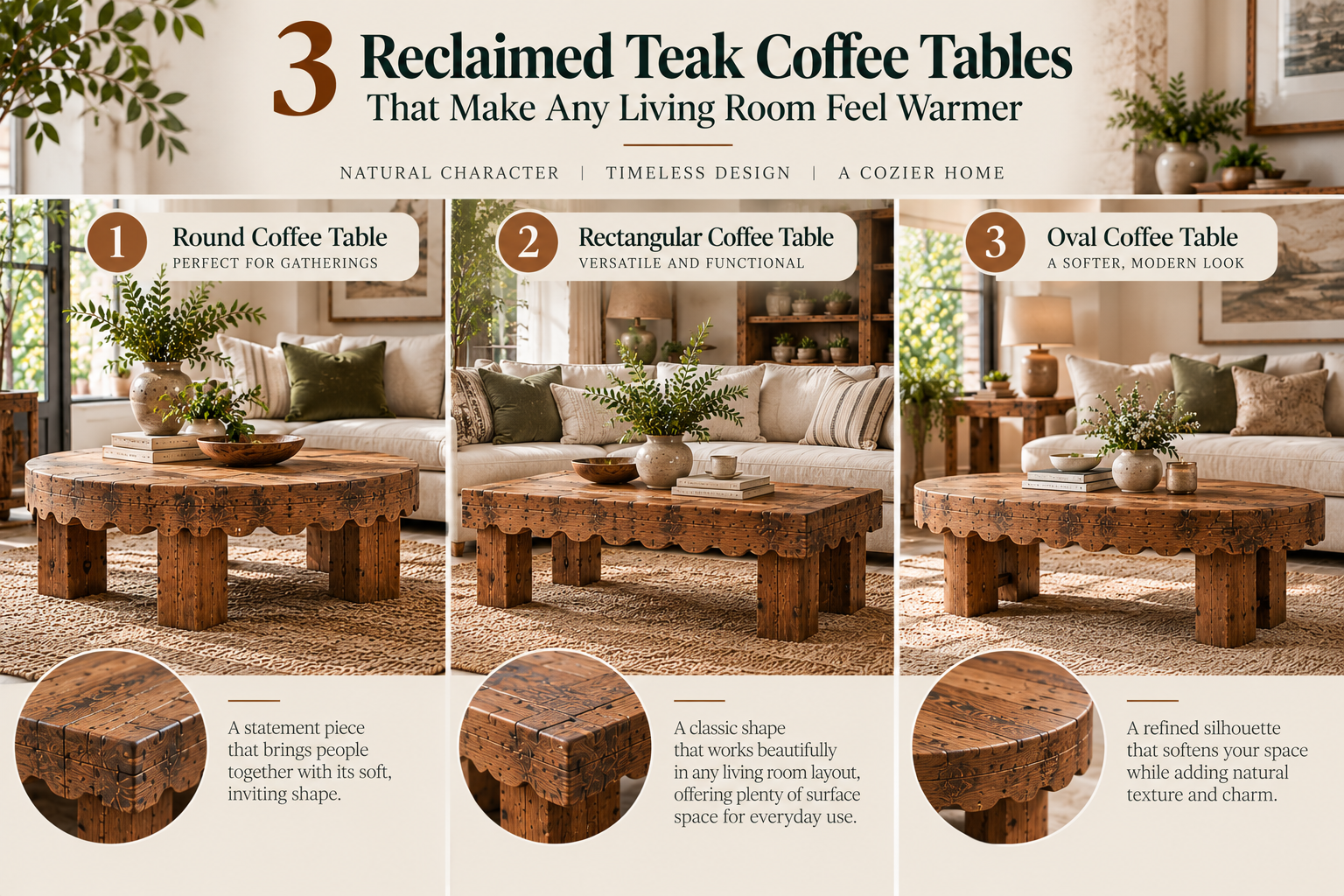
Table of Contents
- The Unique Qualities of Reclaimed Teak and Their Importance
- The Round Table: A Blend of Rustic Charm and Contemporary Style
- The Arch Table: A Fusion of Design and Essence
- The Oval Table: Gentle Curves for a Cozy Atmosphere
- Craftsmanship: From Workshop to Your Home
- Tips for Decorating with a Reclaimed Wood Coffee Table
- FAQ
- Final Thoughts
The Unique Qualities of Reclaimed Teak and Their Importance
Not all wood ages the same way. Teak, in particular, becomes something more interesting with time — denser, darker in places, with a natural oil content that makes it resistant to moisture and wear without any chemical treatment. But reclaimed teak takes that a step further.
When teak is sourced from old structures, salvaged floorboards, decommissioned boats, or demolished colonial-era buildings, it arrives with decades of compression and use already in it. The grain is tighter. The colour variation is richer. And the character marks, small knots, the occasional crack sealed with age, and faint tool marks from a previous craftsman aren’t imperfections. They’re a record.
Beyond the aesthetics, reclaimed teak carries an environmental logic that matters more and more. No new trees felled. No forest cleared. The wood already exists; it just needed someone to see its second life.
For interior designers and thoughtful homeowners alike, that combination of beauty, durability, and purpose makes reclaimed teak one of the most compelling materials a furniture piece can be made from.
The Three Tables
1. The Round Table: A Blend of Rustic Charm and Contemporary Style
There’s a reason round tables have a long history in communal spaces: they invite people in. No sharp corners to navigate, no dominant end. Everyone gathered around a round table is at the same distance from the centre, which makes the whole room feel less arranged and more inhabited.
This particular round coffee table is made from thick slabs of reclaimed teak, and the craftsmanship keeps things honest: the surface is smoothed and finished, but the wood’s natural grain is left to read clearly. You’re not meant to mistake this for anything other than what it is: old wood, carefully given a new form.
It works especially well in smaller living rooms where a rectangular table would feel like an obstacle. The circular form also pairs naturally with curved sofas and rounded accent chairs, a design choice that interior stylists increasingly lean toward for rooms that feel relaxed rather than rigid.
Best for: Cozy apartments, Japandi interiors, eclectic living rooms, families with young children.
2. The Arch Table: A Fusion of Design and Essence
The arch base table is what makes this one stop you. It’s a shape that manages to be simultaneously architectural and warm, like the bones of an old doorway, rebuilt in miniature and placed in the middle of your living room.
The tabletop is a spacious piece crafted from reclaimed wood, showcasing the unique variations in grain and colour that only age and usage can impart. However, it is the base that narrates a design tale. Two gracefully arching supports, sturdy and assured, provide the table with a notable presence without feeling cumbersome. This is a piece that justifies its footprint.
For spaces that already have some visual interest a gallery wall, patterned textiles, and layered rugs, the arch table holds its ground without competing. It’s also a good choice for higher-ceilinged rooms, where a lower, sprawling table might feel lost.
Best for: Bohemian interiors, mid-century modern spaces, statement living rooms, and designers who want a focal point that isn’t a sofa or rug.
3. The Oval Table: Gentle Curves for a Cozy Atmosphere
If the round table is an invitation and the arch table is a statement, the oval coffee table is something more like a sigh of relief. It has all the flow of a round form but with a longer surface that gives you more practical room space for a tray, a stack of books, a candle, and still somewhere to set your coffee.
The oval also has a particular quality in a narrow room: it takes up less visual width than a rectangle while still offering real table length. Interior designers working with tight layouts often choose oval tables for this reason.
In reclaimed teak, the oval form takes on additional depth. Because the wood has its own pattern, sometimes lighter at the edges and darker toward a central knot, an oval slab can feel almost like a natural object, something that arrived at this shape on its own. That quality is hard to manufacture and impossible to fake.
Best for: Narrow living rooms, Scandinavian and organic modern interiors, design-conscious minimalists, anyone who finds rectangular tables too formal.
Craftsmanship: From Workshop to Your Home
Handmade reclaimed wood furniture doesn’t begin in a design software file. It begins with the wood itself, a piece sourced, assessed, and understood before a single cut is made.
The reclaimed teak used in tables like these often arrives with its own history visible: old bolt holes, saw marks, and the faint imprint of previous use. Part of the craftsman’s work is deciding what to preserve, what to plane away, and what to let sit as a reminder. That decision-making is where the handmade nature of these pieces becomes most apparent. No two tables are ever quite identical, even when built to the same form.
Once the wood is selected and prepared, the shaping begins: joinery fitted, edges softened, and legs and bases constructed to carry the weight of a slab that might have spent thirty years as something else entirely. The finishing is low-intervention: oils that feed the wood rather than seal it off, preserving its natural feel underfoot and under your hand.
When the table finally arrives in your home, it doesn’t need to announce itself. It just settles in. And because the materials are honest, real reclaimed teak, and real hand-built construction, it tends to look better as it ages, not worse. A scratch becomes part of it. A coffee ring fades in time. The table adapts to your life instead of requiring you to protect it from it.
That’s what makes handmade reclaimed wood furniture a fundamentally different investment than most things you might buy for your home. You’re not purchasing a product that will need replacing in a few years. You’re acquiring something that was already built to last — and built again, by hand, to last even longer.
Tips for Decorating with a Reclaimed Wood Coffee Table
The good news about styling a piece like this is that it doesn’t require much. The wood does a significant amount of the work on its own; its colour, grain, and natural variation give the table visual interest before anything is placed on it. The goal, then, is to complement rather than compete.
Keep the Surface Intentional, Not Cluttered
A reclaimed teak coffee table tends to get lost under too much styling. A simple tray anchoring one corner, a small stack of books, or a single candle or plant, that’s often enough. The wood grain itself is worth leaving visible. Think of the table as art you can use, not a shelf that needs filling.
Layer Textures Around It
Warm wood reads differently depending on what surrounds it. A jute or wool rug underneath pulls out the earthy tones. Linen-covered cushions nearby echo the natural palette. The contrast of a ceramic vase or stone coaster against the teak grain adds depth without colour-clashing. Reclaimed teak tends to sit harmoniously with almost everything; it’s neutral in the way that only natural materials can be.
Consider the Light
Reclaimed teak changes considerably under different lighting. In warm evening light, the amber and honey tones come forward. In natural daylight, you notice more of the variation: darker mineral streaks and the subtle shift from sapwood to heartwood. Placing your table near a window, or under a warm-toned floor lamp, will bring out qualities that overhead fluorescent light simply won’t show.
Pair It With the Right Interior Style
Reclaimed teak coffee tables are flexible enough to work across several interior styles, but they’re most at home in Japandi interiors (the imperfection is intentional), organic modern rooms (where natural materials anchor everything else), and eclectic or bohemian spaces (where the table’s character contributes to a layered look). They can even hold their own in more contemporary settings when the surrounding furniture is kept clean-lined and minimal.
FAQ
Is reclaimed teak sufficiently durable for daily use?
Very much so. Teak is one of the densest and most naturally oil-rich hardwoods in the world, originally prized for shipbuilding and outdoor architecture precisely because of how well it holds up under continuous use and changing conditions. Reclaimed teak, having already been structural wood in a previous life, is typically even denser and more stable than freshly milled boards. A reclaimed teak coffee table built with proper joinery should last for decades with minimal maintenance.
What is the best way to maintain a reclaimed teak coffee table?
Less intervention than you might expect. Wipe spills with a damp cloth; avoid leaving standing water. Once or twice a year, a light application of teak oil or natural beeswax will feed the wood and maintain its lustre. Avoid harsh chemical cleaners. Exposure to direct sunlight over time can lighten the surface slightly, this is natural and many people prefer it. The wood’s character evolves, which is part of what makes it interesting to live with.
Will my reclaimed teak coffee table appear just like the images?
Nearly similar, yet distinct — and that’s by design. Reclaimed wood is inherently variable. Each board showcases its unique grain pattern, individual history, and subtle colour differences. While tables are crafted to consistent dimensions and shapes, the unique character of the teak surface varies. will be unique to your piece. This is considered a feature, not a flaw. You’ll end up with something no one else has.
Does reclaimed wood furniture truly have a positive impact on the environment?
Generally, yes. Using reclaimed wood means no additional trees are felled for your furniture. The embodied energy in the original harvesting and processing of the wood is already spent. For buyers who care about their environmental footprint, reclaimed wood furniture is one of the more straightforward ways to make a lower-impact choice without sacrificing quality or aesthetics.
Can a reclaimed teak coffee table work in a modern or contemporary interior?
Absolutely. The key is in how it’s surrounded. Pair it with clean-lined furniture in neutral tones of whites, greys, and soft blacks and the warm, organic quality of the teak becomes a counterpoint to rather than a clash with contemporary design. A single natural wood piece in an otherwise modern room often ends up being the most visually interesting element in it.
Final Thoughts
A coffee table is, in theory, a simple thing. A surface. A place to set things down. But in practice, it’s the piece of furniture your eye returns to most often when you’re sitting in a room and the one your guests are most likely to reach out and touch.
That makes the material matter. And reclaimed teak, shaped by hand into a round, an arch, or an oval, brings something to a room that a mass-produced alternative simply can’t replicate: the sense that the thing you’re living with has a genuine history and a genuine future.
Should any of the three tables resonate with you, or if you’re still contemplating, it’s beneficial to engage with the actual items. While the photographs capture their shape, the unique character of the wood will reveal itself in your own environment and lighting.