
Wooden furniture never really goes out of style, but the way we use it keeps shifting. Some years it’s all sharp lines and dark stains; lately it’s softer, warmer, and a little more handmade. If you’ve been scrolling design feeds and saving more wood than you can keep track of, you’re not alone.
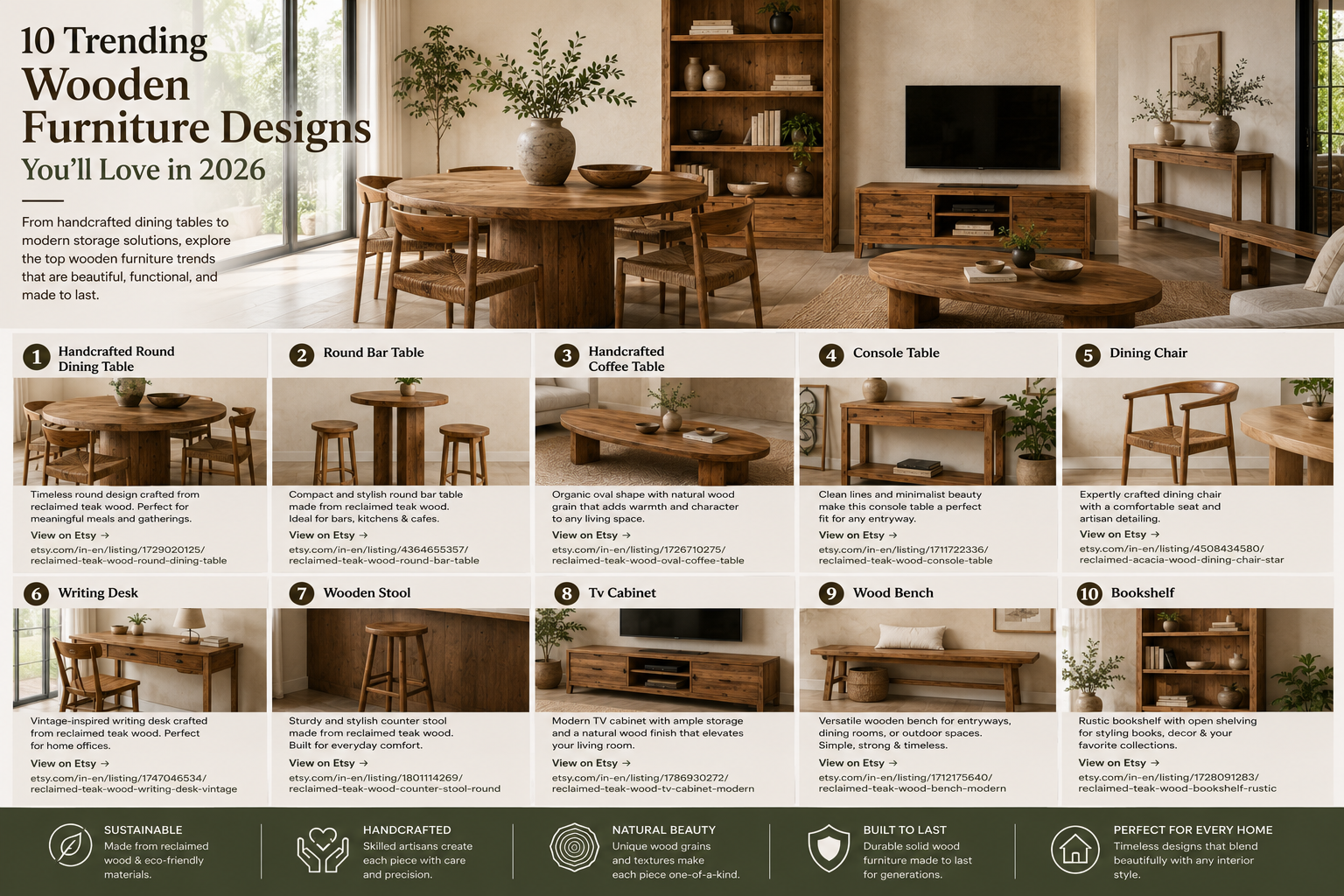
This is a roundup of ten wooden pieces having a genuine moment right now, the kind that show up again and again in well-styled rooms. For each one I’ve added a quick note on why it works and how to make it land in your own space. Whether you’re furnishing from scratch or just hunting for one piece to lift a room, there’s something here worth a closer look.
Walk into almost any well-designed home right now and you’ll spot one: a solid wood bench. By the front door, at the foot of the bed, tucked under a dining table. After years of mass-produced metal-and-veneer furniture dominating our feeds, the humble wooden bench has quietly become one of the most requested pieces among interior designers — and honestly, it makes sense.
A bench does what very few furniture pieces can. It seats people without crowding a room, stores things without looking like storage, and ages beautifully instead of falling apart. If you’ve been wondering whether a solid wood bench deserves a spot in your home, this guide covers why the trend is real, where these benches work best, and what to look for before you buy.
Table of Contents
- Why Solid Wood Benches Are Trending Again
- What Makes Solid Wood Different
- Where a Bench Works Best in Your Home
- From the Workshop to Your Home
- The Case for Handmade Reclaimed Wood
- Styling Tips That Actually Work
- FAQ
- Final Thoughts
Why Solid Wood Benches Are Trending Again
Three forces are driving this comeback, and none of them are passing fads.
Design fatigue. A decade of minimalist grey interiors left homes feeling cold. The pendulum has swung hard toward warmth—natural grain, visible joinery, and materials with texture you can feel. A solid wood bench delivers all of it in one piece.
Flexible living. Homes work harder now. The entryway doubles as a mudroom; the dining room becomes an office by day. Benches slide under tables, move between rooms, and seat three people where two chairs would fit. That flexibility is exactly what modern households need.
The sustainability shift. Buyers are asking harder questions about where furniture comes from. Fast furniture—particleboard pieces designed to last three to five years—is losing ground to solid wood that lasts generations. When that wood is reclaimed, the appeal doubles: character and conscience in the same purchase.
What Makes Solid Wood Different
Not all “wood” benches are equal, and this is where many buyers get burned. Veneer over MDF looks similar in photos but chips at the edges, swells with humidity, and can’t be refinished. Solid wood — especially dense hardwoods like teak — behaves completely differently.
Teak in particular has natural oils that resist moisture, insects, and warping. It’s why old teak furniture from the 1960s still sells for serious money while flat-pack pieces from five years ago sit on the kerb. A scratch on solid teak? Sand it out. A scratch on veneer? Permanent.
Here’s a quick test when shopping: look at the end grain. On solid wood, the grain wraps continuously around the edge. On veneer, you’ll see a thin layer sitting on top of a different material, like icing on a cake.
Where a Bench Works Best in Your Home
The Entryway
This is the bench’s natural habitat. You need somewhere to sit while putting on shoes and somewhere for those shoes to live. An entryway bench with a built-in shoe rack solves both problems in one footprint—seating on top and a storage shelf below. For narrow hallways, keep the depth under 40 cm so the walkway stays clear.
Against a Wall or in a Reading Corner
If the bench will sit against a wall where people lean back—a hallway nook, a bedroom corner, or a covered verandah—choose one with a backrest. It turns occasional seating into somewhere people actually linger.
The Dining Table
Pairing a bench with chairs is one of the easiest ways to make a dining setup feel collected rather than catalog-bought. A rustic teak bench on one side, chairs on the other—it seats more people, slides away cleanly, and softens the formality of a matched set.
Foot of the Bed
A bench with a lower shelf at the end of the bed gives you somewhere to sit, somewhere to drop tomorrow’s clothes, and a shelf for blankets or baskets. It also anchors the bed visually, which makes even a simple bedroom feel finished.
From the Workshop to Your Home
There’s a story behind a handmade bench that no factory line can replicate, and it starts long before the wood reaches a workshop.
Reclaimed teak typically begins life elsewhere—old homes, doors, beams, and sometimes furniture too damaged to save whole. Craftsmen sort through this salvaged timber piece by piece, setting aside boards with sound structure and interesting grain. The wood is then cleaned, de-nailed, dried, and milled by hand.
Joinery comes next, and this is where handmade earns its name. Instead of staples and cam locks, a craftsman cuts traditional joints—mortise and tenon and dovetails—that hold through decades of daily use. Sanding happens in stages, finer and finer, until the surface feels like worn river stone. A natural oil or wax finish goes on last, protecting the wood while letting every knot, nail mark, and weathered patch show through.
By the time a bench reaches your home, it carries two histories: the decades the wood already lived and the hours of handwork that gave it a second life. No two pieces come out the same, because no two boards go in the same.
The Case for Handmade Reclaimed Wood
Beyond the story, there are practical reasons reclaimed wood furniture keeps winning over buyers and designers alike.
Old-growth teak — the kind found in salvaged beams and vintage structures — is denser and more stable than most freshly harvested timber available today. It has already done its expanding and contracting over decades, so it’s far less likely to warp in your home.
Then there’s the environmental math. Every reclaimed bench means one less tree cut and one more load of usable timber kept out of landfill. For homeowners trying to furnish responsibly without sacrificing quality, it’s one of the rare choices where the sustainable option is also the more durable one.
And character, frankly, can’t be manufactured. The small nail holes, the color variation, the patina—these are the details designers point to when a room photographs beautifully.
Styling Tips That Actually Work
- Layer a runner or sheepskin over part of the bench, never the whole thing. Let the grain show.
- Stick to the two-thirds rule in entryways: the bench should span roughly two-thirds of the wall it sits against.
- Pair warm with warm. Reclaimed teak loves linen, jute, terracotta, and brass—skip cool grays.
- Echo the wood elsewhere. A teak bench pairs naturally with a reclaimed teak coffee table in the same room; matching tones tie a space together without matching sets.
- Leave it imperfect. A water ring or scuff on reclaimed wood reads as character, not damage. Resist the urge to over-polish.
FAQ
Are solid wood benches worth the price?
Yes, when you factor in lifespan. A solid teak bench can last 50+ years and be refinished multiple times, while veneer furniture typically needs replacing within a decade. Cost per year of use almost always favors solid wood.
Is reclaimed teak as strong as new teak?
Often stronger. Reclaimed teak usually comes from old-growth trees, which produce denser timber than modern plantation teak. It has also fully seasoned, making it more stable.
How do I maintain a reclaimed wood bench?
Dust regularly, wipe spills promptly, and apply a natural wood oil once or twice a year. Keep it out of prolonged direct sunlight to slow color fading. That’s genuinely all it needs.
Can a wooden bench be used outdoors?
Teak can handle covered outdoor spaces like verandahs and balconies thanks to its natural oils. For fully exposed areas, expect the wood to weather to a silver-grey patina unless oiled regularly.
What size bench should I buy for an entryway?
Aim for 100–120 cm in length for a standard entryway, with a seat height of 45–48 cm. If space is tight, prioritize a model with built-in storage so one piece does two jobs.
Final Thoughts
The return of the solid wood bench isn’t really about trends—it’s about people choosing furniture that works harder, lasts longer, and feels like it belongs. Whether it lands in your entryway, your dining room, or at the foot of your bed, a well-made bench earns its space every single day.
If handmade reclaimed teak appeals to you, take a look at small workshops crafting these pieces from salvaged wood. The bench arrives with a history already built in and a few more decades ahead of it.