
A crack in a wood table or dresser can feel like a defect, something that shouldn’t have happened to a piece you paid real money for. Most of the time, though, cracking isn’t a manufacturing problem. It’s a response to the environment the wood is living in: dry air, sudden humidity swings, direct heat, or sunlight the wood wasn’t built to sit in day after day.
Solid wood is a natural material, and it behaves like one. It absorbs and releases moisture constantly, expanding and contracting in ways that are invisible most of the time and only become a problem when the swings are too fast or too extreme. Understanding what actually causes cracking makes it much easier to prevent, and most of the fixes are simple habits rather than anything technical.
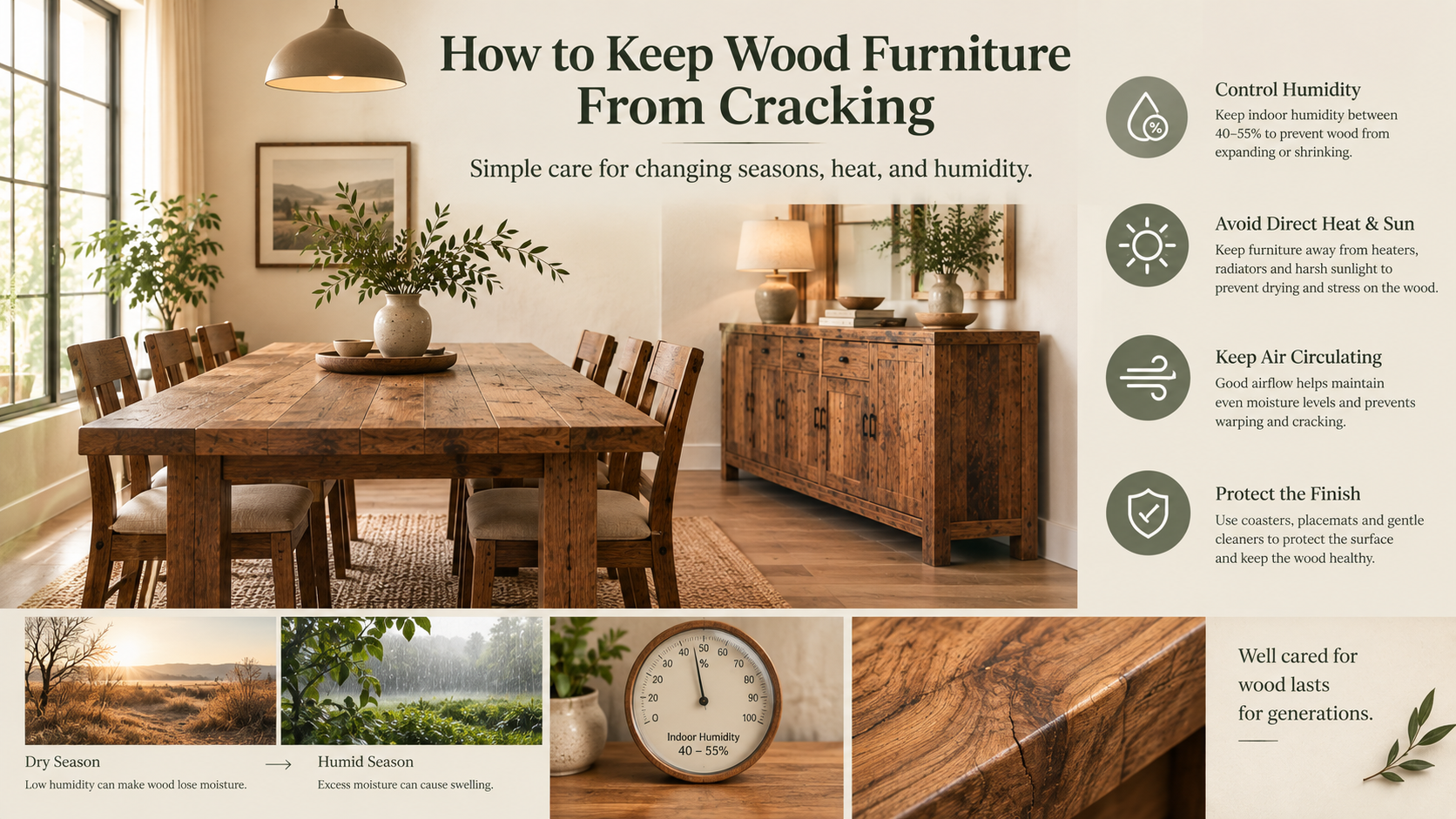
Table of Contents
- Why Wood Cracks in the First Place
- The Role of Humidity
- Heat and Direct Sunlight
- Seasonal Changes and What to Expect
- Conditioning and Finish Maintenance
- Placement Choices That Prevent Problems
- From Workshop to Home: How Construction Affects Crack Resistance
- A Note on Reclaimed Wood and Natural Stability
- FAQ
- Conclusion
Why Wood Cracks in the First Place
Wood is made up of fibers that hold onto moisture, and that moisture content shifts constantly based on the humidity in the air around it. When the surrounding air is dry, wood releases moisture and shrinks slightly. When the air is humid, wood absorbs moisture and expands. This happens across the entire piece, but not always at the same rate in every direction, since wood grain runs differently across a board’s length versus its width.
Cracking happens when that expansion and contraction is uneven or too rapid for the wood to adjust gradually. A board that dries out quickly on the surface while the interior is still holding moisture creates internal stress, and that stress is what eventually shows up as a visible crack or split.
The Role of Humidity
Consistent humidity is the single biggest factor in preventing cracks. Wood furniture generally does best in a relative humidity range of about 35 to 55 percent. Below that range, especially during winter months when indoor heating dries out the air significantly, wood can lose moisture faster than it’s built to handle gracefully.
A humidifier placed near solid wood furniture during dry winter months helps maintain more stable moisture levels in the air, which in turn reduces stress on the wood itself. In very humid climates, the opposite concern applies: excess moisture can cause swelling and, in some cases, warping, so a dehumidifier or good airflow around the piece helps in those conditions.
Heat and Direct Sunlight
Direct sunlight does two things to wood furniture: it can fade or unevenly tone the finish over time, and it dries out the surface much faster than the rest of the piece, which creates the kind of uneven moisture loss that leads to cracking. A table or dresser positioned directly in a sunbeam for hours each day is at a meaningfully higher risk than the same piece placed a few feet away from that direct exposure.
Heat sources matter just as much. Furniture placed too close to a radiator, a heating vent, or a fireplace experiences the same kind of localized drying, since the heat pulls moisture out of the wood faster in that one area than in the rest of the piece. Keeping solid wood furniture at least a few feet from direct heat sources meaningfully reduces this risk.
Seasonal Changes and What to Expect
Some seasonal movement in solid wood is completely normal and not a sign of a problem. A drawer that sticks slightly in summer humidity and loosens again in the drier winter months is the wood responding naturally to seasonal humidity changes, not a defect. The goal isn’t to eliminate this movement, since that’s not realistic with a natural material, but to keep it gradual and moderate rather than extreme.
Sudden transitions are what cause the most trouble. Moving a piece from a humid environment directly into a very dry, heated room, or the reverse, gives the wood little time to adjust gradually, which increases the risk of stress cracks forming.
Conditioning and Finish Maintenance
A well-maintained finish acts as a buffer between the wood and the surrounding air, slowing down how quickly moisture moves in and out. Oiled finishes typically need reapplication every six months to a year to keep that protective layer intact. Waxed finishes benefit from refreshing every few months in higher-use pieces. Lacquered or polyurethane finishes generally last longer between treatments but should be inspected periodically for areas where the finish has worn thin, since bare wood exposed through a worn finish is more vulnerable to rapid moisture loss.
If you’re not sure what finish your furniture has, a small water-drop test in an inconspicuous spot helps. Water that beads up indicates a sealed finish, while water that soaks in quickly suggests the wood may benefit from a fresh coat of finish or conditioning oil.
Placement Choices That Prevent Problems
Beyond humidity and heat, a few placement habits go a long way. Keep solid wood furniture away from exterior doors and drafty windows where temperature and humidity swing more dramatically than in the rest of the room. Avoid placing pieces directly against radiators, baseboard heaters, or fireplaces. Rotate any table runners or decor periodically if a piece sits near a window, so sun exposure doesn’t concentrate unevenly on one section of the surface over time.
From Workshop to Home: How Construction Affects Crack Resistance
How a piece is built affects how well it resists cracking once it’s in your home. Wood that’s properly dried and seasoned before construction, rather than rushed through the process, is less prone to developing internal stress after it’s already been shaped into furniture. Builders working with reclaimed timber typically inspect each board carefully for stability before it’s used, since reclaimed wood has already gone through years of natural drying and settling in its previous life, which can actually work in its favor.
Joinery matters too. Furniture built with traditional joints that allow for natural wood movement, rather than rigid glue-only construction that fights against it, tends to hold up better over years of seasonal humidity changes.
A Note on Reclaimed Wood and Natural Stability
Reclaimed wood often has an advantage when it comes to crack resistance, simply because it’s already lived through years, sometimes decades, of natural expansion and contraction before becoming new furniture. That extended aging process means much of the wood’s initial moisture adjustment has already happened, which can make it more dimensionally stable than freshly milled lumber in certain conditions. That said, no solid wood is entirely immune to environmental stress, so the same humidity and heat precautions still apply. If you’re considering a reclaimed wood piece for your home, it’s worth browsing a shop like Modern Karigar and asking directly about the specific care recommendations for a particular piece and finish.
FAQ
Is a crack in wood furniture always a sign of poor quality?
Not necessarily. Cracking is often caused by environmental factors like low humidity or heat exposure rather than a flaw in the construction itself, though proper drying and joinery during manufacturing does reduce the risk.
What humidity level is best for solid wood furniture?
Generally between 35 and 55 percent relative humidity. A humidifier in dry winter months and good airflow in humid conditions both help maintain that range.
Can a small crack be repaired?
Minor surface cracks can sometimes be filled and refinished by a professional, though larger structural cracks may require more extensive repair or, in some cases, cannot be fully corrected.
Does reclaimed wood crack less than new wood?
It can be more dimensionally stable due to its natural aging process, but it’s still solid wood and benefits from the same humidity and heat precautions as any other wood furniture.
How often should I condition or oil wood furniture to prevent cracking?
For oiled finishes, roughly every six months to a year, depending on use and climate. This helps maintain a protective barrier that slows moisture loss.
Conclusion
Cracking in wood furniture is almost always preventable once you understand what’s actually causing it: humidity swings, direct heat, sun exposure, or a worn finish that’s no longer protecting the wood. Keep humidity relatively stable, avoid placing pieces near direct heat, and maintain the finish on a reasonable schedule, and solid wood furniture can hold up well for decades. If you’re shopping for a piece built to handle these conditions well from the start, it’s worth asking about the wood’s drying process and finish before you buy.